Original article: “Orden” a palos contra la protesta social: Milei apelará el fallo que dejó sin efecto el Protocolo Antipiquetes
Milei to Challenge Court Ruling Nullifying Controversial Anti-Protest Protocol Amid Rising Tensions
In a new chapter of the ongoing tensions between the Executive Branch and the judiciary, the government of Argentina’s President Javier Milei announced on Monday that it will appeal a ruling that declared the so-called «Anti-Protest Protocol» null and void. This contentious regulation, which has been in effect since December 2023, is designed to govern and, according to critics, criminalize the right to protest in public spaces. The judicial decision, issued by the Administrative Court No. 11 under Judge Martín Cormick, was hailed by human rights organizations but condemned by the ruling party, which deemed it an endorsement of «chaos.»
The Minister of Security, Alejandra Monteoliva, conveyed the government’s position via social media platform X (formerly Twitter). In her message, she stated: «WITHOUT A PROTOCOL, THERE IS NO ORDER, ONLY CHAOS. A Judge issued a ruling attempting to undermine the Anti-Protest Protocol. This action corresponds to the old politics that seeks neither peace nor order in Argentina. We will not take a step back: we will appeal it.»
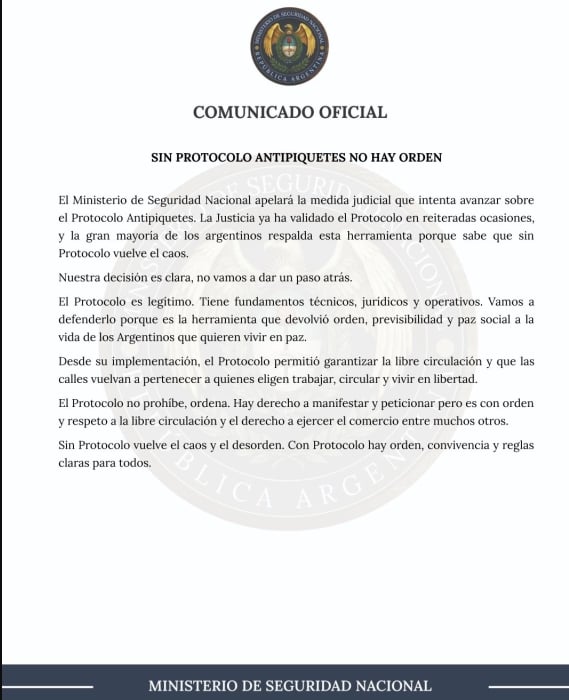
Subsequently, in an official statement, the Ministry of Security asserted that «the protocol is legitimate,» arguing that «it has technical, legal, and operational foundations.»
«We will defend it because it is the tool that has restored order, predictability, and social peace to the lives of Argentines,» they asserted, claiming that its implementation has allowed for «guaranteeing free movement» and for the streets to once again belong to those who choose to work, circulate, and live in freedom.»
Reasons Behind the Ruling Against the Anti-Protest Protocol
The ruling that sparked discontent from the «libertarian» government spans 38 pages and was issued following a legal action brought by the Center for Legal and Social Studies (CELS) along with other social organizations. In his decision, Judge Cormick concluded that public administration lacks the authority to enact regulations that infringe basic constitutional rights, such as freedom of assembly, the right to petition authorities, and freedom of expression.
Echoing the arguments made by CELS, the judge maintained that social protest «cannot in any way be interpreted as equivalent to a criminal offense that justifies explicit police repressive action without proper judicial authorization.»
Moreover, the ruling questioned specific aspects of the protocol, such as the «intelligence tasks» it permitted for gathering information about protesters’ identities through filming and photography, practices that, according to Cormick, violate the National Intelligence Law. He also noted that the regulation fails to make distinctions for vulnerable groups (children, the elderly, people with disabilities) and that it attempts to legislate in criminal and procedural matters, realms beyond the Executive Branch’s authority. For all these reasons, he urged the Ministry of Security to «refrain from implementing the Anti-Protest Protocol and to align its actions with the prevailing rules of the Penal Procedural Code.»
The former Minister of Security and current senator, Patricia Bullrich, architect of the protocol, quickly defended it and supported the appeal. On her social media channels, she declared: «The Anti-Protest Protocol has been validated by dozens of judges and has the support of the Argentine people. Who declares it null? The same judge who always acts against the government. Who celebrates? Those who thrive on chaos, extortion, and destabilization.»
Bullrich emphasized that the victims of the ruling are «the Argentines who want to work, circulate, and live in peace,» concluding with a mantra repeated by the ruling party: «Order is non-negotiable.»
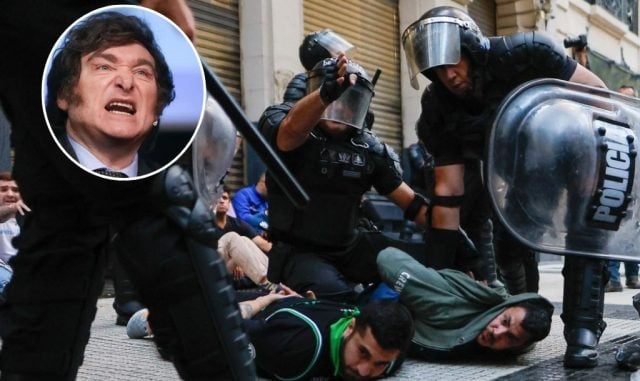
However, for human rights organizations and opposition sectors, the «order» the government advocates comes at a very high cost in terms of institutional violence and the restriction of guarantees. The protocol, in effect during the more than two years of Milei’s administration, has provided the legal framework that supported systematic repression against protesters, journalists, and press workers. The most emblematic case is that of photographer Pablo Grillo, who is still facing a long recovery after being hit in the head by a tear gas projectile on March 12 during a pensioners’ march at Congress.
His situation, far from being isolated, fits into a documented pattern of violence during numerous protests.
The Ministry of Security insists that the protocol «does not prohibit, it orders» and that its goal is to balance the right to protest with other rights such as free movement and work. Nevertheless, Judge Cormick and the plaintiff organizations believe that its actual application prioritizes deterrence and immediate repression, de facto criminalizing protest and delegating police powers that belong to the judiciary.
This ruling occurs in a context of increasing tension between the government and the judicial system, and just a week after Judge Cormick urged the Executive to comply with the University Financing Law.
The appeal announced by Milei’s government will escalate the dispute to a higher instance, where it will be determined whether the vision of «order» based on restriction and force prevails, or the approach that views social protest as a cornerstone of democracy.
Obtén tu Pasaporte y apoya a El Ciudadano
Elimina la publicidad, accede a contenido exclusivo y sé parte de la comunidad.
Cancela en cualquier momento · Sin permanencia