Original article: Alejandro Navarro, sin matices: «El problema no es Maduro, el problema es la soberanía de los países»
By Juan Pablo Orellana
The conversation takes place at GIOCCO café in downtown Concepción. The usual sounds of buses and pedestrians create a contrast with the serious tone surrounding the current international situation at the table.
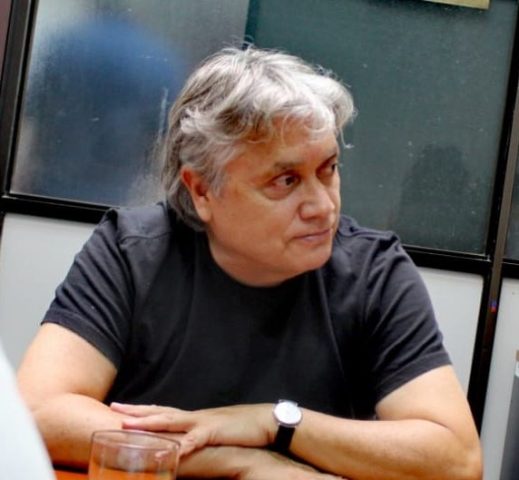
Alejandro Navarro Brain arrives without delay. The former senator, who was the most voted and dubbed the hardest worker in a report by La Tercera, is one of those figures who, for better or worse, never learned to tone down his speech to make it more palatable.
Throughout his career, Navarro has faced evident political costs for failing to “toe the line.” He broke from the Socialist Party, fell out of alliances, and was caricatured as excessive or outdated by the youthful members of the Frente Amplio. Nevertheless, no one can overlook his courage as a defining trait.
Known for his steadfastness, even more so by his adversaries than by his supposed allies, Navarro does not adjust his sails according to the wind. Today, while much of the political spectrum remains silent or nuanced regarding the capture of Nicolás Maduro and the U.S. offensive against Venezuela, Navarro chooses to confront the prevailing narrative. This is nothing new.
The interview is straightforward and sharp:
Former Senator Navarro, let’s get straight to the point: How could Maduro’s exit have been planned differently? Is there not a degree of political irresponsibility in defending a regime so opposed?
Navarro: First and foremost, there is a significant informational irresponsibility, because normalizing the kidnapping of a President and calling it democracy is unacceptable. I do not condone human rights violations; you may sympathize with Maduro or not, but what cannot be justified—in defense of our own sovereignty—is letting another country act like a neighborhood bully. This sets a very poor precedent for what may happen soon in Chile or anywhere else.
So this time, I denounce military and political aggression that violates the United Nations Charter. Defending sovereignty does not mean supporting a regime: it means defending the right of peoples to decide without bombs. I love my country, I love Chile, and under no circumstances would I wish for or justify foreign invasion.
But Nicolás Maduro is accused of drug trafficking by U.S. authorities. Are you saying all of that is false?
Navarro: I’m saying something very simple: the United States is not the world’s tribunal. They used the same false accusations in Iraq, Afghanistan, and Libya. They talked about weapons of mass destruction, and all they found were large reserves of gold, which they criminally claimed. When they cannot dominate, they criminalize. There is not a single independent international condemnation that supports this fabrication.
I believe that a large part of the population, even those opposed to Nicolás Maduro, knows that he is not a drug trafficker. President Petro has said that Maduro’s problem has been a lack of democratic guarantees; well, let’s debate from there, but evidently, the U.S. interest is not to capture a drug trafficker but to discipline nations that do not align with Northern interests.
There is a direct threat to Petro, to President Claudia Sheinbaum of Mexico, to President Lula in Brazil. And the cynicism explodes with the pardons Trump offers to the former Honduran president Juan Hernández, who was tried for drug trafficking. It is infuriating that, from the left, we cannot counter the imposition of this narrative. The fundamental part of democracy is the ability to dissent.
You speak of ‘kidnapping,’ but many would argue that Maduro fell because he lost support, even within his own sector.
Navarro: That is propaganda. Maduro did not fall; he was kidnapped following a foreign military action. At that moment, insisting or not that this episode represents another point within the Venezuelan crisis shows a misunderstanding of the issues at hand. The point is no longer Maduro’s figure, but what type of policy and narrative is being imposed.
The update of the Monroe Doctrine from Trump—along with his national security strategy document—is a way to discipline countries that do not align. Therefore, as I said, the issue is not Maduro or even Venezuela; it is about sovereignty, which the false patriots stumble over.
What will they say to the U.S. when it comes for copper or lithium? Or if tomorrow a European president is kidnapped, will they also claim that he ‘lost support’? Language matters because it normalizes crime. Just look at what happens with Netanyahu. Declared a war criminal by the international court for killing tens of thousands of children in Palestine, and what happens? Nothing. He is invited to the U.S. Senate. An ironic way to defend the nation.
You defend Delcy Rodríguez, but isn’t it evident that the U.S. sees her as a more moderate figure, even functional to a transition?
Navarro: That demonstrates a deep ignorance. Delcy Rodríguez is not a negotiable piece. She is a politically educated woman with a family history marked by torture and the political assassination of her father during the Venezuelan neoliberal dictatorship. To think she would hand over oil and sovereignty shows a lack of understanding of both her biography and Venezuela.
Do you think your discourse might come off as more Chavista propaganda than political analysis?
Navarro: That’s a classic resource. When they cannot refute the facts, they discredit the messenger. My discourse is based on international law, recent history, and verifiable facts. The ideological stance is to believe that bombing countries brings democracy or that Trump is a savior of the world.
I believe many people have opinions, many who love Chile and have not studied the new U.S. doctrine for Latin America and the Caribbean—a document of over thirty pages where they literally express that the natural resources to sustain their economic future are found here in the southern cone. That is no longer propaganda; it’s the policy they want to impose on us. True patriots must read this carefully and think politically to defend a sovereign, free, and democratic Chile.
Trump openly speaks of ‘recovering Venezuelan oil.’ Is it an exaggeration to say this is the central motivation?
Navarro: No, it’s literal. He said it himself. The United States has never hidden that its interest lies in strategic resources. Drug trafficking is the narrative; oil is the goal, and as we said, all the directives are in the national security document.
Many in Latin America celebrate Maduro’s departure. Are they all mistaken?
Navarro: Many react out of fatigue or misinformation. But the joy over a presidential kidnapping is dangerous. Today they cheer because they dislike the government; tomorrow they might mourn when it’s our turn.
I fondly remember and emphasize the history of our heroes: O’Higgins, the Carrera Brothers, Ramón Freire, and many others who gave their lives for our independence from the Spanish crown. Keeping proportions in mind, we are in the same convulsive climate of September 1810, and I imagine many compatriots will gather to pledge loyalty to the new King, but there are Chileans like us who will continue to resonate with the independentist airs and hope for Chile to be a truly sovereign country, as sovereignty must rest with the citizenry.
Do you not fear being on the wrong side of history by defending such questioned leaders?
Navarro: History isn’t written with headlines; it’s written with principles. I will always stand on the side of peoples’ self-determination, of each nation and people’s sovereignty, even if it makes powerful countries uncomfortable. I’d rather be wrong with the peoples than right with empires. Going back to our heroes, let’s remember that O’Higgins himself died in exile. Time and history will judge us.
In one sentence, what would you say to those who see Trump as a liberator of Venezuela?
Navarro: I would say that we are in a rather convulsive world. We had mentioned long ago: a premature victory of the U.S. and Israel over Palestine, with the Holocaust suffered by millions of victims—among the dead, displaced, and murdered children—without international community outrage, could pave the way for a victory over Venezuela. This American excursion, with no global reaction, represents total loss. It signals the emergence of a different, entirely new world—a world of war through bullying and the law of the strongest.
The next target is Brazil, Mexico, or the lithium triangle, where we are located. Whether Maduro is authoritarian or not, at this moment, it makes no difference. No country that bombs seven nations in a year can liberate anyone. Freedom does not come through missiles.
Alejandro Navarro no longer tries to convince everyone; he knows he is swimming against the current in a world that only favors one perspective. His approach, as always, and as a good philosophy teacher, is different: to leave a record.
The Owl of Minerva takes flight at dusk, stating, paraphrasing the old Hegel, although the price once more may be being left out of the consensus. Loving the homeland means understanding that everyone has the right to do so, and those who do not love their homeland do not love their mother, he confides to me, noting he heard that from a Residente song, from Calle 13. You’re up to date, Senator, I tease him, laughing. There are young old and old young, he concludes.
The Citizen
Obtén tu Pasaporte y apoya a El Ciudadano
Elimina la publicidad, accede a contenido exclusivo y sé parte de la comunidad.
Cancela en cualquier momento · Sin permanencia
Artículos Relacionados
Chilean Police Seize Phone and Computer from Senator Alejandro Kusanovic Amid Allegations of Corruption
Hace 2 meses