Original article: Motosierra y violencia
By Valeria Paz Yáñez Álvarez, actress, director, and theater researcher, director of Casa Marx Santiago and activist with Pan y Rosas
On December 14, 2025, Chile held its presidential runoff election, resulting in the election of José Antonio Kast, the far-right conservative candidate affiliated with the Republican Party and linked to a family with deep ties to the coup d’état and human rights violations in Chile.
In a previous campaign, Kast was quoted saying, «If Pinochet were to vote for someone, it would be for me.» His platform, focused on tax cuts, security, and anti-immigration policies, propelled him to the presidency.
Two days after the election, Kast traveled to Argentina to meet with President Javier Milei, affiliated with La Libertad Avanza, at the Casa Rosada. This first official visit aimed to discuss elements of their future diplomatic relationship, including the creation of a «humanitarian» corridor for migrants and commercial agreements.
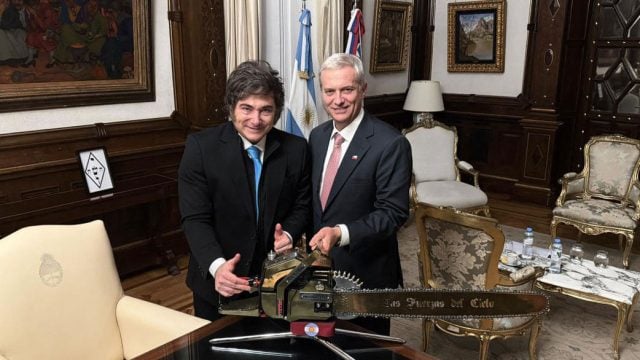
These xenophobic and racist ideas arise from an ideological framework typical of the international far-right. However, the most contentious aspect was the photo and video that surfaced publicly, featuring both leaders posing with a chainsaw, a distinctive symbol of Milei’s campaign.
The chainsaw serves as an explicit metaphor: a tool to reduce the size of the state and expand the private sector; a chainsaw for firing government employees, for cutting social rights, and for attacking pensions. In Argentina, it symbolizes the fiscal adjustment pushed by Milei, while in Chile, it foreshadows a similar approach, especially considering the over $6 billion in fiscal cuts announced by Kast during his campaign without providing clear details on their implementation.
Milei’s emblematic chainsaw is inscribed with the words «The Forces of Heaven,» which contribute to the god-like image he cultivates as Argentina’s president.
Frequently referencing biblical narratives connected to Judaism, Milei, who has declared his support for Israel, echoed the sentiment, «Victory in war does not depend on the number of soldiers, but on the forces that come from heaven» at the start of his campaign.
This rhetoric has inspired young supporters who refer to themselves as the «Praetorian Guard» or the «armed wing» of La Libertad Avanza, believing they are «saving the country» with divine backing.
Their aesthetic—comprising banners, references to Roman heroes, AI-generated videos, and grandiose classical music—constructs a narrative of being invincible, paired with Milei’s violent rhetoric toward his opponents, including leftists, communists, and the state (as fascists glorified violence against «enemy» groups). Here, the chainsaw becomes a symbol of destruction, energizing his followers.
This political staging, heavily influenced by North American imperialism and global reactionary far-right movements, represents the powerful man: the ‘America first’ ideology and white supremacy.
In 1967, Guy Debord published his landmark essay ‘The Society of the Spectacle,’ examining how the spectacle becomes the official language of society and an instrument of unification: «The spectacle is not a collection of images, but a social relationship among people mediated by images,» Debord states, indicating how it obscures our gaze and our ability to access authenticity.
Debord argues that society has transformed into a realm of images, a consumption and circulation of commodities that contemplate themselves: a bewitched domain by the fetish of merchandise. This diagnosis by Debord challenges and complicates the relationship between truth, reality, and appearance.
From this perspective, the image of the chainsaw compels us to question: Is this chainsaw real? Is Milei a worker? Is he a lion or a «cute kitten» of the economic power?
The chainsaw in the photograph is no ordinary tool; it is a handcrafted, bronze chainsaw colored gold, black, and silver: an elegant, «home-made» creation. It was made by Argentine artist Tute Di Tella, a construction machinery salesman, who also crafted another similar chainsaw for Elon Musk, gifted by Milei in Washington, and another for Donald Trump, which includes a small Statue of Liberty in the design.
This chainsaw embodies the notion of «going for everything,» destroying like the master of the earth, resonating with the Monroe Doctrine that perceives Latin America as the “backyard” of the United States. It symbolizes extractivism and capitalist environmental depredation.
This symbolic chainsaw is vastly different from the actual tool used by a wage worker to clear trees for power lines or in forestry work. The chainsaw displayed in the image of Kast and Milei is not a work tool; it is an artifact of symbolic violence, a threat and a symbol of masculinity, designed to showcase power and attempt to instill fear or make an impact on the public.
This image aims to configure a scene of might, representing the euphoria, rage, and indignation felt particularly among a segment of disenchanted young men. Recent political campaigns have been rife with iconographies of Roman emperors and epic narratives. In Chile, we saw this with AI-generated videos, North American aesthetics, and abundant national flags, reinforcing an exaggerated sense of nationalism.
So, who are Milei and Kast, and what do they represent? Both are part of an organized international reactionary right: they participate in the Madrid Forum, targeting progressive Latin American governments and preparing for political changes, as witnessed in Chile. They advocate for traditional family models, promote increased birth rates, and are antifeminist and denialist.
They are also involved in the Conservative Political Action Conference (CPAC), which, since the Trump era, has aligned with the MAGA (Make America Great Again) movement and international populist right, including white supremacist sectors.
Regarding how we interpret images, Susan Sontag, in her work “Against Interpretation” (1966), writes: «Interpretation is not (as most people presume) an absolute value, a gesture of the mind located in some timeless domain of human capacities. Interpretation must also be evaluated within a historical context of human consciousness. In certain cultural contexts, interpretation is a liberating act. It is a means of revising, revaluating, and evading a deceased past. In other cultural contexts, it is reactionary, impertinent, cowardly, and suffocating.»
The interpretation of this photograph becomes a liberating act as it allows us to read between the lines, unravel the symbolic power both leaders seek to construct, and confront their ideology. As Sontag suggests, it is a «revenge taken by the intellect.»
It represents the cultural battle against the common sense that the contemporary right attempts to impose against its declared enemies of «cultural Marxism» or «woke progressivism,» utilizing all tools at their disposal to build hegemony, in this case, with the image of the «hero» heralding a supposed «change of era» with a chainsaw symbolizing that change.
It is crucial to ask how these images operate as instruments of power and how we process the social frameworks and networks that uphold them. Giorgio Agamben proposes to think about the profanation of devices: to interrupt their functioning to establish a lucid and conscious relationship with them.
If devices guide behavior, shape opinions, and produce discourse, then the critical question of another relationship with images becomes urgent: How can we transform our gaze? How can we avoid being captured by that image?
In this line, Alejandra Castillo in ‘Addicted to Images’ (2020) asserts that the image lies at the center of political economy. «The image activates and anesthetizes, seduces and alters like a drug,» she states.
However, she warns that the power of alteration does not reside in the images themselves, but in the discursive and archiving frameworks that narrate them. Images move and affect us, and they, in turn, are influenced by the coordinates that frame them.
Thus, the inquiry into the regime of domination that these images display becomes central, as does their potential for transformation and the possibility of altering the visual order. How are images profaned? This is the question Agamben also raises.
In this sense, the use of the chainsaw aims to produce fear and apprehension, directing the audience’s— or citizens’— reaction towards demands for individual security. Simultaneously, the great powers amplify the rulers’ delusions of grandeur and energize their most fanatic supporters.
It is noteworthy that both leaders present a limited physical presence, far removed from the classic ideal of strong, muscular masculinity. In Milei’s case, his bursts of anger and public contradictions reveal a wounded masculinity reinforced by objects that symbolize power and destruction; hence the need to accompany himself with an object that amplifies his presence.
Returning to Debord, the spectacle constitutes the socially dominant model of life, where there is a degradation of being into having, and from having to appearing.
«It is a life entirely devoted to capital, where even the increase in leisure cannot be regarded as liberation from work, nor from the world shaped by that work, but rather as another activity lost in the submission to its result,» analyzes Soto Calderón in reviewing Debord.
In her work «The Performative Nature of Images» (2020), Soto Calderón discusses a disconnection, a «suffering of the eyes,» and a fatigue of the gaze due to an «abundance of images and visual stimuli that drown and anesthetize us, preventing us from digesting what we see; concurrently, these images demand our bodies and devour us.»
I believe this is what happens with these images: they scandalize and then normalize. In Chile, the video of Kast celebrating that «if there is good news, it is that freedom advances throughout Latin America,» while Milei responds, «Long live freedom, damn it!» wielding the chainsaw, operated as a prelude of what could come to Chile.
In a scenario saturated by the incessant circulation of images, it becomes urgent to halt our gaze and fracture the dominant visual regime. It is not about seeing more, but learning to critically look at the visual devices that produce affections, guide behaviors, and shape common sense. Sharpening our eyes against images that exalt violence, authoritarian masculinity, and patriarchal reaction becomes essential.
These montages are not isolated provocations, but power devices that channel fear and social frustration toward demands for order, security, and austerity, deactivating political imagination and erasing other possible experiences and imaginaries. As Soto Calderón warns, «Perhaps the greatest problem is all those realities that lack images, meaning, they lack the capacity to be imagined.» Thus, pondering the image becomes a central political task.
It is not surprising that both Kast and Milei present themselves as allies of Donald Trump, adopting his rhetoric and aligning with the interests of American imperialism, offering their countries as platforms for economic and political subordination. The image of both leaders wielding a chainsaw is not an anecdote or an eccentric gesture: it is a visual condensation of a power project that promises to obliterate rights, bodies, and memories.
To profane that image, dismantle its symbolic operation, and contest its meaning, becomes an indispensable condition for imagining other possible futures.
By Valeria Yáñez Álvarez
Obtén tu Pasaporte y apoya a El Ciudadano
Elimina la publicidad, accede a contenido exclusivo y sé parte de la comunidad.
Cancela en cualquier momento · Sin permanencia