
Original article: Milei amenaza con descontar el día: gremios desafían al Gobierno y salen a la calle contra la reforma laboral
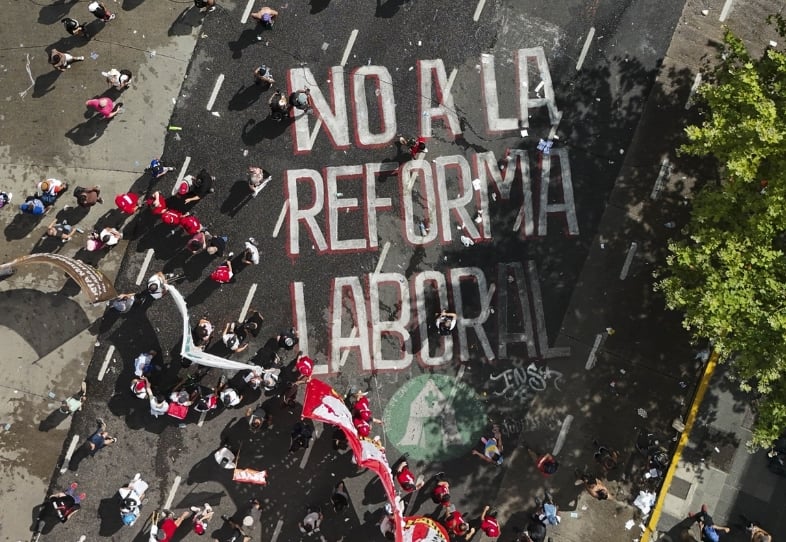
Under the slogan «we stop the labor reform in the streets,» thousands of Argentine workers will mobilize this Thursday to protest the labor reform proposed by Milei, which seeks to extend the daily working hours to 12, compensating with time off instead of overtime pay.
The decision by the leadership of the Argentine General Confederation of Labor (CGT) to call a general strike without a march, right when the Chamber of Deputies is set to discuss the Labor Reform project, has prompted several unions to organize their own gathering at the Plaza del Congreso. Meanwhile, staying true to its style, the government of Javier Milei has threatened to deduct a day’s pay from state workers who participate in the strike, even though public transportation is confirmed to be unavailable.
Under the premise of «we stop the labor reform in the streets,» the United Unions Front (FreSU) has reaffirmed its call for a mobilization on Thursday, February 19. This alliance includes the UOM, Oil Workers, Pilots, the Association of State Workers, and the two central labor organizations of Argentina. They announced that there will be a press conference at the House of Mothers in Plaza de Mayo, followed by a concentration in front of the legislative body, with parallel actions throughout the country.
«We call for the broadest unity of all union, social, and productive sectors to stop this project that threatens the future of our nation,» they urged in a statement.
Similar to previous general strikes, the Milei administration has warned that it will deduct a day’s pay from workers who participate in the CGT call next Thursday. However, the situation is different from the strike on April 10, 2025, as all transportation unions have announced their adherence to the protest, making transportation for workers impossible, as reported by Página/12.
Union representative for state workers, Rodolfo Aguiar, was blunt in his remarks, calling on government spokesperson Manuel Adorni and other cabinet members to «bring your own tea or instant coffee because there won’t be anyone to serve you on Thursday.»
«The regular exercise of a right does not constitute an illegal act,» he stated, reminding that «the right to strike is still enshrined in the national Constitution.»
Aguiar predicted that the public administration strike «will be total across the country,» directly challenging the threat of salary deductions from the far-right leader.
Naval unions begin a 48-hour strike
Meanwhile, the National Conductors Union (SICONARA) has initiated a 48-hour strike starting midnight this Wednesday. According to the union’s General Secretary, Mariano Vilar, this action is taken as a protest against the labor reform project that «aims to exclude embankment personnel from the Labor Contract Law, leaving them without basic labor protections and subjecting them to the Commercial Code,» hence demanding that «it be excluded now in the Deputies after its approval in the Senate.»
SICONARA warned that if this is approved, it would apply «a labor adjustment that threatens fundamental protective principles, deteriorates maritime transport conditions, and will generate direct operational impacts on the logistics and foreign trade of the country.»
They alerted that the consequences extend beyond mere labor issues, affecting the overall economic activity.
Union Secretary Mariano Vilar indicated that naval drivers «are Argentine workers in Argentina, on land or at sea, and must be governed by the same rights as others.»
«They intend to exclude us even from the scope of labor justice, placing us under the Commercial Code as if we were not workers, including us in other regimes, like those deprived of their freedom,» he asserted, as noted by Página/12.
The Dangers of Milei’s «Chainsaw» Labor Reform
The labor reform pushed by Milei enables flexible working arrangements through time banks, allowing for daily shifts of up to 12 hours while compensating with time off instead of overtime pay.
This proposal has faced severe criticism from labor law experts and union organizations, who warn about the impact on workers’ health and the balance with family life.
Another central issue is the elimination of overtime pay through the creation of a «time bank,» which would replace the traditional «double payment» system that many workers rely on to boost their income. Instead of receiving additional salary for hours worked beyond the usual hours, the time bank stipulates that employees make up that extra time by working less on other days or taking a day off. For sectors that have historically depended on overtime as a salary supplement, this change represents a significant blow to their monthly earnings.
Additionally, part-time contracts for periods shorter than legal working hours are introduced, which could signify a gateway to income precarization. Unions warn that this setup will allow companies to hire personnel for a few hours daily, with proportionally reduced salaries and no access to the same benefits as full-time workers.
Restrictions on the Right to Strike
In terms of collective conflict, the reform introduces substantial changes. The list of activities considered essential services is expanded, mandating a minimum required coverage of 75% during any strike action. This provision directly affects the unions’ ability to exert pressure in strategic sectors of the economy.
The new regulatory framework designates telecommunications—including specifically internet and satellite communications—commercial aviation, air traffic control and port services in all their variations, immigration and customs services, health and hospital services (including the transport and distribution of medicines), the production and distribution of drinking water, gas, oil, fuels and electricity, waste collection, cash transport, private security services and custody, and education up to primary and secondary levels as essential services, excluding only university-level education.
Additionally, a new category is created: «critical services» or «transcendental importance,» which must guarantee a 50% operational floor during conflicts. This category includes a range of services from maritime, river, land, and underground transport of people and goods, to customs and immigration services related to foreign trade, pharmaceutical production, radio and television, industries with continuous processes (steel, aluminum, chemical, and cement), food industry across its value chain, banking and financial services, hospitality, gastronomy, e-commerce, construction, airports, mining, cold storage, postal services, the agricultural sector, and production tied to export commitments.
Security forces, for their part, will have to provide 100% coverage, meaning no officer can participate in strike actions under any circumstances.
According to the reform, unions are required to notify of strike actions five days in advance, a timeframe that unions consider excessive and detrimental to the effectiveness of labor protests, especially in conflicts requiring immediate responses.
Assemblies: With Permission and Without Pay
Another point that evoked strong criticisms during the debate in the Argentine Senate is the new regulation regarding labor assemblies at the workplace. According to the approved text, union meetings «may not interrupt normal company operations» and will require prior authorization from the employer. This provision severely limits one of the traditional mechanisms for organizing and deliberating among workers within workplaces.
Additionally, the union must prove that it is current in the payment of dues to exercise this function, a requirement that many unions view as a bureaucratic obstacle aimed at hindering union activity. The time allocated for assemblies, the law states, «will not be compensated,» as reported by El Destape, implying that workers must hold these meetings outside their work hours or, if held during the day, suffer corresponding pay deductions.
Collective Agreements: The End of Ultraactivity
The reform introduces a substantial change to the collective negotiation system by drastically limiting the principle of ultraactivity. Following the enactment of the law, only normative clauses—those establishing conditions and direct benefits of work—will remain valid once the agreement expires. These clauses will remain operational until a new agreement takes effect.
Obligational clauses—those regulating the relations between parties, union rights, and union dues—will only remain valid by express agreement of the parties. This modification implies that upon the expiration of an agreement, unions automatically lose essential tools for their operations if they cannot agree on a new one.
Additionally, it establishes that agreements at smaller levels (company, regional) will take precedence over those at larger levels (activity, national), thus reversing the principle of normative hierarchy that traditionally governed. This provision fragments collective negotiation and weakens the power of large national unions against companies, which will be able to negotiate particular conditions with business unions or smaller, potentially weaker unions.
The Ministry of Labor, for its part, is empowered to suspend by reasoned resolution the effects of agreements in force due to ultraactivity «when their application generates serious economic distortions affecting the general interest.» This attribution grants the Executive Power a direct intervention tool over collective agreements without going through parliamentary debate, which unions have interpreted as a surrender of legislative sovereignty in favor of the current government.
Labor Conflict Scenario in Argentina
With the government’s threat of salary deductions, the mobilization called by FreSU, and union activity strikes, the upcoming Thursday presents itself as a day of high political and social tension. The CGT’s decision not to mobilize has been overshadowed by the initiative of unions that aim to bring the conflict to the very doors of Congress while deputies debate the official initiative.
Public transportation is paralyzed, with the support of state unions and promises of actions across the country, creating a strong social protest backdrop against a reform that, if approved, will structurally change labor relations in Argentina. The ruling party’s response, with threats of wage deductions, foreshadows a conflict that could extend beyond the day of parliamentary debate.
Obtén tu Pasaporte y apoya a El Ciudadano
Elimina la publicidad, accede a contenido exclusivo y sé parte de la comunidad.
Cancela en cualquier momento · Sin permanencia