
Original article: DD.HH. para quienes los violaron: la derecha busca imponer un proyecto que vuelve a tensionar la memoria
Right-Wing Push for Bill Could Compromise Human Rights Justice in Chile
The general approval of the bill to commute sentences for those convicted of human rights violations is more than just a legislative formality. It raises critical questions about Chile’s handling of crimes committed during the dictatorship in 2026: Are these convictions seen as a symbol of justice or are they being undermined under the pretext of «alternatives» and «humanity»?
In a remarkably close vote — 23 in favor and 22 against — the Senate has greenlit the initiative that regulates the suspension and alternative fulfillment of prison sentences. In practice, this bill — introduced by right-wing senators — would allow for alternatives to incarceration, such as house arrest, in certain scenarios, potentially enabling those convicted of human rights abuses to receive benefits.
This discussion extends beyond legal boundaries; it is inherently political and historical. When dealing with crimes perpetrated by the state’s repressive apparatus, the conversation transcends mere penalties. It addresses the meaning of «never again» and the ongoing need for a memory that has yet to be fully acknowledged.
The voting took place this Wednesday, following an initial session on Tuesday in which lawmakers requested a delay to further the debate.
The Macaya and Bianchi Factor
However, the session was not only highlighted by the narrow outcome. A political front emerged focusing on senator Javier Macaya, whose crucial vote enabled the bill’s progression.
During the debate, senator Daniel Núñez formally requested that Macaya disqualify himself from the vote, citing a potential conflict of interest. He argued that since the initiative could enable benefits linked to age criteria, it was legitimate to discuss whether Macaya should participate under these circumstances.
Núñez went further, noting that Macaya’s father, Eduardo Macaya, was convicted for sexual offenses against minors. “I call on senator Macaya to disqualify himself because, if this bill passes, his father could stand to gain,” he stated during the session, invoking Senate rules about parliamentary disqualifications.

The right reacted strongly. Senator Rojo Edwards described Núñez’s comments as “the lowest point” of parliamentary debate and defended that the bill had no bearing on Macaya’s father’s situation. He even demanded that the communist senator’s remarks be struck from the record.
Nonetheless, the session proceeded, and the bill was voted on regardless. The outcome — 23 votes for and 22 against — left a politically significant detail: Macaya’s support tipped the balance, and the controversy surrounding his participation became a central part of the broader debate currently affecting the legislative process.
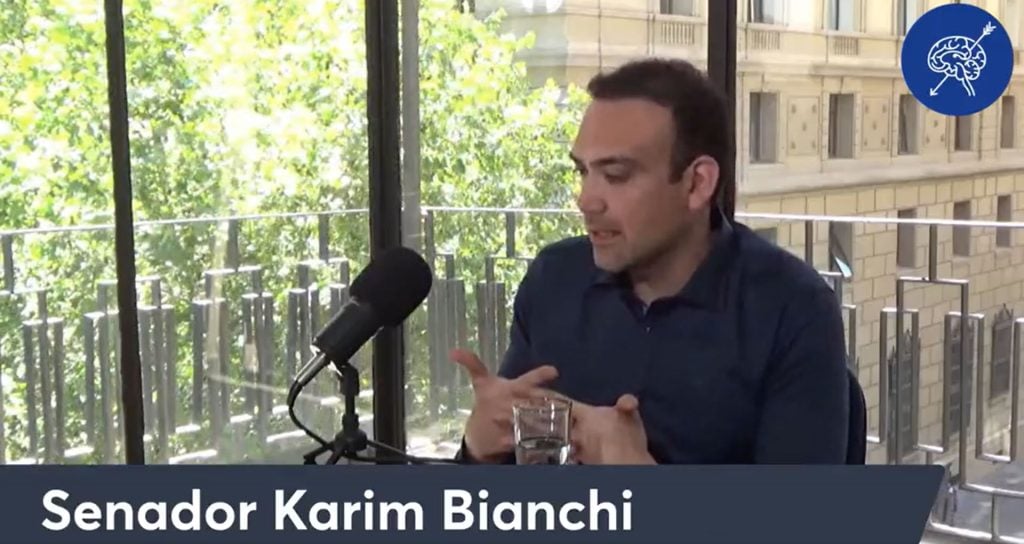
Another factor that intensified tensions within the government was the absence of independent senator Karim Bianchi during the vote. Center-left lawmakers accused that Bianchi had been present at the Senate for most of the day, but when it was time to cast his vote, he simply did not show up, resulting in a lost opportunity to tie the vote and potentially block the bill’s advancement.
Center-left reactions were even harsher. They argue that Bianchi — who has previously collaborated with progressive factions and the DC — abstained from voting due to his alignment with the rightwing administrative agreement in the Senate. In other terms: the bill progressed not only due to a right-wing offensive but also because of the silence and absence that, in a narrow voting scenario, counts as a vote in favor.
The Political Offensive Behind the Bill
The bill to commute sentences for those convicted of human rights violations does not emerge in a vacuum within the public debate. For years, right-wing factions have promoted initiatives aimed at modifying the prison regime for elderly inmates, many of whom are convicted of crimes committed during the dictatorship.
This situation repositions the controversial Punta Peuco facility at the forefront of the discourse, where numerous former agents of Augusto Pinochet’s repressive regime are imprisoned.
For human rights organizations and victim family groups, the progression of such proposals signifies much more than a legal change. They view it as a tactic to lessen the penalties meted out after decades of judicial investigations and struggles for truth and justice.
The Political Executed Group, for instance, has warned that initiatives like these pave the way for prison benefits for individuals who committed serious crimes during the dictatorship.
Pushback from the Government and Victims
The bill has also encountered criticism from the Executive and segments of the ruling coalition.
The current drafting — and this is part of the issue — does not differentiate by type of crime. In other words, the benefit is granted based on age and health conditions, rather than on the severity of the crime. Hence, the government has raised specific examples illustrating potential outcomes if the initiative progresses as it stands.
One such case is Julio Pérez Silva, the “psychopath of Alto Hospicio,” sentenced to life for 14 homicides and 18 years for two rapes, who due to his age and physical condition could seek to access sentence commutation.
He wouldn’t be the only one. María del Pilar Pérez, known as “La Quintrala,” who is serving life for multiple planned homicides, could also qualify. Likewise, Hugo Bustamante, convicted of the femicide and rape of Ámbar Cornejo, could potentially request this benefit if he meets the required age and medical conditions in the coming years. Additionally, Miguel Krassnoff, a former DINA agent condemned in over a hundred cases of abduction, torture, and murder during the dictatorship, might also request commutation based on age and health, as would many inmates of the ex-prison Punta Peuco.
The Justice Ministry has cautioned that the initiative could yield complex consequences for both the prison system and public safety. The government has reiterated that age or health conditions of a convicted individual cannot negate the severity of the crimes committed, especially concerning human rights violations.
Senator Fabiola Campillai has also voiced her opposition to the bill, emphasizing that sentences should be enforced in consideration of the gravity of the crimes committed.
These criticisms reflect an underlying tension: should the penal system apply humanitarian criteria broadly or maintain stricter standards for human rights violations due to their historical significance?

A Country Still Debating Its Past
The discussion surrounding the bill to commute sentences for those convicted of human rights violations brings uncomfortable questions back to the forefront of Chilean politics: what role do the crimes committed during the dictatorship play in today’s democracy?
For human rights organizations, allowing prison benefits to those convicted of such crimes signifies a regression in the progress made towards truth and justice.
Conversely, other political sectors argue that the prison system should incorporate mechanisms applicable to all individuals deprived of liberty without distinction.
What remains clear is that the vote outcome underscores that the discourse is far from resolved.
Following the general approval, a period has opened for presenting amendments to the bill. Senator Claudia Pascual has requested to facilitate this stage of legislative debate, setting a deadline for modifications to the text on Monday, March 16 at noon.
It will be during this phase that the scope of the bill will be determined, whether it retains its current form or if changes are implemented affecting its potential impact.
Meanwhile, the memory of these events is again under dispute: not as a mere symbolic gesture, but as a tangible decision regarding whether Chile will uphold the standards of justice achieved or regress under the guise of an “alternative solution” for those who violated human rights.
Obtén tu Pasaporte y apoya a El Ciudadano
Elimina la publicidad, accede a contenido exclusivo y sé parte de la comunidad.
Cancela en cualquier momento · Sin permanencia
Artículos Relacionados
Justice Appoints Trinidad Zegers to Revitalize Stalled Civil Procedure Reform After Over a Decade
Hace 4 semanas