Original article: CELAG: Noboa gobierna Ecuador entre deriva autoritaria y sombra narco
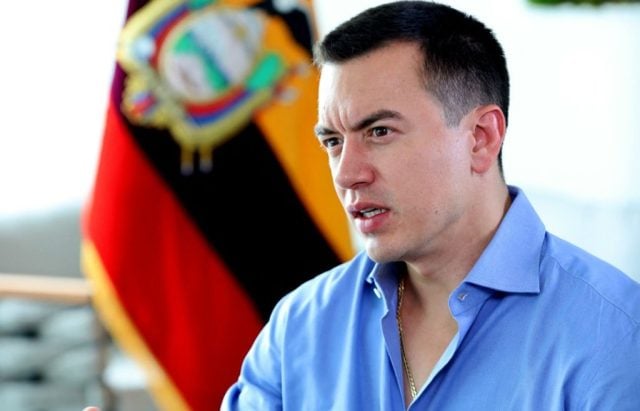
Two years into his presidency, Ecuador’s Daniel Noboa is demonstrating an authoritarian drift, marked by efforts to undermine opponents, while the economy bears signs of potential money laundering linked to drug trafficking, warns the Latin American Strategic Geopolitical Center (CELAG).
According to the organization’s analysis, the right-wing leader «has abandoned a strategy of political accumulation (presenting a national project) and is now focused on destroying his adversaries, preventing any emergent political projects from arising.»
The report highlights a key characteristic of Ecuador’s current political moment: the absence of a structured political project centered around the presidency.
«Noboísmo doesn’t exist,» the analysis states, while acknowledging that the «anti-adversary» strategy is currently effective for governance.
The document indicates that the businessman’s actions unfold across multiple fronts, impacting not only organized political opposition but also media, local governments, and regulatory bodies, in what the center describes as an «authoritarian drift» that disregards «minimum democratic principles, such as electoral participation, independent press, respect for territorial autonomy, and separation of powers.»
Media: Caught Between Economic Pressure and Persecution
One area where CELAG most clearly identifies the government’s authoritarian turn is in its treatment of the press. The analysis distinguishes two parallel phenomena: on one hand, the co-optation of media through official advertising and changes to their editorial lines; on the other, outright persecution of those who maintain a critical stance.
«Major media outlets stay close to the government thanks to millions of dollars in official advertising,» the report points out, referring to the sale of the El Universo newspaper, regarded as the largest in the country.
According to CELAG, the newspaper «was sold in February 2026 to an investor based in Florida (USA), and its editorial line is beginning to shift in favor of the Government.»
This movement is not isolated; the analysis notes that «several small digital platforms have been acquired by actors close to the presidential circle (e.g., Radio La Calle, La Posta, Radio Centro), beginning to uncritically support government measures.»
In contrast to this alignment strategy through economic incentives, the right-wing government has simultaneously applied pressure mechanisms against media that resist co-optation.
«Media that do not align with official communication face processes of persecution and intervention,» CELAG asserts, citing the case of the Expreso newspaper, which was intervened by the Superintendency of Companies as part of a phase of pressures that started in 2025, via the Internal Revenue Service (SRI).
The report mentions cases of journalists like Alondra Santiago and Andersson Boscán, who «have had to leave the country due to judicial persecution.»
This combination of buying editorial loyalty, administrative pressure on media companies, and judicial persecution of journalists creates, in CELAG’s view, a scenario of a «cornered or purchased press» that severely erodes freedom of expression in the country.
Local Governments: Political Persecution and Financial Asphyxiation
The CELAG analysis identifies a systematic offensive against local authorities, particularly those that could pose political alternatives to the central government.
«The mayors of Guayaquil, Quito, and Cuenca face criminal processes or controls that can be interpreted as attempts to block their re-election or political projection,» the report suggests.
This interpretation extends to how the major opposition force is treated. «The Ciudadana Revolution is undergoing constant attacks aimed at legally incapacitating the political movement representing correísmo,» warns the think tank.
Alongside judicial persecution, Noboa’s government is believed to have pushed administrative measures with devastating effects on Ecuador’s finances. According to the analysis, «an (unconstitutional) reform to the decentralization regime cuts over USD 1 billion in transfers to local governments (more than 30% of what they currently receive).»
This action appears to have a dual purpose: on one hand, «to alleviate the central government’s debt with provinces, municipalities, and parish councils» and, on the other, «to weaken local social services (education, health, inclusion) that compete in legitimacy with those of the national government.»
The report also highlights a specific case of government intervention at Segura EP, a municipal security firm in Guayaquil that manages surveillance cameras and «had allowed for the reporting of emblematic insecurity cases, such as the disappearance of children in Las Malvinas.»
CELAG interprets this intervention as an attempt to control the mechanisms of citizen oversight that had made sensitive cases visible to the government.
Capturing the Justice System
One of the most critical aspects pointed out by the organization is the process of co-opting the judiciary by the Executive, including a political maneuver that allegedly allowed the businessman’s administration—who is the son of Álvaro Noboa, one of Ecuador’s wealthiest men—to place an ally at the head of the Judicial Council, leveraging the situation of a member criticized for drug trafficking ties.
«Before the dismissal of the president of the Judicial Council, Mario Godoy, for his ties to drug trafficking, the government disqualified the member who was to replace him and instead appointed Damián Larco, a Noboa official without a track record in the justice system,» the analysis reveals.
«Only after ensuring this appointment did the Acción Democrática Nacional (ADN, Noboa’s party) allow the impeachment process against Godoy to proceed,» it states.
According to the think tank, this strategy is not new in Noboa’s management, as it was already used in 2025 to dismiss his vice president, Verónica Abad.
Concerning autonomous oversight bodies, CELAG identifies a situation of prolonged interim leadership that benefits the right-wing’s interests.
«The Attorney General’s Office and the National Electoral Council (CNE) remain in provisional roles (not launching new competitions) because the government has failed to consolidate a transition that guarantees its dominance over these bodies,» it warns.
The CNE appears in the analysis as a particularly questioned institution, experiencing a «serious legitimacy crisis,» as nearly 65% of the population «believes it serves private interests and about 75% calls for its renewal,» according to an opinion study published in February.
Regarding the selection process for a new Attorney General, CELAG warns of modifications that would facilitate the appointment of a government-friendly candidate.
«For the new Attorney General competition, the requirement that candidates not have defended drug traffickers was eliminated, suggesting a process designed to cater to the government’s candidate,» it explains.
The analysis also mentions the «removal of members of the Citizen Participation and Social Control Council in 2025 with the aim of influencing the Attorney General contest and other oversight bodies,» completing a picture of systematic intervention over the institutions that should act as checks on executive power.
Economy Under the Shadow of Money Laundering
One of the most complex aspects addressed by CELAG’s analysis is the contradiction evident between institutional and social crisis and certain positive macroeconomic indicators.
The report notes that by February 2026, Daniel Noboa’s positive approval rating was around 38-40%, following two years of governance marked by corruption scandals, an energy crisis, health issues, and security concerns, as well as institutional deterioration and manipulation of democratic rules.
According to the think tank, this relatively high level of approval, given the circumstances, can be explained by the influence of anti-correísmo—which has remained around 25% in recent years—but notes that when excluding this hard anti-correist core, «Noboa maintains about 15% support autonomously.»
However, the report recognizes an additional factor contributing to presidential popularity, based on a «novel economic dynamism.»
«Historically, the Ecuadorian economy relied on public investment, but today that engine is practically turned off. Paradoxically, GDP is growing, housing construction is expanding despite stagnant wages and a depressed secondary market; high-end vehicles are proliferating along with luxury consumption spaces; international reserves are reaching historic highs (over USD 11 billion), and sales registered with the SRI show growth rates exceeding 8-10% annually,» CELAG describes Ecuador’s productive scenario.
In response to the question of how this economic dynamism is possible amidst a paralyzed public investment and social crisis, CELAG provides a blunt answer: «Behind this apparent ‘macroeconomic bonanza’ in terms of growth lies a new replacement engine for public investment, and that is money laundering associated with the criminal economy.»
The report adds a significant geopolitical detail to support this thesis, indicating that «over 80% of the drugs that reach Europe pass through Ecuadorian ports.»
This position as a transit hub for drug trafficking to the European market generates illicit financial flows of such magnitude that they distort the real economy.
CELAG’s analysis delves into how drug trafficking funds integrate into the Ecuadorian economic fabric, generating contradictory effects. On one hand, these illicit flows support positive macroeconomic indicators; on the other hand, they deepen the legal economy’s dependency on criminal activities.
«Thus, the monetary circuits of an underground economy, fueled by illicit resources, sustain a fragile macroeconomic stability,» the report states. But the phenomenon has more complex ramifications: «Indirectly, they also keep afloat some local businesses, even without participating directly in illegal activities.»
This observation is crucial for understanding how drug trafficking can generate certain social acceptance—even among sectors not directly involved in illegal activities: laundered money stimulates consumption and general economic activity, creating a structural dependency that is hard to break.
According to CELAG’s analysis, «in upper strata, this illicit economy integrates with the agro-export model: narcos launder resources alongside business elites and introduce weaponry through front companies linked to security.»
Drug Money Contributes to Political Legitimacy
This symbiosis between illegal capital and legal business sectors is cited as a factor explaining both the state’s permeability to organized crime and the tolerance of certain elites toward administrations that enable or facilitate these operations.
The analysis concludes with a note linking illegal economies directly to Daniel Noboa’s management.
«The money from drug trafficking and other criminal economies floods the economic stream and acts as a multiplier that mitigates the abandonment of public services amid a sharp social crisis. All of this partially contributes to the political legitimacy of the government,» it warns.
Obtén tu Pasaporte y apoya a El Ciudadano
Elimina la publicidad, accede a contenido exclusivo y sé parte de la comunidad.
Cancela en cualquier momento · Sin permanencia