Original article: Las llaves de Santiago no son un trofeo político
By Claudia Barahona Chang
While some gestures may seem merely ceremonial, the decision by Santiago’s Mayor Mario Desbordes to transform such a gesture into an ideological statement signifies much more than it appears. A prime example is the decision to bestow the keys to the city upon Venezuelan leader María Corina Machado.
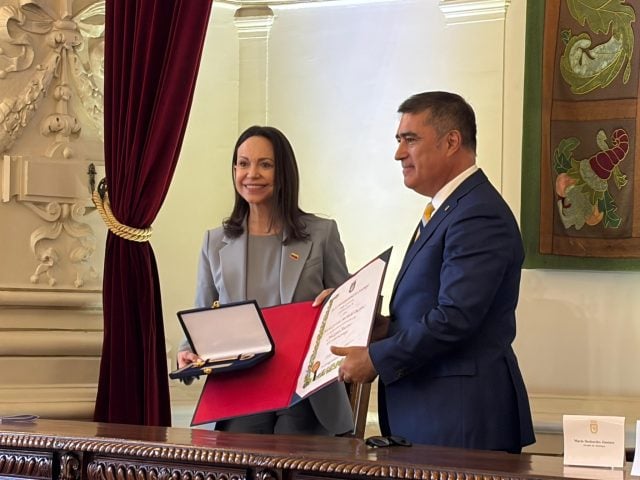
According to local officials, the mayor has declared her an «Illustrious Visitor» and symbolically presented her with the keys to the capital during her visit to Chile, coinciding with presidential inauguration activities.
However, an unavoidable question arises: What concrete merit does she possess to receive an honor that symbolically represents all of Santiago?
The presentation of a city’s keys is not a trivial gesture. Historically reserved for individuals who have made significant contributions to the city’s cultural, social, or political development, it stands as an institutional gesture honoring legacies intertwined with the history and life of the city.
In this respect, one must ask: What connection does María Corina Machado have with Santiago or Chile that justifies such an honor?
Machado is undoubtedly a prominent political figure in Venezuela, a leader of the opposition against Nicolás Maduro’s regime, and has positioned herself internationally as a face of the Venezuelan political crisis. However, she is also deeply controversial, both nationally and on the international stage.
Her remarks, connections with American political factions, admiration for Donald Trump, and support for international pressure strategies against the Venezuelan government have sparked significant divisions. For some, she represents the fight for democracy; for others, she embodies a confrontational politics that has legitimized scenarios of external intervention, including armed interventions, in her country.
Beyond the mixed sentiments her figure evokes, the fundamental question remains: Why would a city like Santiago award institutional recognition to a foreign leader who has no direct ties to the city’s history, life, or challenges?
The answer appears to lie less in Santiago’s history and more in the current political climate. Machado arrives in Chile invited to participate in the events surrounding the presidential transition. Her presence is part of a network of political affinities that currently connects right-wing sectors across Latin America and globally, where the Venezuelan conflict has become an ideological symbol.
In this context, the presentation of the city’s keys shifts from seeming a mere ceremonial gesture to being perceived as a political statement: a way to symbolically position Santiago within a continental narrative confronting competing ideological projects.
Moreover, it raises an even more pressing issue: Does this decision truly represent the residents of Santiago?
Cities do not belong to their mayors; they belong to the people who live in them. When recognizing individuals on behalf of an entire city, it would be reasonable to expect some degree of public or institutional deliberation to understand the significance of such recognition.
For Santiago is characterized by its political, social, and cultural diversity. A decision such as this is unlikely to be interpreted as a unanimous representation of the city’s inhabitants.
In a city where countless community leaders, residents, artists, academics, and organizations strive daily to improve community life, the question becomes even more uncomfortable: Why is public recognition directed toward a foreign figure rather than those who have dedicated their lives to building this city?
International politics will always have a place in public debates. However, when a municipal authority uses an institutional symbol of the city to express ideological affinities, it does not merely represent a diplomatic gesture: it employs Santiago as a stage for a personal political declaration.
Ultimately, this decision is less about María Corina Machado and more about the Mayor of Santiago himself. The handing over of the city keys seems to serve as a political signal in a specific moment, not a tradition of civic recognition. When a municipal authority utilizes a symbol that belongs to all to express their own ideological stance, the least that should occur is a public discussion.
Santiago is not a propaganda platform or a symbolic trophy in international political disputes: it is a pluralistic city that deserves to be represented with greater institutional prudence.
The symbols of a city belong to its residents, not to the political agendas of its authorities.
(*) Claudia Barahona Chang is a member of the Political Commission and the Central Committee of the Socialist Party, and also part of the Feminist Program of the Equality Institute.
