Original article: La ofensiva negacionista de Milei no prende: 71% de argentinos rechaza la dictadura
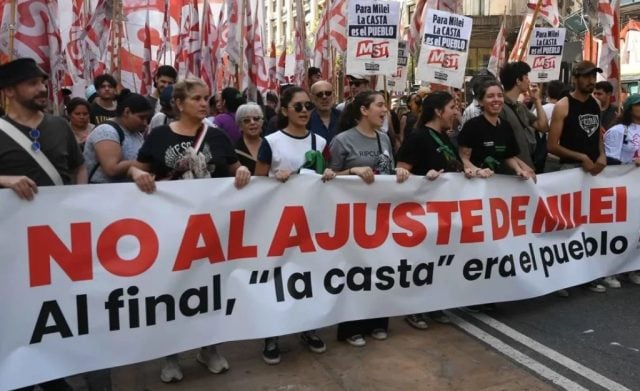
Fifty years after the coup that established Argentina’s bloodiest dictatorship, and amidst official assaults on policies of memory, truth, and justice, society strengthens its collective consciousness and counters the denialist offensive. A recent survey by the Pulsar.UBA observatory and the Center for Legal and Social Studies (CELS) revealed that, despite President Javier Milei’s attempts to revive theories equating state violence with that of guerrilla groups, a substantial majority of the populace rejects the regime of Jorge Rafael Videla (1976-1986).
The report titled «Retrospective Views on the Argentine Dictatorship: 50 Years Later» provides a clear snapshot of popular sentiment almost five decades after the institutional rupture. According to the opinion study, 71% of Argentinians rate the military government as «bad» or «very bad.»
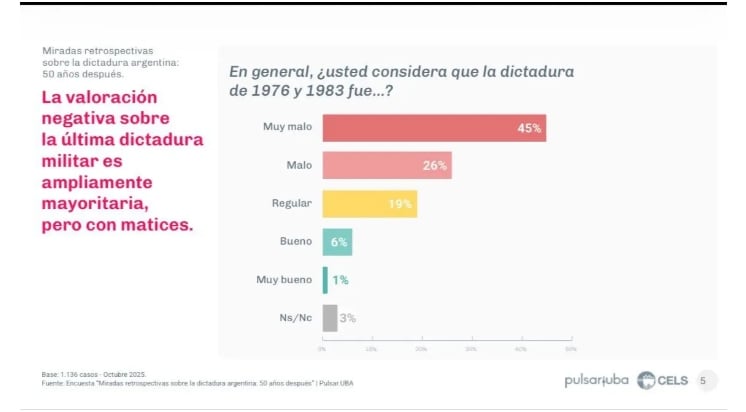
In addition, 63% indicated that there were no justifications for the coup on March 24. Most respondents attribute primary responsibility for the institutional break to the Military Juntas.
These percentages gain particular relevance given the current political context, marked by an Executive Power that, since its inception, has promoted a narrative aimed at eroding the democratic consensus built over these decades.
The study not only investigates the rejection of the dictatorship but also how society interprets that period. The results reveal a deep-rooted perspective on human rights. «For the majority of the population, the period is primarily understood as a systematic plan for forced disappearances and human rights violations (61%),» details the report, based on a survey conducted in October 2025 with a sample of 1,136 cases across the southern country.
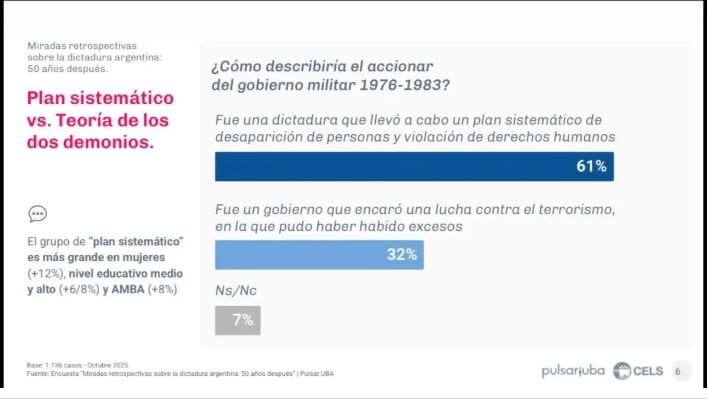
However, the researchers also warn about the persistence of certain narratives that seek to justify repressive actions. The study itself notes that «32% interpret the military government as ‘a fight against terrorism in which there may have been excesses,’ showing that while there is a clear condemnatory consensus, there remain areas of ambiguity in the interpretation of the period.» This percentage, though minority, represents a breeding ground upon which the libertarian government’s discourse of the «two demons theory» tries to operate, equating the responsibility of the terrorist state with that of armed organizations.
The Language of Human Rights as Common Sense
The work of UBA and CELS also highlights the success of memorial policies implemented since the return of democracy. The intergenerational transmission of knowledge about state terrorism has been crucial. Most respondents report having learned about the dictatorship in school, university, or through family conversations, which has established a common vocabulary to name the horror.
“Another of the most relevant findings is that, half a century later, the language of human rights continues to shape how Argentine society names and understands the dictatorship. The categories of ‘disappearance’, ‘repression’, ‘rights violations’, and ‘systematic plan’ are part of the democratic common sense,” emphasizes the UBA and CELS study.
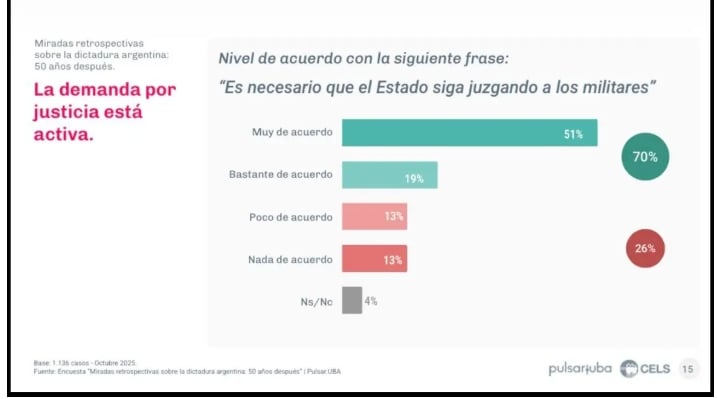
This internalization of the human rights paradigm also translates into strong support for the continuation of judicial processes. According to the survey, seven out of ten respondents agreed that the State should continue to prosecute the military responsible for crimes against humanity.
Official Obstruction of the Search for Grandchildren
While society consolidates its rejection of the dictatorship, the government of Javier Milei deepens an unprecedented offensive against the institutions created to uphold memory and seek the truth. Far from limiting itself to a debate of ideas, the libertarian administration has implemented concrete measures that, according to claims from human rights organizations, actively obstruct the search for over 300 children of the disappeared who still retain their suppressed identities.
The historic work of the Grandmothers of Plaza de Mayo, which has enabled the restitution of 140 grandchildren, has always depended on a close and essential collaboration with the National State. However, since December 2023, that assistance has been reversed. Through decrees and administrative resolutions, the «libertarian» government has minimized collaboration, implemented a smear campaign against the organization led by Estela de Carlotto, and advanced a systematic divestment that jeopardizes the continuity of investigations.
The CELS report titled «Under Siege» precisely details the dismantling of state tools. “One of the main problems arises from the decision, in August 2024, to close by decree the Special Investigation Unit (UEI) that worked in coordination with the Judiciary and the Public Prosecutor’s Office for 20 years,” warns the text.
The UEI, which operated under the jurisdiction of the National Commission for the Right to Identity (CoNaDi), was a key pre-judicial instance with specific powers to investigate documentation in appropriation cases. It had the authority to access archives from the Armed Forces and security forces, and to request information directly, a power that no public office currently possesses.
The weakening of CoNaDi is another chapter in this story. Since Milei’s assumption, the agency has lost 40% of its staff, and the 30 people still performing duties have seen their salaries reduced between 20% and 70%. Even before the closure of the UEI, the Ministries of Security and Defense, then headed by Patricia Bullrich and Luis Petri, were already refusing to provide records from the Armed Forces, the Federal Police, and other security forces, a crucial obstacle considering that many of the child appropriators were military or police.
Genetic Database at Risk
The obstruction has also targeted the scientific core of the search: the National Genetic Database (BNDG). Milei attempted to strip it of its functional autonomy through a decree that was ultimately repealed by Congress, but the budgetary and operational damage persists.
“The Bank is operating with insufficient funding as it has maintained the 2024 budget, which replicated that of 2023. During 2025, it was headless for several weeks, and all procedures for genetic analyses were paralyzed,” warned CELS in its assessment.
Additionally, it pointed out that institutional uncertainty worsened due to the lack of authorities.
«The position of technical deputy director has been vacant since January. This situation was partially remedied with the retroactive extension of the appointment of Mariana Herrera Piñero as president until a public competition of opposition and credentials, which has not yet been called,» it said, according to reports from El Destape.
Despite this hostile context and obstacles, the struggle of the Grandmothers of Plaza de Mayo has not halted. During the libertarian government, against the denialist tide, three new grandchildren were successfully restored.
This achievement, viewed in light of the UBA and CELS survey, underscores the profound contradiction between an extreme right government that besieges human rights organizations and a society that, overwhelmingly, not only rejects state terrorism but also demands justice and supports the tireless search for those who are still missing. The denialist cultural offensive, as the data shows, fails to resonate in a populace that has made memory an unbreakable banner.
Obtén tu Pasaporte y apoya a El Ciudadano
Elimina la publicidad, accede a contenido exclusivo y sé parte de la comunidad.
Cancela en cualquier momento · Sin permanencia