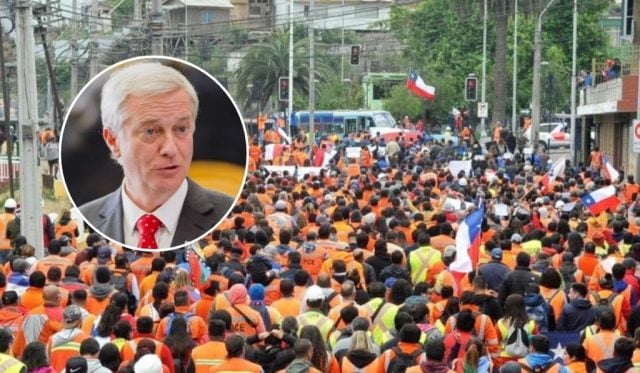
Original article: “Es un gobierno de los empresarios”: Kast sepulta la negociación ramal y refuerza su agenda antisindical
The administration of José Antonio Kast has officially withdrawn the bill that establishes collective bargaining for sectoral or «ramal» negotiations, an initiative pushed forward by the previous administration of former President Gabriel Boric. This decision, described by the Central Unitaria de Trabajadores (CUT) as a «political provocation» and indicative of the administration’s «pro-business» stance, signals a widening rift in social dialogue and suggests a tense environment ahead for upcoming labor discussions, such as minimum wage negotiations.
In a letter addressed to the Chamber of Deputies, the President—backed by the signatures of Finance Minister Jorge Quiroz; Economy and Mining Minister Daniel Mas; and Labor Minister Tomás Rau—explicitly requested the cessation of the bill’s processing while annulling the message contained in official document No. 281-373 dated January 9, 2026.
This document was submitted to the Corporation on Tuesday as part of the incoming administration’s neoliberal agenda.
The initiative proposed by Boric’s government sought to reform the Labor Code to introduce a «coordinated multi-level collective bargaining model,» designed so that workers and employers in the same economic sector could agree on minimum standards related to working conditions such as health and job safety.
It also aimed to address aspects such as wages, wealth distribution, productivity, and challenges relating to the transition of the labor market, alongside rules for implementing various agreements.
The bill outlined a coordinated multi-level collective bargaining model, featuring an institutional design that organizes the system on three levels (sectoral, intermediate, and enterprise) with distinct objectives and complementary functions. To support this system, it planned for the creation of Labor Sectoral Councils and Subsectoral Commissions, paritarian dialogue spaces comprising representatives from the most representative unions and business associations.
The reform also aimed to enhance effective participation, particularly of business associations, and included mechanisms linking access to state benefits, «whenever there is an intent to fulfill the State’s role in promoting, through its public policies, the full exercise of the right to collective bargaining,» emphasizing wages, wealth distribution, productivity, labor market transition challenges, and other related aspects.
When introduced with «urgent priority» last January, then Labor Minister Giorgio Boccardo highlighted the historic scope of the initiative and its potential contribution to social dialogue, productivity, and democracy: «With this bill, we are taking a step to settle a debt with the world of work and strengthen social dialogue in Chile.»
He emphasized, «The more social dialogue there is, the more democracy and better development there will be for Chile.» Meanwhile, the CUT stated that the ramal negotiations «were something overdue for over 30 years» and aimed to extend the opportunity for collective bargaining to employees and companies belonging to the same productive sector or subsector.
Kast: «We Believe It Is Not a Priority»
The justification presented by Kast’s administration for shutting down the project relied on a reordering of national priorities, placing the employment situation above structural reforms in labor relations. During a press conference at the Antofagasta airport, the Republican asserted that the legislative discussion on multi-level collective bargaining is not an urgent matter.
“Today, we have over 850,000 people without formal jobs. Is ramal negotiation urgent today? We believe it is not. Is it a political decision? Yes, but it is founded on evident issues,” he stated.
«Government for Business»: The CUT’s Strong Reaction
The presidential decision prompted an immediate and forceful response from CUT leadership, who labeled the new administration’s determination as a «political provocation.»
CUT’s Secretary General, Eric Campos, expressed that the measure demonstrates that this «is a government for business» and accused the administration of operating under a «pro-business view, granting far more guarantees while stripping rights away from workers.»
In a press conference, Campos not only challenged the substance of the decision but also criticized the manner of its communication, deeming it a «malicious interpretation» of parliamentary regulations.
He recalled that the project had already made progress in its processing and was the result of an unprecedented dialogue.
«We wish to express our surprise at the withdrawal of the multi-level or ramal bargaining bill, which had not only been approved in the first instance by the Chamber of Deputies’ Labor Committee, but was also the product of extensive national dialogue with unions and grassroots organizations. In all regions, we conducted collaborative dialogue with the previous government to achieve the outcome and the drafting that was later approved by the Chamber,» he stated.
«We believe the government’s action is a malicious interpretation of parliamentary regulations. Parliamentarians will need to elucidate the improper form in which this government acted to withdraw this bill,» he added.
Campos did not restrict his criticism to the withdrawal of the ramal negotiation project, framing it within a broader series of government announcements that, according to the CUT, constitute a systematic offensive against workers’ rights and the quality of life for citizens. The union leader linked this decision to other initiatives, such as tax reductions for large companies and interference in autonomous bodies like the Labor Directorate.
“Not only is there surprise, but this is also adding to yet another anti-worker, anti-citizen announcement made by the government this week. Remember, it is not just the tax cuts for large corporations, nor the proposal for the state to cover workers’ prevident contributions, allowing employers to increase profits, but now they are also pushing this withdrawal that ends social dialogue in Chile,” he posited.
“This additionally connects to a matter of considerable seriousness: the government’s interference in an autonomous body like the Labor Directorate, where they have already announced they will intervene in the application directives for forty-hour work weeks. Therefore, this is a blow to the quality of life for workers, and we will analyze each of these legislative proposals, as there is an attempt to scapegoat the reconstruction in the south to advance a legislative agenda that benefits only large business interests and harms working families in Chile,” he concluded.
The union leader also commented on the approach of the new Labor Minister, Tomás Rau, whom the CUT accused of not living up to the social dialogue required by the country. The multi-union, accustomed to engaging with various actors, including businesses, denounced that Kast’s government has opted for a unilateral relationship with no dialogue.
“We will, of course, conduct all our internal legislative analyses, but above all, we will reflect on Minister Tomás Rau’s attitude. We have requested from him at various points through the press, just as he has communicated with us via the press, to engage in dialogue. We are accustomed to negotiating with major businesses. We are waiting for a formal meeting to present their work agenda and, certainly, for the CUT to also present its agenda. This is not the way to govern; they are informing workers in Chile they will govern without dialogue, and we may not legitimately agree, but this is not how workers and their representatives should be treated,” Campos questioned.
Despite viewing this as an «affront,» the CUT reaffirmed their intention to engage with Kast’s administration, «but not with a gun on the table, rather with a fraternal dialogue on equal terms, not solely where we are informed of measures like these.»
The Secretary General of the organization warned that this situation is concerning, considering that minimum wage discussions are set for April. “If this is the government’s stance, we believe it sets a poor precedent heading into May 1. We do not want to anticipate any measures, but rest assured the CUT will reflect on how to address this genuine barrage of anti-worker legislative proposals,” he stated.
CUT Denounces Use of «Tragedy as a Facade» for Pro-Business Reforms
The multi-union’s discontent materialized in a public statement that further analyzed the government’s direction, accusing the Republican of using the emergency situation and presenting a «National Reconstruction Plan» for regions affected by wildfires in the central-southern area as part of a «facade» to implement a neoliberal agenda benefitting large economic groups at the expense of the working class.
In the document, the CUT asserts that the Kast administration uses «tragedy as an opportunity window to implement a tax reform.» Specifically, the union points to two concrete measures: «the reduction of the corporate tax from 27% to 23% and the elimination of the capital gains tax.» For the multi-union, these changes have no relation to the reconstruction of housing or recovery of affected areas. In the text, they argue that these tax benefits «are not social relief measures, but rather a direct gift to large companies to ensure that, even in crises, their profits continue to grow at the expense of public budgets.»
Another focal point of union rejection relates to labor policies announced in the plan, particularly the employment subsidy. The Republican government has proposed a mechanism where the state would assume part of the labor costs to incentivize hiring. However, for CUT, this subsidy is merely «a transfer of resources from all Chileans’ taxes to the business cost sheet.»
The organization also spoke out against modifications to the universal gratuity system, which the far-right president seeks to limit this benefit to students up to 30 years of age, excluding older individuals seeking to start or continue higher education. Additionally, it aims to strengthen the mechanisms for collecting the State Guaranteed Credit (CAE). The CUT interprets this measure as an act of direct discrimination against the working class, stating that «removing university gratuity from those over 30 years is an act of age and class discrimination.» They accuse the Kast government of deciding to «protect banking interests over the right to knowledge and the progress of working families.»
Obtén tu Pasaporte y apoya a El Ciudadano
Elimina la publicidad, accede a contenido exclusivo y sé parte de la comunidad.
Cancela en cualquier momento · Sin permanencia