Original article: ¿Dónde está la emergencia económica? Chile creció 2,5% en 2025 impulsado por inversión y consumo
Chile’s Economy Grows by 2.5% in 2025 Driven by Investment and Consumer Spending
In 2025, Chile’s economic activity grew by 2.5% compared to the previous year, fueled by robust domestic demand supported by both investment and consumption, according to the Central Bank. This finding contradicts the notion of an ‘economic emergency’ as posed by José Antonio Kast upon taking office.
The Central Bank has released the National Accounts Report containing information for the last quarter of the previous year. This report estimates frequent macroeconomic aggregates, including Gross Domestic Product (GDP), providing timely and high-quality information about the economic condition, which serves as a useful tool for understanding cycles and monitoring developments within the sector.
It is important to note that the Quarterly National Accounts (CNT) are published with a 48-day delay for the first three quarters of the year and a 77-day delay for the final quarter. Thus, with the latest estimation, the preliminary version of the year is complete, offering a snapshot of the economic status of the country.
With the recorded 2.5% growth in 2025, the economy’s performance exceeded the Central Bank’s last inflation report projection of 2.4% and was two-tenths above the preliminary figure published in the Imacec at 2.3%, aligning with expectations set by the Ministry of Finance during the tenure of former President Gabriel Boric.
According to the report, 2025 had one less day than 2024, which was a leap year, and one additional working day, resulting in a calendar effect of -0.1 percentage points on the final figure.
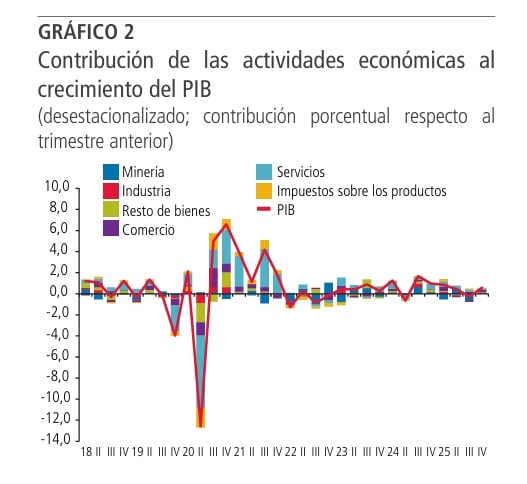
The Central Bank reported that many economic activities showed positive figures, with the sectors most contributing to GDP growth being commerce, personal services, manufacturing, and business services. In contrast, mining and the supply of electricity, gas, water, and waste management reported declines.
Seasonally adjusted, GDP accelerated in the last quarter, driven primarily by commerce.
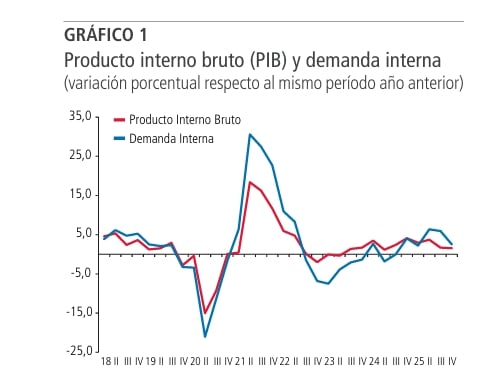
On the expenditure side, the expansion relied on internal demand. Household consumption grew by 2.7%, with increases across all components, particularly in non-durable goods—especially clothing and food—health services, restaurants, hotels, and durable goods, with a notable rise in technology product purchases.
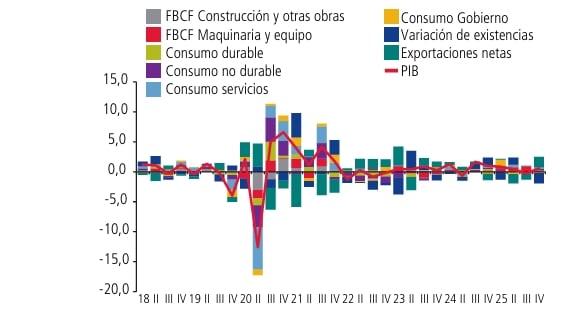
Government consumption expanded by 3.0% due to increased spending on public health.
Investment rose by 8.9%, primarily reflecting the performance of gross fixed capital formation (FBCF), which grew by 7.0% due to increased purchases of electrical and electronic equipment and transportation vehicles—trucks and buses. The construction and other works segment also contributed, albeit to a lesser extent. A smaller reduction in inventory was recorded with an annual ratio of -0.1% of GDP.
On the international trade front, both exports and imports of goods and services increased, with a net negative effect on activity.
Exports grew by 4.6%, primarily propelled by shipments of fruits—cherries and nuts—gold, food, and tourism services. Imports expanded by 10.5%.
The imports increased by 10.5%, “in line with stronger imports of machinery and equipment, particularly electrical and electronic devices and transport vehicles. Additionally, imports of services increased,” stated the Central Bank.
“According to seasonally adjusted figures, the quarterly GDP growth in the last quarter was explained by net exports. In contrast, domestic demand fell, influenced by inventory variation,” explained the central entity.
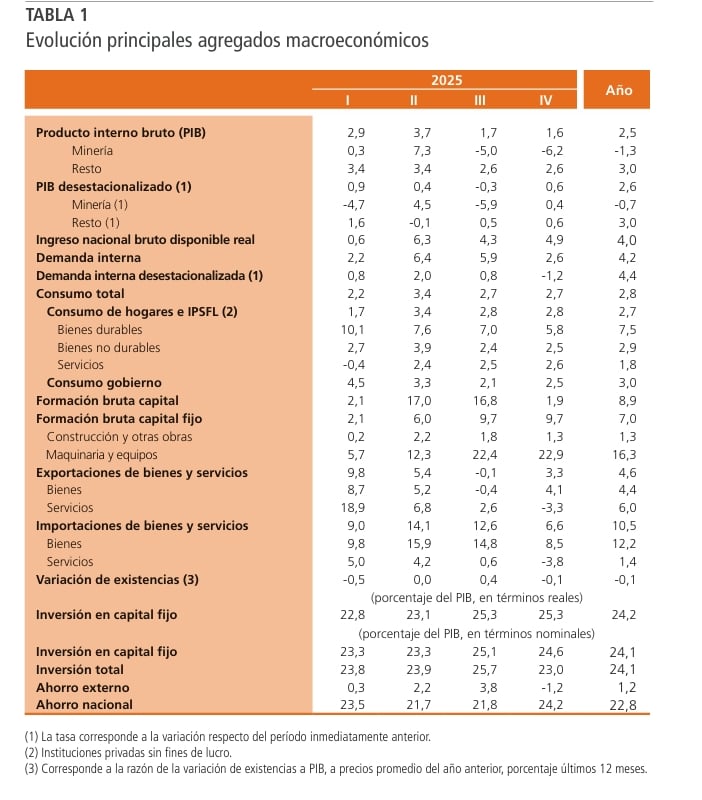
The report also revealed that real gross national disposable income grew by 4.0% in 2025, a higher result than that observed in GDP, «which was explained by an increase in terms of trade, an effect that was partially offset by higher rents paid to foreigners.»
Additionally, total gross savings amounted to 24.1% of GDP in nominal terms, reflecting a national saving of 22.8% of GDP and external saving of 1.2% of GDP, corresponding to the current account deficit in the Balance of Payments.
Where is the Economic Emergency?
Data from the National Accounts Report regarding the last quarter of the previous year, released by the Central Bank, refutes the hypothesis of an ‘economic emergency’ that the government of José Antonio Kast has sought to establish in public opinion, asserting that the country is facing an exceptional situation requiring swift decisions.
Utilizing this premise, three days after assuming power, the far-right leader and his Finance Minister Jorge Quiroz announced a series of measures that include corporate tax reductions, elimination of contributions, and limitations on university gratuity.
However, this supposed ‘economic emergency’ scenario has been challenged by experts in the field.
In an interview on CNN Chile’s Influential program, economist and former Finance Minister Ignacio Briones questioned the premises put forth by the current president, even before arriving at La Moneda.
He stated that while he considers the ‘emergency government concept to be an extraordinary electoral genius,’ it is problematic in a longer-term perspective.
In his view, this approach “risks overlooking medium- and long-term urgencies,” and he insisted that the actions must translate into substantive reforms.
“It needs to translate into bold reforms, those that are politically costly,” he asserted.
Economically, the former official raised technical objections regarding Kast’s promise to cut $6 billion from the state budget in a year and a half.
“Here the key is to restore credibility with demanding but achievable goals,” he indicated while warning that an immediate adjustment close to 7% of fiscal spending would face significant political difficulties, even within right-wing ranks.
Part of this narrative of a supposed ‘economic emergency’, Minister Quiroz asserted that the previous Boric administration left the treasury ‘empty’, claiming they would have around 1% of what is usual.
“The treasury closed under the previous administration with $40 million as of December 31, 2025. Normally, treasuries close, in normal administrations, between $3 billion and $4 billion,” he stated at a press conference, prompting criticism and reactions, including from his predecessor in the Finance Ministry, Nicolás Grau.
Through a social media post, Grau stated, “I won’t give interviews or comments, out of respect for the new authorities. Regarding the treasury data I’m asked about: the last public data is $1,406 million (end of January, I’m copying the photo) and the value at the start of this week (it fluctuates a lot) was over $800 million.”
The former minister supported his data with an image that shows the updated figures from the treasury, which quickly went viral as a rebuttal to the statements made by Kast’s minister.
With this hypothesis of an adverse scenario, the far-right administration is building a narrative to attempt to define what constitutes an ‘emergency’ and what does not, justifying the implementation of neoliberal measures that may lead to discontent and rejection from the public. Nonetheless, the Central Bank has shared official and reliable data confirming that economic activity recorded an increase of 2.5% in 2025 compared to the previous year, thanks to domestic demand driven by both investment and consumer spending among Chileans.
Next, you can access the National Accounts Report with data on the last quarter of the previous year.
Obtén tu Pasaporte y apoya a El Ciudadano
Elimina la publicidad, accede a contenido exclusivo y sé parte de la comunidad.
Cancela en cualquier momento · Sin permanencia