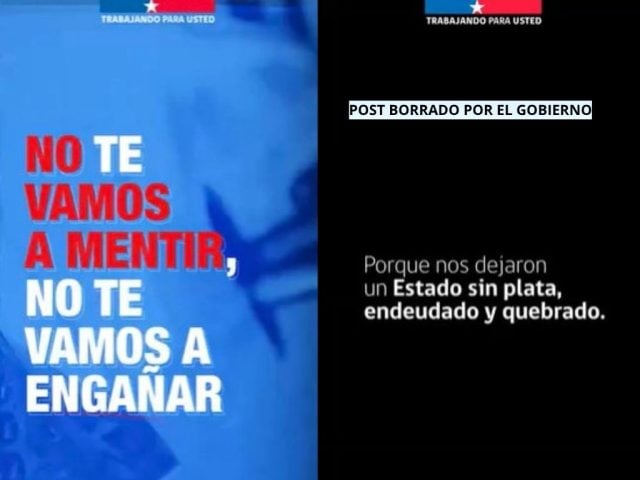
Original article: Borró el post, no la mentira: Kast buscó instalar un “Estado en quiebra” para justificar el bencinazo
«A lie repeated a thousand times becomes the truth.» This phrase, often attributed to Joseph Goebbels, the Nazi regime’s Propaganda Minister, is frequently cited as a warning about the power of messages when they’re established, amplified, and repeated from positions of authority. While it doesn’t fully explain the events that transpired, it does provide insight into a sequence of actions led by the government of José Kast amidst the gas price hike: from official channels, the notion was spread that the President inherited a «bankrupt state» from the previous administration; subsequently came the deletion of posts, the backlash, and the distancing by officials, despite the message already being disseminated.
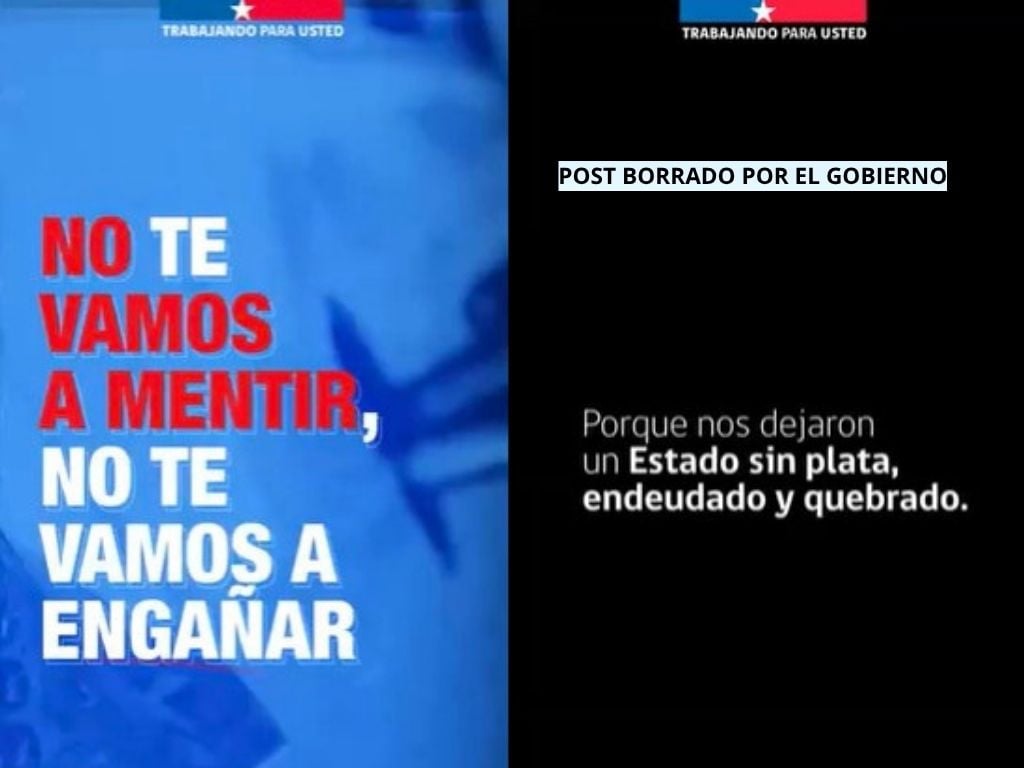
This is the crux of the issue. It was not merely an unfortunate post or a correctable slip, but a strategic attempt to establish a political-communicative framework for justifying the increase in fuel prices. Although the posts were deleted in response to criticism, ministers’ distancing, and the actions of the Comptroller’s Office, the thesis they intended to promote had already begun to circulate.
Not Just a Mistake
The swift sequence of publication, reaction, distancing, and deletion was initially interpreted as a misstep. However, it is hard to maintain that it was merely an isolated error.
First, the phrase did not appear out of nowhere. The idea of a severe fiscal crisis has been a cornerstone of the government’s discourse since its inception. Second, the dissemination was executed through official platforms, under the responsibility of spokesperson Mara Sedini.
In this context, the name of Cristián Valenzuela, an influential communication «strategist» from La Moneda, began to circulate as one of the architects of the «bankrupt state» concept, a notion the government itself later recognized as erroneous by distancing some ministers from it. This is no small detail: Valenzuela had already faced scrutiny in 2025 for labeling public servants as «state parasites«, indicating a confrontational rhetorical line that has resurfaced in the heart of La Moneda.
Moreover, this is not an isolated phrase detached from the official machinery. The content aligns with other communication strategies from the government, such as the leaked internal briefing that directed the narrative surrounding the war and fiscal legacy.
In this context, speaking of a «bankrupt state» doesn’t seem accidental; rather, it appears to be an attempt to push this narrative to its extremes.
Establish, Measure, Retract
The aftermath is well known. The message elicited criticism, even from within the government itself. Some ministers distanced themselves, and the posts were deleted without explanation.
However, in political communication, deleting content does not equate to a complete retraction. In many cases, it is part of the same process: an idea is established, its impact is measured, and if the cost is too high, adjustments are made. The problem is that the message has already circulated.
This is where the old logic re-emerges. Playwright Casimir Delavigne warned: «The more incredible a slander, the more memory fools have to remember it.» Beyond the tone, the intuition is clear: extreme messages tend to stick more strongly.
This is precisely what the idea of a «bankrupt state» accomplishes. It simplifies, dramatizes, and orders the debate into a single axis: there is no money, there is no alternative.
Comptroller and the Limits of Discourse
The episode transcended political spheres. The Comptroller’s Office decided to address the use of official channels for disseminating such content, opening a more complex dimension.
Because one thing is political debate and another is the use of public resources to establish claims that are later retracted. Here, it is no longer merely a communication issue but a matter of institutional standards.
This is no minor detail: if the state communicates that it is «bankrupt,» that is not just another phrase. It is a signal that affects expectations, trust, and economic perception.
And if that message is deleted hours later, the question does not vanish. On the contrary, it amplifies.
Unforced Error or Failed Strategy?
The most delicate point lies here. Was it an unforced error or a failed attempt to establish a harsher framework?
The history of political propaganda offers clues. Roger Bacon warned centuries ago: «Slander boldly; something always sticks.» Rousseau, for his part, noted a similar idea through a informant’s words: even if denied, a lie leaves a scar.
It’s not about equating contexts or exaggerating analogies but recognizing a pattern: once issued, messages create effects that do not depend on their permanence.
In this case, the concept of a “bankrupt state” sets up an interpretation that benefits the government at a critical juncture: it frames the gas hike not as a decision, but as an inevitability.
The Narrative That Persists
This is the core of the problem. Not the error itself, but the framework being attempted.
Because if the state is «in bankruptcy,» then there is no wiggle room. And if there is no wiggle room, the rise in fuel prices and its cascading effects appear as something that simply had to be done.
But this premise is contested. Former authorities and economists have challenged this characterization, pointing out that it does not accurately depict the fiscal scenario and that it reflects a political option rather than an absolute constraint.
Meanwhile, the Bills Keep Coming
As the government corrects messages, deletes posts, and reorganizes its discourse, the effects of the gas price hike have already begun to be felt.
The increase in fuel prices directly impacts transportation, food, and services. In other words, it affects the daily lives of families.
This is where the debate returns to the essentials: not only how a measure is communicated but who pays the consequences.
Because posts can be deleted. Yet when an idea manages to take hold, even for a few hours, it leaves a mark. And when that idea serves to justify decisions that impact citizens’ wallets, the problem transcends communication.
It becomes political.
