Original article: Chile: Cuando el regulador pesquero tiene historia
Isadora Reyes Marín, Regional Director, Frente Amplio, Valparaíso
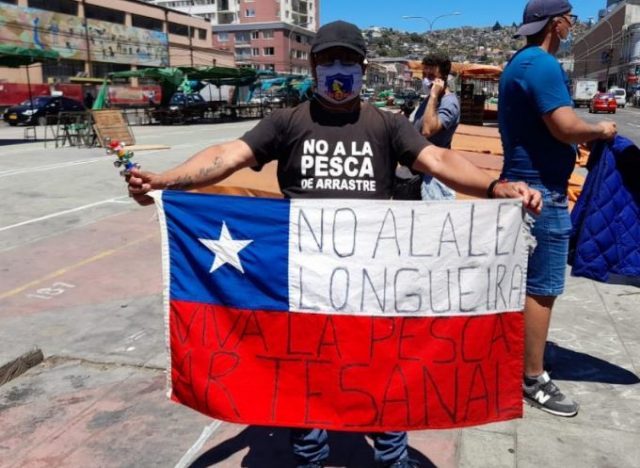
There was a time in Chile when discussions went beyond just annulment of the Longueira Law; actual legislation was proposed. There were projects, parliamentary debates, commissions, and votes.
The outrage was not unfounded; it was a justified reaction to a law marred by corruption. This was not mere suspicion or ideological critique but rather grave offenses resulting in convictions for bribery, tax fraud, and corruption related to its passage.
The message of the new Fishing Law — the very law the Kast administration has chosen to withdraw — explicitly recalled this troubled history.
However, the proposed annulment did not succeed, and it became clear that the Longueira Law would not simply dissolve on its own. It needed to be replaced, not simply managed better or adjusted; it required a new law, rooted in legitimacy and established under different rules.
This was precisely what the new Fishing Law represented.
Thus, its withdrawal cannot be viewed merely as an administrative decision. What is being withdrawn is not just a project; it signifies the loss of an opportunity to completely replace a law tainted by corruption with one built for the citizens. This distinction is crucial. It matters greatly. In politics, managing an illegitimate legacy is not the same as daring to break with it.
Furthermore, this new law did not emerge from hasty decisions or the closed doors of a few; it was a project supported by 11 ministries, developed through countless meetings nationwide, with input from the artisanal sector, scientists, related activities, and the industry.
Then came the legislative process: unanimous approval to legislate, regional sessions, hundreds of parliamentary amendments, and a discussion process that was substantive, not merely ornamental. Around 300 articles were approved. In other words, this was not a case of the Executive sending a text for the Congress to rubber-stamp. There was political work, deliberation, and legislative ownership. Congress was not just a mailbox.
This illustrates why the withdrawal is so severe. When a project has been discussed, amended, grappling with challenges, and partially agreed upon in Congress, withdrawing it is more than just closing the Executive’s agenda. It disregards an already produced institutional deliberation. It indicates that even when democratic politics advances, everything can regress if it touches too sensitive interests.
So, what critical aspects was this law addressing? Much more than quotas. Much more than numbers.
The new Fishing Law began to establish a different framework for the sector: introducing the concept of fishing transparency in all its dimensions, increasing the role of science and ecosystem approaches, enhancing monitoring tools against illegal fishing, facilitating real discussions about competition in the industry — where asymmetries also exist — and recognizing SMEs and related activities, with a concrete emphasis on food security through bolstering human consumption.
Moreover, it addressed something even more uncomfortable: it introduced a social dimension for artisanal fishing, with concrete support instruments and a logic geared towards more than mere survival. It was about acknowledging that rights also exist in that context.
That was the real conflict.
Because this law did not just correct technical aspects of the system; it began to discuss the type of social, economic, and territorial pact that should organize the country’s relationship with the sea. It was starting to assert, albeit partially, that it was unacceptable to have a system that generates concentrated wealth for some while perpetuating structural precariousness for others.
It is no coincidence that this discussion faced explicit resistance during its legislative process. Certain sectors made its progress problematic, pushing for delaying strategies that brought the debate to the extreme of reviewing article by article, clause by clause.
And now, with the same law being withdrawn, the signals accompanying this shift — including the involvement of teams linked to those who actively defended the status quo — only reinforce a question that the sector is increasingly asking itself.
Therefore, it is insufficient to simply say there were issues with the project. Of course, there were. Any law of such significance comes with challenges. But that is why amendments exist, including substitution ones; that is why urgencies exist; that is why the Executive exercises political leadership. Withdrawing is the most drastic decision. And in this case, it is also the most telling. Because withdrawing does not mean correcting. Withdrawing means renouncing a fundamental discussion.
And this is where the new undersecretary comes into play.
The problem lies not in having an opinion about fishing; it is that, in a sector with this history, the new head of Subpesca does not come to clarify uncertainties but rather to expand them.
When the only law aimed at entirely replacing the inherited system is withdrawn, when an already opened discussion in Congress is closed, and when this choice is left in the hands of an authority whose previous history aligns more with protecting the industry’s stability than with fundamentally reassessing the model, a reasonable doubt emerges.
And for the artisanal sector, this doubt is not abstract: it reinstates the feeling that their position within the system remains secondary. Who is this new regulator here to protect? That is the question left unresolved. It is not whimsical; it is a legitimate inquiry. And it is also a political question.
Because this was not just about discussing a new fishing law. It was about something deeper: whether Chile would continue to uphold its fishing system based on a law whose origin is tainted by corruption or would finally dare to replace it with one constructed through participation, deliberation, and democratic legitimacy.
With this withdrawal, the government has already taken a stance. It chose not to push for a new foundation for the Chilean fishing system. Instead, it opted to continue managing the heritage of the Longueira Law. And in a sector with this history, managing that heritage is never neutral.
Isadora Reyes Marín
Obtén tu Pasaporte y apoya a El Ciudadano
Elimina la publicidad, accede a contenido exclusivo y sé parte de la comunidad.
Cancela en cualquier momento · Sin permanencia