Original article: Baquedano vuelve a Plaza de la Dignidad: CMN reaviva la disputa por el símbolo del centro de Santiago
Baquedano Returns to Plaza de Dignity: CMN Revives Dispute Over Santiago’s Central Symbol
Baquedano returns to Plaza de Dignity. This phrase is not just informational; it carries political weight. The National Monuments Council (CMN) has approved the request to reinstall the equestrian statue of General Manuel Baquedano in the heart of Santiago. However, this decision is far from a mere heritage procedure.
This is a direct intervention in the most symbolic space of the country. When symbols are subjected to change, memory is also reshaped.
The CMN reported that the approval came after a «strictly technical analysis.» Furthermore, they stated that «the requesting institution must certify to the Technical Secretariat that the interventions made on the pedestal yield favorable results in tests of resistance and feasibility before installing the equestrian figure, following Chilean norms’ criteria and deadlines.»
The organization added that the background analyzed seeks to «ensure the safety of citizens, the preservation of the sculpture, and the integrity of the pedestal,» taking into account «the historical relevance and complexity of the sculptural ensemble.»
However, the debate does not center on the structural integrity of the pedestal; it lies in what the figure being reinstated represents.
A Square with Three Names and the Same Conflict
The square where the monument will be reinstalled has three names and three overlapping narratives: Plaza Baquedano, Plaza Italia, and Plaza de Dignity.
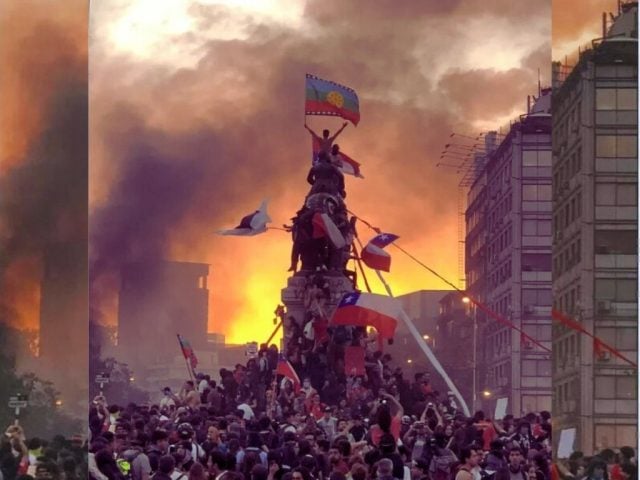
Each designation encapsulates a different vision of the country. Plaza Italia refers to republican tradition and sporting celebrations. Plaza Baquedano reflects a heroic military narrative. Plaza de Dignity emerged from the social explosion as a symbol of protest, questioning, and hope for transformation.
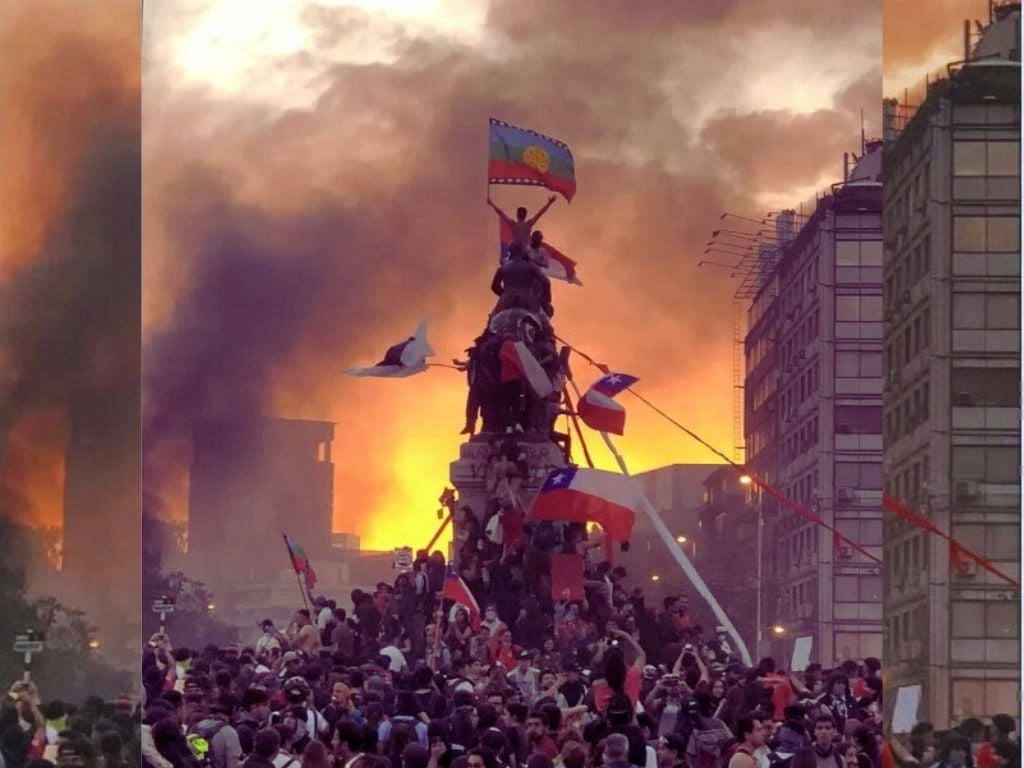
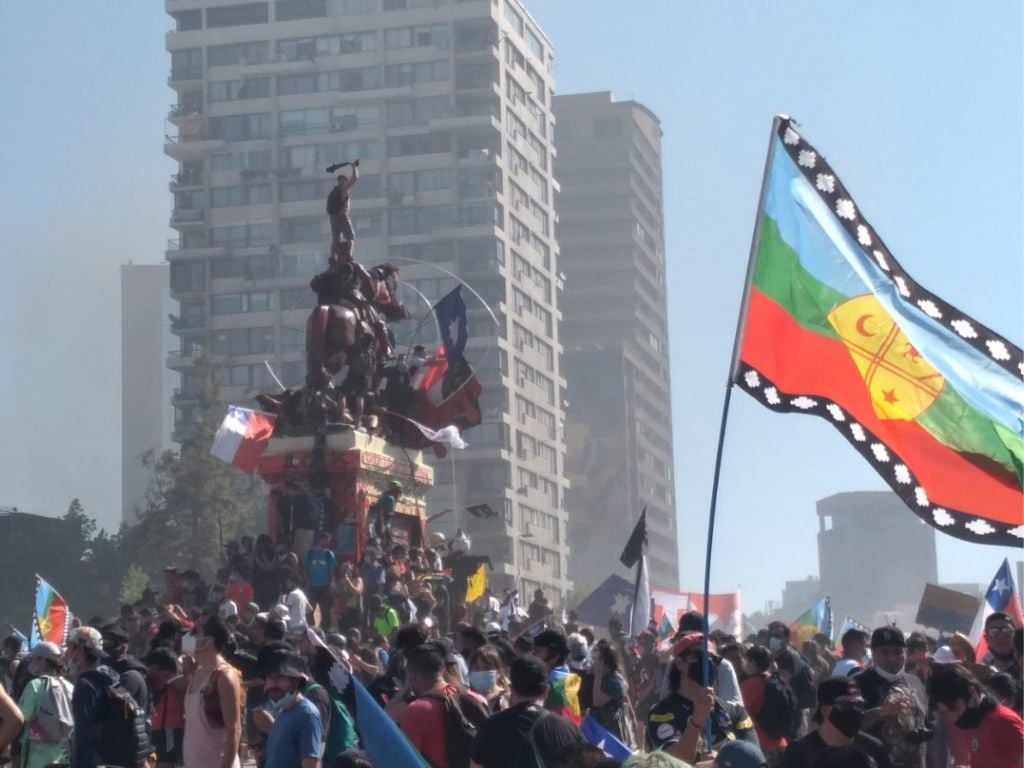
Since October 18, 2019, this space has evolved from being solely a point of urban transit to becoming the epicenter of historic mobilizations. It has been the site for massive marches, social demands, feminist, student, and Mapuche flags. It has also witnessed the repression that marked one of the most intense periods in recent history.
The removal of the statue in 2021 was interpreted by many as a symbolic break: the center of Santiago has transitioned from being presided over by a general to becoming a stage for mobilized citizenship.
Its return reopens that fracture.
Reactions: Order and Restoration versus Memory and Questioning
Following the CMN’s approval, right-wing sectors and military representatives welcomed the decision as a restoration of heritage and «institutional order.» From their perspective, the reinstatement represents a correction following what they see as a period of chaos.
Conversely, social, student, and Mapuche sectors view the measure as a political gesture that reinstates in the heart of the country a symbol associated with the state’s military power.
This is not merely about a statue; it is about which historical narrative occupies the center of public space.
Baquedano, the State, and Mapuche Memory
The figure of Manuel Baquedano is linked to the Pacific War, but it is also connected to the military occupation of Mapuche territory in the 19th century, known as the «Pacification of Araucanía.»
That episode continues to spark controversy. For some, it is part of the state consolidation process. For others, it represents forced territorial expansion, violence, and genocide against Indigenous peoples.
In a country where the conflict between the state and Mapuche communities remains alive, reinstalling the figure of the general in the main demonstration space inevitably carries political significance.
Because monuments are not just historical pieces; they are permanent declarations of which memory is privileged.
Technical Criteria, Power, and Symbolic Dispute
The CMN justifies its decision with technical criteria. Indeed, heritage does require protection. However, symbols extend beyond their material dimension.
The square is not a museum frozen in time. It is a living space where social tensions are expressed. Here converge memories of the uprising, dignity demands, critiques of the system, and unresolved debates over historical justice.
The acting government spokesperson, Aisén Etcheverry, noted that the monument would return to share space with the sculpture of Gabriela Mistral. This coexistence projects a new symbolic configuration of the place but does not eliminate the dispute.
Because the center of Santiago is not merely a geographical point; it is the stage where national projects intersect.
The Center as a Mirror of the Country
The fact that Baquedano returns to Plaza de Dignity does not close the discussion; it ignites it. This gesture occurs in a country still debating the meaning of the social upheaval, the role of the state in the face of protest, and the historical debt with the Mapuche people.
Symbols condense meanings. They accumulate layers of history. They direct perspectives and actions. They are neither neutral nor innocent.
In the heart of Santiago, bronze is not just bronze. It is memory materialized. It is power represented. It is visible contention.
And when a symbol returns to the center, what returns is not merely a statue. A narrative returns. And that narrative — like the square itself — will continue to be a territory in conflict.
Relacionados
Baquedano vuelve a Plaza de la Dignidad: CMN reaviva la disputa por el símbolo del centro de Santiago
Hace 2 minutos
Ancient Human Remains Unearthed in Pilmaiquén: Communities Accuse Negligence to Conceal Cemetery
Hace 3 semanas
National Monuments Council to Decide on El Bosque Air Base Declaration as a Site of Memory
Hace 1 mes