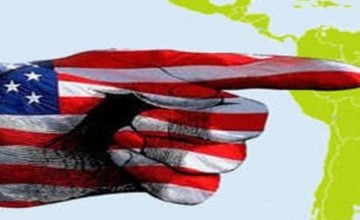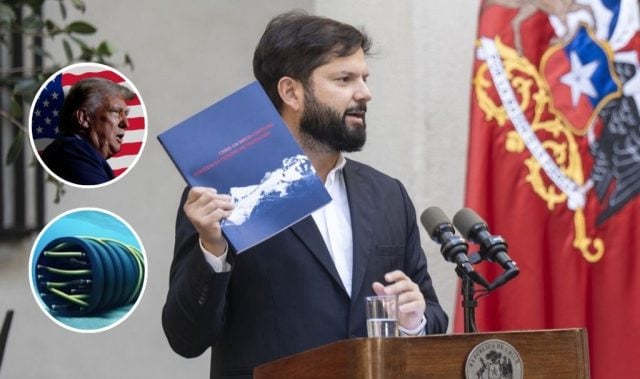
Original article: “So pena de castigos”: Boric denuncia presión de Washington y liga sanciones por el cable chino a la doctrina Monroe
Boric Criticizes Washington’s Pressure and Links Sanctions to Monroe Doctrine Over Chinese Cable Project
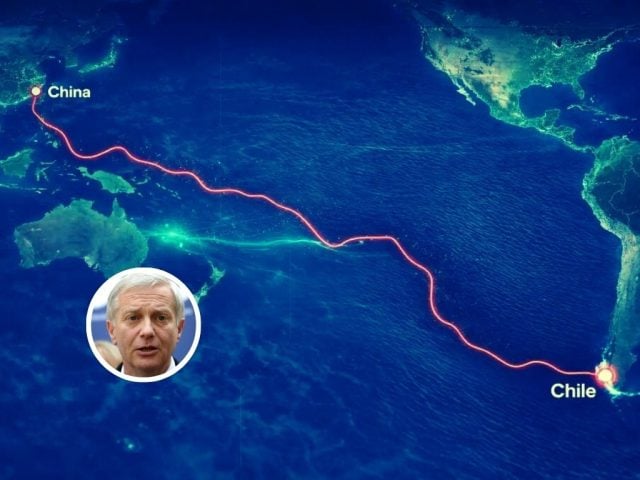
On Thursday, President Gabriel Boric directly criticized U.S. foreign policy under Donald Trump, following the revocation of visas for three high-ranking Chilean officials over the Chile–China Express project, related to the installation of a submarine fiber-optic cable intended to connect Valparaíso directly to Hong Kong.
During the launch of the Institutional Report from the Foreign Ministry for 2022-2026, Boric condemned the sanctions imposed by the Republican administration, framing them within a long-standing geopolitical logic that, in his view, is resurging strongly across the continent.
On November 26, 2025, a consortium comprising major Chinese tech giants—China Telecommunications Corporation, China Mobile Communications Group, and China United Network Communications Group—submitted a formal request to the Subsecretary of Telecommunications (Subtel) to obtain a concession for building the submarine cable, involving an investment of approximately $500 million.
This initiative, currently under evaluation, sparked outrage in Washington. Last Friday, U.S. Secretary of State Marco Rubio declared that the project could «undermine regional security» and announced visa revocations for Chile’s Minister of Transport and Telecommunications, Juan Carlos Muñoz, Subsecretary of Telecommunications, Claudio Araya, and Chief of Staff Guillermo Petersen.
In response to this unilateral action, officials from La Moneda stated that the submarine cable project remains under evaluation «following institutional protocols,» emphasizing that decisions are made «in the best interest of Chile and its people.»
Pressure and Punishment from Washington
During the official event on Thursday, the head of state reflected on Washington’s security strategy and recalled that at the end of 2025, he made «an explicit reference to the Monroe Doctrine, the 19th-century idea that the western hemisphere, particularly the Americas, constitutes a preferred sphere of influence for the United States.»
By evoking this historical concept, Boric drew a parallel between the expansionist policies of the 19th century and the actions of the current U.S. government led by Trump, which he believes seek to limit the autonomy of countries in the region.
In this context, the president elaborated on how this doctrine manifests today. He argued that its application «implies, in particular, that Latin America must align with national security and development criteria set by Washington and limit ties considered uncomfortable or competitive, under threat of punishments or consequences for the peoples or elected leaders who do not follow this path.»
This situation refers to an asymmetrical relationship where dissent or simple diversification of alliances incurs costs imposed from the White House.
President Boric not only criticized this stance but also identified concrete consequences of such a logic in the regional landscape.
“In practice, this logic is already translating in several Latin American countries into economic, technological, or security cooperation with the U.S. being conditioned on a subordinate stance to this worldview,” he argued.
Linking to recent events, he asserted that “the consequences of this have been evident in Chile in recent days with the sanctions imposed on members of our Government, merely for processing an investment project and reviewing whether it complies with Chilean legal standards.”
This way, Boric defended the legitimacy of the internal process, making it clear that the government exercised its sovereign evaluation powers without justifying a retaliatory action from the U.S.
The president warned that such pressures have effects that go beyond the specific case of bilateral relations between Santiago and Washington, affecting the broader Latin American region.
“This, obviously, also has implications for Chile and the rest of the countries in the region, as these dynamics reduce the autonomous space of medium-sized countries to develop and diversify their relationships with extra-regional actors, especially countries like China,” he cautioned.
“This is a logic that, from my perspective as a head of state, we cannot accept,” he emphasized, reaffirming a stance against any form of interference with our country’s sovereignty.
However, he clarified that this does not imply a break with the United States and stated that Chile values “having a solid and respectful relationship with the United States of America.”
Nevertheless, in the face of Washington’s alignment pressures, he indicated that “Chile’s task is not simply to deny that tension, but to manage it in the best interest of our homeland.”
President Boric: “Strengthening Chile’s Autonomy Means Expanding Our Options”
In light of the renewed Monroe Doctrine by the U.S., the head of state proposed a roadmap based on autonomy and cooperation.
He argued that Chile must “position itself as an autonomous interlocutor, articulate principles and concrete work in the region, defend our strategic autonomy, and maintain an open insertion without renouncing our relationship with the United States or strategic diversification with other partners such as China, the European Union, or India.”
“In the face of any unipolar primacy logic, the most effective response is functional regional coordination,” he reiterated in statements reported by Bio Bío Chile.
Additionally, the president called for advancing toward a more integrated South America and stated that “strengthening Chile’s autonomy is expanding our options, not limiting them.”
In his view, the key lies not in isolating or permanently choosing a side, but in building more open cooperation networks.
Thus, he called for forming coalitions to create a flexible architecture of cooperations, in contrast to “permanent alignments” and “rigid blocks,” emphasizing that it is not necessary to “share every policy of the partners we may have in these coalitions.”
With this declaration, Boric promoted a model of international relations for the 21st century, where autonomy and the ability to forge multiple and non-exclusive alliances serve as the best defense against the unilateral pressures of great powers.
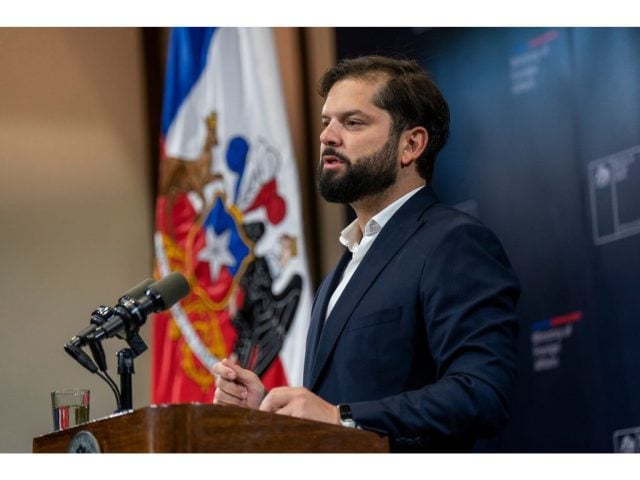
You can see the president’s full speech below:
Relacionados
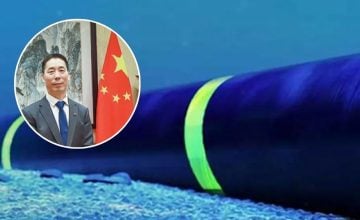
Chinese Ambassador Dismisses Concerns Over Submarine Cable, Affirms No Threat to Regional Security
Hace 1 día
Camila Vallejo Dissects the Approval Narrative: Submarine Cable Project Remains Under Evaluation
Hace 1 día