Original article: Cuesta Barriga y 110 víctimas: Plan de Búsqueda presenta querella por inhumación y exhumación ilegal y apunta a la operación “Retiro de televisores”
A legal complaint seeks to clarify the final fate of over a hundred political executions who were buried and subsequently clandestinely exhumed in the Cuesta Barriga mountain range between 1973 and 1977 by the Joint Command and the National Intelligence Directorate (DINA).
The Undersecretariat for Human Rights, as part of the National Search Plan, filed a criminal complaint with the San Miguel Court of Appeals aimed at uncovering one of the darkest chapters of enforced disappearance during Augusto Pinochet’s civic-military dictatorship. This legal action targets the crimes of illegal burial and subsequent exhumation of at least 110 individuals in the area known as Cuesta Barriga, a mountainous region near Curacaví, which was extensively used as a clandestine grave between 1973 and 1977 by agents from the National Intelligence Directorate (DINA), the Anti-Subversive Joint Command, and Carabineros de Curacaví.
The legal action was presented by Undersecretary Daniela Quintanilla and the head of the Human Rights program, Paulina Zamorano, supported by a substantial body of evidence, including testimonies from 15 former agents of various repressive organizations, given in 10 distinct legal cases.
These accounts consistently identify Cuesta Barriga, specifically an old mine located at kilometer 12 of Route 68, as a frequent destination for disposing of the bodies of executed political prisoners. «We are presenting this document for 110 victims,» Quintanilla stated.
The legal file aims not only to establish accountability for the clandestine burials but also for the subsequent removal of the corpses, an obfuscating operation ordered from the highest levels following the discovery of other graves.
«Previous lawsuits focused on identifying those responsible for the crimes of kidnapping and murder of the victims, but today we are aiming to investigate the crime of illegal burial and exhumation, thereby seeking truth for the families,» explained Zamorano, outlining the innovative approach of this legal action that prioritizes the right to truth and mourning for the families.
The Discovery of Horror in Cuesta Barriga
The history of Cuesta Barriga’s use as a clandestine necropolis began to unravel with the testimony of former DINA agent Héctor Valdebenito Araya, alias «The Old Green», before the Human Rights Brigade of the PDI on February 7, 2007. Valdebenito, anxious during his interrogation, recounted how in 1975, while searching for the MIR leader Andrés Pascal Allende, he discovered the site.
“Thus, during the night, we arrived at Cuesta Barriga, encountering some locals who were trapping rabbits. We noticed a fire they had going. As we approached, they showed us the area, walking around until we reached a cave that turned out to be a mine, where we verified that the fugitives were not present,” he stated.
This chance discovery became a protocol of horror. Shortly thereafter, Valdebenito brought his superior, Major Juan Morales Salgado, head of the Lautaro Brigade and former bodyguard of Augusto Pinochet, to the site. Subsequently, in a night operation, he guided two officers from the Caupolicán Brigade, the notorious former agents Ricardo Lawrence and Germán Barriga, to the site.
When they arrived at the entrance of the old mine, the agents from the other brigade got out of their vehicles and unloaded three or four bundles, which they threw into the pit inside the mine.
According to «The Old Green», the bundles smelled burnt and he added that an agent named Almendra told him that «they had probably been burned after being killed, to then make them disappear in the bowels of that mountain range,» reported El Mostrador.
DINA’s Modus Operandi: Sacks, Lime, and Torches
Testimonies from other former agents vividly describe the procedure. María Angélica Guerrero, who also worked within DINA, confessed: “I was part of the team of agents that removed two lifeless bodies wrapped in burlap sacks, which we took to a cave in Cuesta Barriga… most likely, lime was thrown on top of them.”
Jorgelino Vergara, the former agent who revealed the existence of the Simón Bolívar extermination camp, referred to the flow of victims and recounted that detainees were “interrogated and then executed, bundled up, some were put on rails, which I deduced were going straight to the sea, while others were taken to lime mines in Lonquén or Cuesta Barriga.”
Agent Eduardo Reyes Lagos provided even more macabre details, acknowledging his involvement in two trips to the mine. On the first trip, he carried at least ten victims; on the second, he transported two bodies from Villa Grimaldi. Before throwing them into the «sinkhole that was over two meters wide and deep,» they burned their hands with torches to eliminate their fingerprints.
Operation «Television Withdrawal» and the Clandestine Exhumation
The complaint takes a crucial step by investigating not only the initial concealment but also the subsequent exhumation of the graves.
Following the discovery of the ovens in Lonquén in 1978, dictator Augusto Pinochet ordered the operation named “Television Withdrawal,” a national maneuver to exhumate and again disappear the bodies, throwing them into the sea from helicopters, incinerating them, or shredding them.
The former director of DINA, the late Manuel Contreras Sepúlveda, alias “El Mamo,” admitted to this operation concerning Cuesta Barriga. According to his account, in 1979, CNI director Odlanier Mena ordered the removal of the bodies because “the Vicariate of Solidarity was getting very close to finding them.”
Contreras acknowledged that “80 sacks with around 200 corpses were removed, which were transported to Peldehue, where they were thrown into the sea from helicopters.”
The individual who executed the order on the ground was former agent Enrique Sandoval Arancibia, who in 2004 described the horrific scene he found in the mine: “It was filled with rodents, bats, putrefying remains, and had a smell consistent with the remains.”
Sandoval reported working with nine other agents for three nights: “We removed about 50 potato sacks. I remember there were bones, pieces of clothing, some were in large plastic bags, but most were unwrapped, and I even have the impression that they were without clothing.” To cover up the trail, he threw “bodies of about five dead dogs” into the pit. Later, the sacks were taken by truck to a plot in Malloco before their final transport to Peldehue.
Executions and Shallow Graves
Cuesta Barriga was not exclusively under DINA’s domain. The famous defector from the Joint Command, Andrés Valenzuela, described in 1984 to journalist Mónica González how that organization, dependent on the Air Force, operated in the area. He recounted on-site executions and burials in shallow graves.
“In the operation I participated in, there was a typical cemetery smell. It was evident that other operations had been carried out previously,” he said at the time. He even recounted a macabre episode: as he stepped away to urinate, a companion warned him: “You’re peeing on the dead.” Upon observing, he noticed “a mound where obviously two or three people had been recently buried.” Among the 17 victims attributed to this organization is Carlos Contreras Maluje, who attempted to escape by throwing himself against a moving bus in downtown Santiago.
These victims are joined by seven detainees from Carabineros de Curacaví, executed in the area on September 16, 1973, following the coup against President Salvador Allende. Two of them initially survived, José Barrera and Enrique Venega, but Barrera was detained again in 1974 and remains missing, similar to one of the victims from the execution on the slope, Nicolás Gárate Torres.
Persistent Search by Families
Despite the cleanup operation, the land of Cuesta Barriga has not revealed all its secrets. In 2001, skeletal remains were found in the mine, and to date, 11 of the 12 genetic profiles obtained from the site have been identified, corresponding to the following victims: Jenny del Carmen Barra Rosales, Lincoyán Yalu Berríos Cataldo, Horacio Cepeda Marinkovic, Ángel Gabriel Guerrero Carrillo, Juan Fernando Ortiz Letelier, Hernán Sántos Pérez Álvarez, Matilde Pessa Mois, Ricardo Ignacio Ramírez Herrera, Hernán Soto Gálvez, Jacobo Stoulman Bortnik, and Jorge Andrés Troncoso Aguirre, reported El Mostrador.
For the families, this lawsuit represents an opportunity to clarify the facts after a decades-long search. As stated by Ester Araneda, widow of Alfonso Araya Castillo, one of the victims of the Joint Command,
“My husband disappeared on September 9, 1976, and that’s why he is on this list… With the group we have filed every possible lawsuit, all throughout our lives we have known more or less who the culprits are… But today’s action is very important for me because what the search plan seeks is to know the final fate of each of our relatives,” she declared to the cited media.
Through the courts, this legal action aims to reconstruct the final journey of the 110 disappeared detainees, revealing not only how they were killed and concealed, but also the last desperate attempt of the repressive apparatus to erase them from the face of the earth, a crime that, under Chilean law, is not subject to statute of limitations.
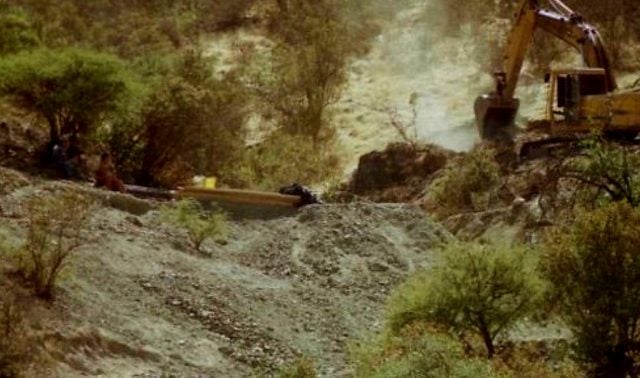
*Featured photo: Excavations at Cuestas Barriga (Memory Museum).
Relacionados

Prosecutors Seek Over 23 Years in Prison for Cathy Barriga in Fraud and Mismanagement Case
Hace 1 mes

CDE Seeks 37-Year Prison Sentence for Former Maipú Mayor Cathy Barriga Over Massive Fraud
Hace 2 semanas