Original article: La demolición de la sede de la UNRWA: De la protección humanitaria a la impunidad
By Vera Baboun, Ambassador of the State of Palestine in Chile
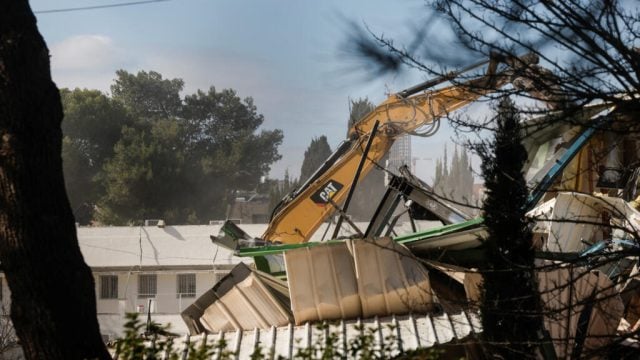
The events of January 20, 2026, in Sheikh Jarrah, East Jerusalem, transcended the mere demolition of the UNRWA headquarters, symbolizing a direct assault on international legality.
The arson attack five days later, on January 25, completed the destruction of a beacon of humanitarian protection that has been deemed inviolable since the post-1949 international order.
Established by UN General Assembly Resolution 302 (IV) on December 8, 1949, UNRWA is a pillar of that system, making the destruction of its headquarters a challenge to the legal foundations of international humanitarian action.
To grasp the severity of this incident, the data speaks louder than rhetoric. The Jerusalem complex was not just an ordinary administrative office; it was the critical operational center of UNRWA for the West Bank and East Jerusalem. Serving as the agency’s operational core in the city, it coordinated on-the-ground activities with its cross-border regional function.
As of 2025-2026, over 5.9 million Palestinian refugees are registered with UNRWA, primarily descendants of individuals displaced in 1948 and 1967, relying on its services across Gaza, the West Bank, Jordan, Lebanon, and Syria. Therefore, its destruction is a blow to a regional humanitarian system.
UNRWA’s mandate is implemented through 58 officially recognized Palestinian refugee camps, administered in cooperation with the agency throughout the region: 19 in the West Bank, 8 in Gaza, 12 in Lebanon, 10 in Jordan, and 9 in Syria.
In this context, the attack on UNRWA’s headquarters strikes at the administrative and coordination core of a humanitarian system that supports millions of refugees across various countries, demonstrating that the impact is not merely symbolic, but structural, regional, and profoundly destabilizing.
UNRWA is the only organization equipped to manage basic services in 27 refugee camps in the West Bank and Gaza. It operates over 700 schools, more than 140 primary health care centers, and extensive food and social assistance programs, making it one of the largest humanitarian operations in the world.
Additionally, UNRWA plays a central and irreplaceable role in the education of Palestinian refugee camps by running one of the largest school systems in the Middle East, offering free and inclusive primary and lower secondary education to hundreds of thousands of boys and girls.
In contexts of displacement, occupation, and recurring crises, its schools ensure continuity of learning and serve as protective spaces with psychosocial support. In practice, UNRWA does not supplement the educational system; it is the educational system itself and, for many, the only pathway to stability and a future.
A recent report from the University of Cambridge in collaboration with UNRWA describes a situation of «schoolicide,» the systematic destruction of a complete educational system, noting that 100% of children in Gaza have lost access to formal education.
In this context, the demolition of UNRWA’s headquarters in Jerusalem threatens to cement this precarious situation: the loss of central coordination leaves 813,000 students in the West Bank in extreme vulnerability, while in Gaza, where 87.7% of educational infrastructure has been damaged and over 20,000 students and 1,000 teachers have died, the population is left without the only technical body capable of leading real educational reconstruction.
The Ministry of Foreign Affairs of Palestine emphasizes that any measures taken by the occupying authorities have no legal effect on the status or activities of UNRWA in the Occupied Palestinian Territory, including East Jerusalem, which continues to be occupied territory under international law and United Nations resolutions.
When the Israeli occupying power disregards the diplomatic immunity of the UN and destroys its centers, it sends a clear message: international law is optional. Impunity has escalated to the deliberate destruction of UNRWA’s archives and headquarters in Jerusalem.
Vera Baboun
Relacionados
Gaza, Two Years of Israeli Genocide: 76,600 Dead or Missing as Hunger and Blockade Are Used as Weapons
Hace 4 meses
Health Catastrophe in Gaza: UNRWA Reports 'Record' Disease Levels Amid Health System Collapse
Hace 1 semana