Original article: Pese a prohibición legal, mineras y pesqueras industriales acapararon $6.700 millones en subsidios del Estado
Mining and Fishing Industries Received $6.7 Billion in Subsidies Despite Legal Ban
Design Copy without Title – 1
A report by Fundación Terram reveals that large mining and fishing companies have accessed state labor subsidies for nearly two decades, despite a legal prohibition. The investigation highlights a lack of oversight, discretionary criteria from the Treasury, and the use of public resources favoring large economic groups with environmental and legal backgrounds.
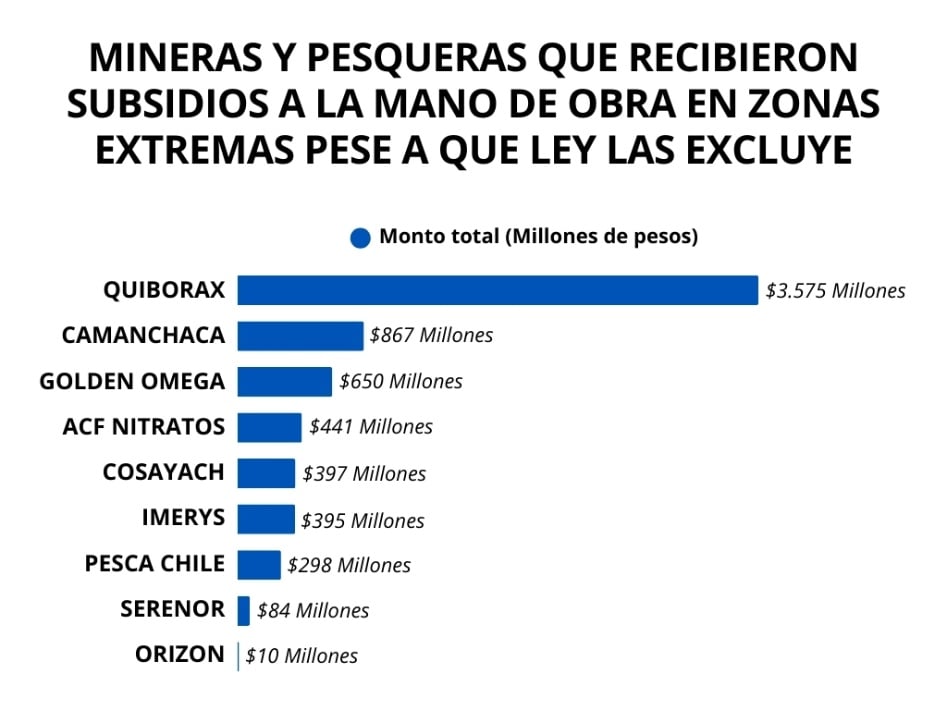
Between 2004 and 2023, at least $6.717 billion in labor subsidies were awarded to mining and fishing companies that did not meet the criteria set forth in Article 1 of Law N°19.853. This legislation explicitly excludes mining companies with more than 100 direct or indirect workers, as well as those engaged in reductive fishing.
This was unveiled in a new investigation conducted by Maximiliano Bazán, a member of Fundación Terram, which also reveals a pattern of insufficient institutional control and discretionary administrative criteria that allowed large companies to access fiscal resources originally designed to support economies in extreme areas. Despite requests made, the Treasury did not provide documentation to legally justify these exceptions.
Source: self-made based on data from the TGR obtained through Transparency Law
Mining Companies’ Noncompliance
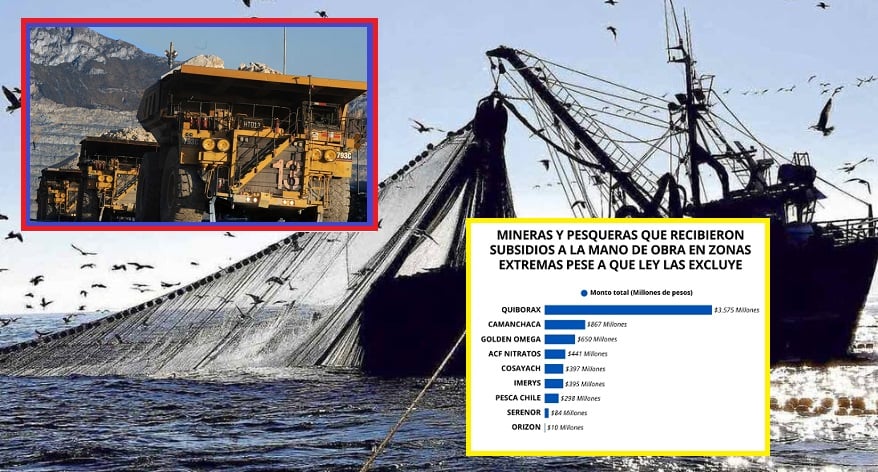
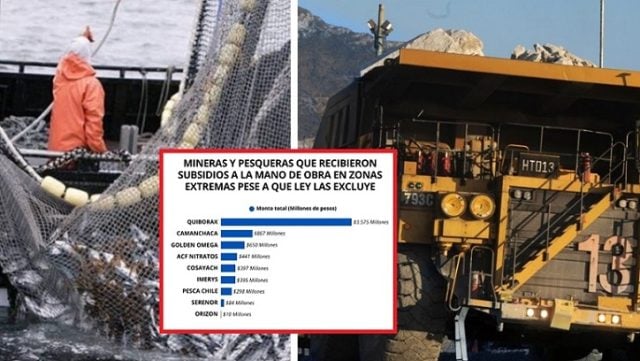
In the mining sector, the report identifies four major beneficiaries that collectively received over $4.8 billion in subsidies, despite significantly exceeding the legally permitted worker limit.
The most notable case is Quiborax, connected to the Fosk family, which received $3.575 billion between 2004 and 2023. The company consistently employs more than 100 workers and operates in the Salar de Surire and Ascotán. Despite facing a lawsuit from the State Defense Council for 37 years of irreparable environmental damage in Salar de Surire and a complaint from the National Forest Corporation (Conaf) to the Environmental Superintendent (SMA) for evading environmental assessment in a region declared as a Natural Monument, the Treasury justified its subsidy access citing its operation in “extreme zones with critical socioeconomic impact.” However, the exclusion from benefits is established by law and any modification requires Congress’ approval, which has not occurred to date.
Also included is ACF Nitrates, owned by the De Urruticoechea family, which received $441 million in subsidies even though its labor records exceed the permitted threshold in most of the analyzed years.
Another significant case is Cosayach, part of the Errázuriz group, which received $397 million. Although they reported few direct workers, oversight reports from Sernageomin in November 2022 indicated hundreds of subcontracted workers, thus disqualifying them from the benefit. Furthermore, the group has interests in lithium extraction projects in the north of the country.
Lastly, Imerys Minerales Chile received $395 million, even when it exceeded the worker limit in various periods. The Treasury claimed it was included because “its activity focuses on non-metallic minerals,” yet this distinction does not exist in the law and has not been supported by any legal modification.
Noncompliance by Reductive Fishing Companies
Reductive fishing refers to the extraction of fish processed to produce by-products like fish meal and oil, mainly from species such as sardines and anchovies, intended as feed for other industries, including salmon farming, which is significantly projected to grow in global aquaculture by 2032, according to estimates from the Food and Agriculture Organization (FAO).
However, the report also found that at least five companies engaged in reductive fishing received labor subsidies, even though this activity is expressly excluded from the legal benefit. In total, these companies obtained over $1.8 billion.
Among them, Camanchaca, which received over $860 million, stands out despite being one of the country’s leading producers of fish meal and oil. The company has been linked to illegal political financing during the legislative process of the Fishing Law, which established current industrial quotas.
Golden Omega, associated with the Angelini group, also received $650 million despite directly engaging in marine oil production. Additionally, Serenor and Orizon, companies from the same conglomerate, accessed subsidies although they are part of the industrial fishing chain.
The case of Pesca Chile is noteworthy, as the company received $298 million for krill extraction operations in Antarctic waters, a highly criticized activity due to its ecosystem impact. The company belongs to the Del Río family business group, which is also connected to illegal political financing cases. In 2025, it was reported for the death of a humpback whale during fishing operations.
When questioned about these cases in the context of the investigation, the Treasury stated that exclusion only applies to companies producing fish meal or oil for industrial purposes, claiming that these companies do not engage in such activities, which contradicts publicly available information from the beneficiary companies, according to the report. Furthermore, the agency did not provide any legal opinions supporting this interpretation.
Read the complete investigation here from Terram
Relacionados
Pese a prohibición legal, mineras y pesqueras industriales acapararon $6.700 millones en subsidios del Estado
Hace 1 minuto
Artisanal Fishermen Warn Kast: "We Reject an Industry Insider in the Undersecretariat of Fishing"
Hace 1 mes
Chile's Trade Volume Rises 8.3% from January to October 2025, Increasing Number of Exporting Companies
Hace 3 meses