Original article: Educación y neofascismo en Chile: Prognosis en torno al nuevo gobierno
By Fabian Cabaluz
History is not merely a record of the past; it extends into the future, intertwining with the present and our collective vision for humanity’s prospects.
Within this context, historians and social scientists have engaged in intense reflections concerning the challenges of the upcoming era, what can be termed the time of ‘not-yet’ or the time of the future.
Away from esoteric interpretations, historiography has developed the concept of ‘prognosis’ or historical prediction, which refers to the efforts to analyze and explain certain trajectories of historical development.
Certainly, some predictions may stem from collective hopes; however, historical prognosis relies on the analysis and recognition of historical trends, which should not be viewed as certainties or determinations. Historical progress is, by nature, uncertain, indeterminate, and contingent, thus inherently open.
In alignment with this understanding, prominent British historian Eric Hobsbawm emphasized the necessity for history, as well as the social and human sciences, to acknowledge trends to inform and shape future possibilities.
According to Hobsbawm, if the aim is to contribute to processes of social transformation, historiography must retain a focus on predicting certain historical-social trends. He stated: “Only history provides direction for those confronting the future; without it, one is not merely blind, but dangerous” 1. His words resonate today, as they bring forth the challenge of identifying trends that may help us forecast processes, outline scenarios, and recognize threats and dangers that arise within our society.
This article aims to highlight some clearly identifiable trends among both national and international neo-fascist right sectors concerning education and pedagogy. This intent, as previously mentioned, is distanced from any mystical or prophetic logic, focusing instead on projecting conflict scenarios and outlining resistance actions from social sectors that have fought for decades for public, community, and popular education.
Below, we will examine six notable trends exhibited by the neo-fascist right in education and pedagogy, which could potentially manifest and develop in the new government led by José Antonio Kast (JAK).
It is essential to understand that these trends should not be interpreted as isolated or parallel, but rather as intertwined. Furthermore, they should not be read hierarchically; they will be presented as a set of propensities that may be developed with varying intensity by the forthcoming government.
I. Privatization Trend. This is quite evident, as the administration led by JAK represents the contingent unity of the entire Chilean right, which in education aligns with promoting and defending market-based education, privatizing approaches, and a steadfast commitment to «educational freedom.»
The proposals advanced by the right are not drastically different from the existing framework; rather, they represent an intensification of privatizing trends and commodification, aiming to perpetuate and deepen the notorious public-private partnership.
In their governmental program, they defended educational freedom and proposed the fostering of new private educational establishments while advancing deregulation efforts regarding private initiatives 2.
The proposal for a «universal nursery» should be understood in this same context, which, consistent with their worldview, would involve creating private childcare facilities and continuing funding through the use of vouchers.
Along these lines, the incoming government has appointed María Paz Arzola as Minister of Education, who has spent much of her career at the Liberty and Development Foundation, a think tank that has been a staunch promoter and apologist for neoliberal education policies 3.
This pronounced trend allows us to assert, with a reasonable degree of certainty, that the education system will continue to receive greater doses of neoliberal policies.
II. Establishing a Neo-Fascist Political-Pedagogical Project. This neo-fascist political-pedagogical project views the educational and cultural spheres broadly, extending beyond schools and universities, as part of what the neo-fascist right designates as the “cultural battle” or the “war of ideas,” manifesting across various spaces: in media, social networks, virtual platforms, political and cultural institutions, curricula, and educational materials, among many others.
Over the past decade, the neo-fascist right has made it clear that in their quest for political, ideological, and cultural hegemony, they aim to reshape common knowledge and re-educate society through a reactionary, individualistic, patriarchal, and conservative lens.
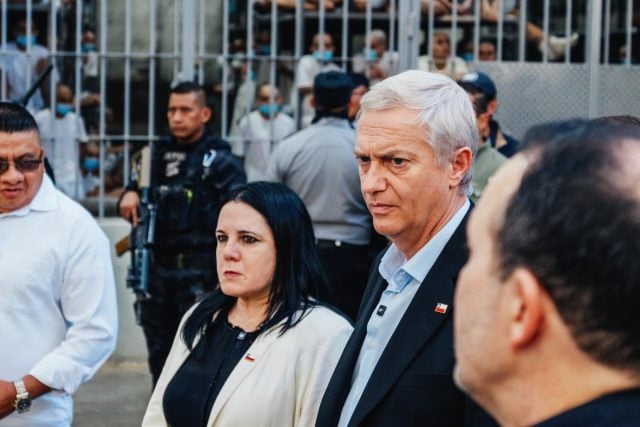
Additionally, it is important to highlight that this political-pedagogical project has been shaped by a form of “reactionary internationalism,” evident in JAK’s initial international visits shortly after his election. His tours included countries strategically aligned with his sector: Argentina, Peru, the Dominican Republic, El Salvador, Panama, Hungary, Italy, and of course, the USA.
This reminds us that neo-fascist right sectors are internationally coordinated and have established common agendas and courses of action in the educational realm (and, of course, in other areas such as security and migration).
The neo-fascist right possesses a global education agenda or a political-pedagogical project that has been agreed upon internationally. In this context, Chile will actively participate in the Conservative Political Action Conference (CPAC), where political parties, think tanks, social and religious leaders coordinate ideologically, collaborate, and establish operational networks 5.
Thus, it will be crucial to analyze in detail the methods, dynamics, and contents that they develop within their global networks.
III. Trend Towards Dismantling Policies. Another clear trend among neo-fascist governments in Latin America has been to dismantle state institutions and to suffocate funding for programs and projects deemed contrary or irrelevant to their interests.
This sector systematically denigrates and attacks public services and their officials. Remember JAK’s “anecdotal” photograph shortly after his election alongside Argentina’s Javier Milei wielding a chainsaw, projecting an aesthetic directly linked to fiscal cuts, the dismantling of state agencies, and public service layoffs, referring to public officials as “parasites” and “political appointees.”
In concrete terms, this trend toward dismantling policies has raised alarms about the future of the implementation of Law 21.040, which established the New Public Education, particularly regarding the transfer of municipal educational establishments to the Public Education Local Services (SLEP). Questions remain about their approach to advancements in comprehensive sexual education within the educational system, their plan concerning national policies for foreign students, the fate of the School Inclusion Law (20.845) that introduced non-discriminatory practices by eliminating selection processes, profit motives, and shared funding, and lastly, what will happen to the School Admission System (SAE) which guarantees non-discrimination access to education, or even the future of tuition-free higher education.
The inclination towards dismantling is evident, and the questions revolve around where the priorities of neo-fascist right forces will lie.
IV. Attacking “Ideological Indoctrination.” In his inaugural speech as president-elect, JAK stated that ideology is a problem and the enemy that must be confronted within the educational system.
The discourse against “ideological indoctrination” in education has been heavily weaponized against teachers and students who oppose market-based education, authoritarianism, and various exclusionary mechanisms present in educational systems.
Neo-fascist agendas have utilized this rhetoric to target trade union organizations, leftist perspectives, “cultural Marxism,” “gender ideology,” environmental activism, calls for truth, justice, reparations, and guarantees of non-recurrence regarding the civic-military dictatorship, among others.
Additionally, the anti-“ideological indoctrination” narrative has sought to install mechanisms of denunciation within communities themselves, creating distrust, straining democratic environments, and instilling fear among various educational actors. This trend promotes a depoliticized education, favoring an ostensibly neutral, objective, and aseptic learning experience, detached from politics and political discourse.
V. Authoritarian Trend. Directly linked to the previous trend, authoritarian logics are central to the neo-fascist project. A prime example is how they have simplisticly addressed the complex issue of “school violence,” repeating the rhetoric of order, discipline, and exemplary punishment.
This approach consistently overlooks factors related to inequality, poverty, exclusion, and marginalization, which are direct outcomes of Chile’s neoliberalism.
In this vein, they will likely continue to employ the Safe Classroom Law and perhaps promote other regulatory instruments to restore order and authority, thereby expanding the powers of school owners and/or administrators. There is a risk of advancing towards the creation of genuine “educational fiefs,” as noted by renowned researcher Jesús Redondo from the University of Chile 7.
Furthermore, it is evident that they will craft narratives against potential “adversaries” or “internal enemies,” who will be scapegoated for violence within schools (as they have shown a propensity for deploying hate campaigns). Students, teachers, and education workers become perceived threats.
Within this framework, the constitutional reform project presented to parliament by UDI senators intending to modify Article 19 N° 10 of the Constitution to declare early childhood, basic, and secondary education as an “essential service” is particularly concerning, as it would enable severe penalties against those orchestrating school strikes and occupations.
VI. Promoting a Nationalistic and Denialist Discourse. The neo-fascist right has repeatedly demonstrated a commitment to reinstating patriotic symbols, traditional rituals, and playful folkloric expressions of an oligarchic Chile. This could potentially advance alongside anti-immigrant, xenophobic, and overtly racist discourses.
The paradoxical nature of this nationalistic discourse is that it unfolds alongside entirely colonial practices concerning the U.S., reflecting a kind of subservient patriotism towards imperialism. It does not reclaim national or popular sovereignty but rather capitulates to American capital and imperialism.
JAK’s statements on the U.S. invasion of Venezuela and the capture of Nicolás Maduro and Celia Flores, which violate international law, are a clear example of this.
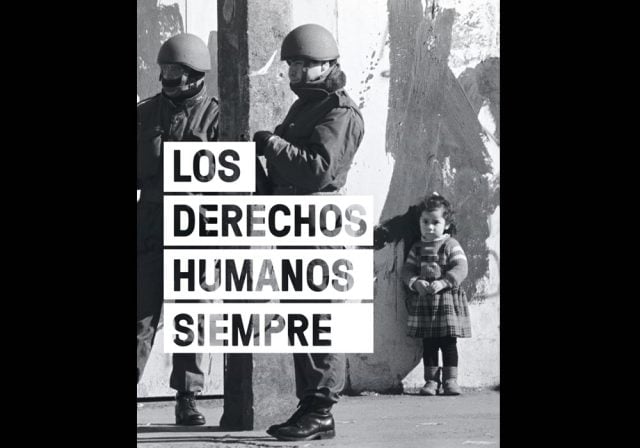
Simultaneously, this sector openly endorses a denialist discourse concerning human rights violations and the climate crisis exacerbated by capitalism.
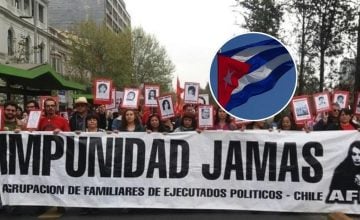
This denialism regarding human rights abuses manifests in numerous ways, including policies promoting impunity for those responsible for state terrorism during the military dictatorship; vandalizing and destroying memorial spaces (such as the recent incidents in the San Joaquín memorial honoring Ana González and the 78 victims of the dictatorship, as well as the José Domingo Cañas Memory House, the Santa Lucía ex-clinic, and the Providence Memory Site); and reviving apologetic symbols and narratives surrounding the civic-military dictatorship led by Augusto Pinochet.
Regarding nature protection and the climate crisis, the neo-fascist right has abetted discourses that deny or downplay the crisis, overlooking the need to transform the energy matrix while labeling legislation protecting our cultural and natural heritage, along with the diverse ecosystems in our territory, as “permissive.”
International evidence indicates the promotion of this denialism will find its way into school curricula, national educational content, and textbooks.
As noted at the beginning of this article, the exercise of prognosis navigates complex arenas of uncertainty, indeterminacy, and contingency.
The realization or crystallization of these trends into public policies will depend on various factors, all linked to the balance of forces that will manifest in this new political cycle.
It is crucial to remember that, in the face of fatalistic, defeatist, or triumphalist discourses, history remains open, and one of the engines driving it is class struggle.
Fabian Cabaluz
Notes
1 See Hobsbawm, Eric (1981). “With an Eye on Tomorrow: History and the Future.” In Hobsbawm, Eric (2012). On History. Editorial Crítica. Barcelona. Pg. 66.
2 For further details, see the chapter of the book titled “Neo-Fascism, Education, and Resistance in Chile, 1973-2024” by Leonora Reyes and Fabian Cabaluz: https://www.academia.edu/
3 Other education ministers from the same ideological background include Gerardo Varela, Marcela Cubillos, Joaquín Lavín, and Cristián Larroulet. This indicates a continuity thread between JAK’s administration and those of businessman and former president Sebastián Piñera.
4 For a deep dive into the concept, see Cinthia Wanschelbaum’s book, “The Political-Pedagogical Project of Neo-Fascism”: https://simehbucket.s3.amazonaws.com/
5 For more on the relationship between educational neo-fascism and the Conservative Political Action Conference, see the article by Javier Diez and Mauro Jarquín titled “Understanding the Cultural Pedagogical Battle of the Extreme Right to Contend for the Future of Democracy”: https://doi.org/10.35362/rie10017164
6 For a deeper exploration, refer to Fabian Cabaluz’s text titled “Education and Ideological Indoctrination. A Critical Reading of the Far Right’s Discourse”: https://biblioteca-repositorio.clacso.edu.ar/
7 It is recommended to listen to the radio program Alerta Educativa in its episode dedicated to analyzing José Antonio Kast’s educational program, aired on Sunday, January 4, 2026: https://radio.uchile.cl/programas/alerta-educativa/885026/
The Citizen
Relacionados
"Gross Regression in Historical Memory": Human Rights Figures Challenge Kast's Proposal on Human Rights Offenders
Hace 3 meses
Chilean Lawmakers Hear from CUT and CPC Representatives on Multi-Level Collective Bargaining Bill
Hace 2 meses