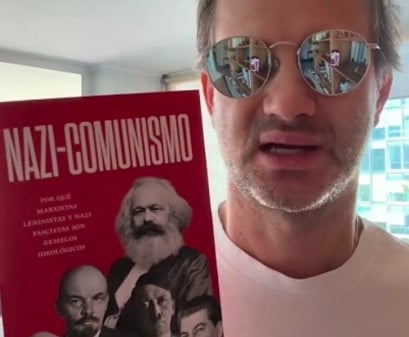
Original article: Gustavo Petro dio cátedra sobre historia de los nazis ante propaganda revisionista y negacionista de Axel Kaiser
Gustavo Petro Educates Axel Kaiser
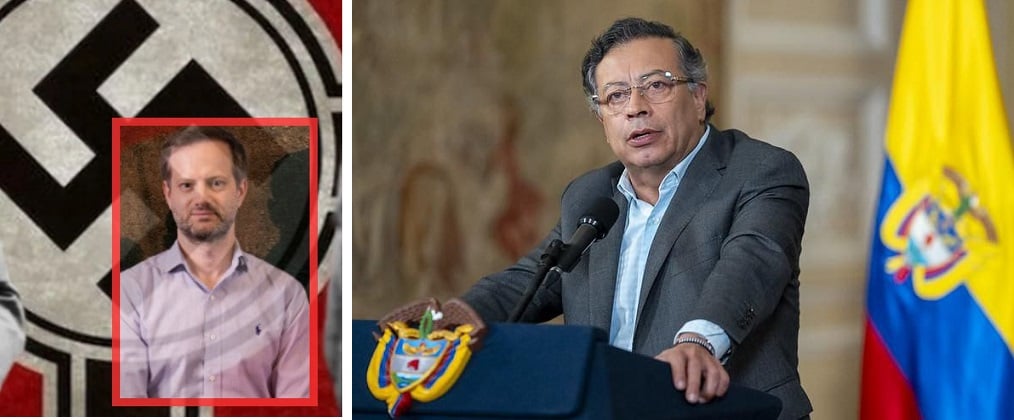
In a powerful exchange on social media platform X, Colombian President Gustavo Petro confronted and dismantled the historical distortion being promoted by far-right Chilean figure Axel Kaiser, who insists on the inaccurate equation that Nazism was a «socialist» or «communist» ideology. President Petro’s response was rooted in indisputable historical facts.
In one of his posts, Petro initiated his rebuttal with a compelling analogy, comparing the nominal strategy of the Nazi Party to that of contemporary political groups: «The Nazis labeled their party as socialist and workers’ to siphon votes and power from actual socialist and worker parties, pursuing entirely different ends.» This analysis targets the core of the deceit: the rhetorical appropriation of popular terms for diametrically opposed purposes.
In response to Kaiser’s attempts to justify his stance with isolated quotes from Hitler or Goebbels, President Petro posed a devastating question that exposes the fundamental historical incongruity: «If the Nazis were socialists, why did they kill all the German socialists?» This question highlights the fact that the initial victims of concentration camps like Dachau were indeed communist militants, social democrats, and trade unionists.
Petro’s position is not isolated but aligns with the global academic consensus. Historians like Michael Wildt have dismissed such theses as «nonsense,» emphasizing that «Hitler fiercely fought against Marxism from the start» and that the National Socialist Party «did not touch the principle of private property.» Nazism was financed and consolidated with the decisive support of German big capital, including conglomerates like Krupp, IG Farben, BMW, and Volkswagen.
This historical manipulation is not merely an innocent mistake but forms part of an international propaganda strategy. The Center for Extremism Research (C-REX) at the University of Oslo points out that distorting the origins of fascism is a recurrent tactic to whitewash far-right ideologies and criminalize any social justice project by falsely associating it with totalitarianism. Global figures like Javier Milei and Elon Musk have echoed this same erroneous narrative.
The debate transcends academia and has deep roots in Chilean history. As historian Felipe Portales documents, the Chilean right lauded Hitler’s «virility» against communism through newspapers like El Mercurio in 1933. Decades later, Chile became a refuge for Nazi criminals such as Walter Rauff, designer of mobile gas chambers, and Paul Schäfer of Colonia Dignidad, who collaborated closely with Pinochet’s dictatorship in the persecution of leftists. The ironic question from Petro and critical media resonates strongly: Were Rauff and Schäfer also «communists»?
By amplifying this false equation, Axel Kaiser absurdly seeks to rewrite history while poisoning the current political debate. His objective, as noted, is to polarize and stigmatize any progressive or leftist idea, equating it with Nazi horror. Essentially, this operation is a «Goebbelsian» communication strategy: the relentless repetition of a historical lie to drain meaning from the struggles for equality and protect the privileges of capital.
UNIVERSAL ARGUMENTS AND HISTORICAL CONTEXT:
The claim that Nazism was socialist is categorically refuted by historical evidence. The academic consensus is overwhelming: National Socialism was an extreme right-wing, racist, anti-Semitic, and anti-communist movement. Israeli historian Ishay Landa, in his book The Apprentice’s Sorcerer: Liberal Tradition and Fascism, explains: «The Nazis were strongly capitalist. They emphasized private property… intervened in the market to save the capitalist system from itself. This has nothing to do with socialist sentiment: it was pro-capitalist» (interview in Jacobin). Their economic interventionism was a response to crisis, not a socialist plan.
The first systematically persecuted after Hitler’s rise to power in 1933 were leftists. Michael Wildt, a specialist in National Socialism, emphasizes for DW: «The first victims who were incarcerated, tortured, and murdered in concentration camps in 1933 were leftists, communists, social democrats, and socialists.» The German Communist Party (KPD) and the Social Democratic Party (SPD) were banned, and their members massacred. In the «Night of the Long Knives» (1934), Hitler purged internal factions that could have socialist leanings, such as those of Gregor Strasser.
Funding and support for the Nazi regime came from the German industrial elite. David de Jong, in Nazi Billionaires: The Dark History of Germany’s Wealthiest Dynasties (The New York Times), documents how business dynasties like Quandt (BMW), Porsche (Volkswagen), and Flick benefited enormously and collaborated actively. Companies like Krupp and IG Farben used slave labor from concentration camps. This symbiosis between big capital and the regime is incompatible with any definition of socialism.
The «socialist» rhetoric of the NSDAP was an electoral bait. Historian Celestina Salomé Kunkeler explains that the party promoted a «racial community» (Volksgemeinschaft) that explicitly rejected class struggle, a cornerstone of socialist thought. As Landa summarizes: «The trick was to benefit from the popularity of socialism… while distancing themselves as much as possible from its essence.» This semantic manipulation is what, decades later, far-right sectors recycle to confuse and rewrite history to their advantage.