Original article: “Acción ilícita del Estado” en dictadura: fallo por torturas a dirigente mapuche ordena indemnización a su hija
Historic Ruling Orders State Compensation for Torture Victim’s Daughter in Pinochet’s Dictatorship
In a landmark and restorative ruling, the Twenty-Fifth Civil Court of Santiago has ordered the Chilean government to pay 20 million pesos (approximately $20,000) to G.J.Q.Q., the daughter of indigenous leader G.Q.Q., who was detained and tortured under the dictatorship of Augusto Pinochet following the coup d’état in September 1973, in the regions of Riachuelo and Osorno.
The ruling, issued by Judge Susana Rodríguez Muñoz, dismissed all defenses presented by the State and categorically established that the claimant suffered direct moral damage due to «the unlawful actions of the State directed against the direct victim.»
The court rejected claims of lack of active legitimacy, inadmissibility of the indemnity, satisfactory integral reparation, and statute of limitations raised by the government.
The tribunal stated that while the State has made «efforts to mitigate the damage caused» through legislation like the Valech Law, «these actions do not constitute a comprehensive indemnification for the damage.»
Judge Rodríguez based her decision on «the age of the claimant and her family context, the duration of her father’s detention, and the illegal duress and torture he suffered, as well as the aftermath they caused, particularly concerning the claimant’s mental health and effects on her family life.»
«It is evident that the claimant, as a result of the unlawful actions of the State against the direct victim, suffered significant trauma and has been deprived of the chance to have meaningful vital development in conditions that are objectively adequate, safe, and dignified,» the document states.
A Childhood Marked by the Terror of Torture
Central to the case is the sworn testimony of G.J.Q.Q., who is now 57 years old and was just six at the time of the coup against President Salvador Allende. Her account, included in the case file, starkly details the systematic persecution of her family within the Mapuche community of Catrihuala, located in Huellelhue, Osorno Province.
Her father, G.Q.Q., was an indigenous leader, a land defender, and a supporter of the Unidad Popular. He was first detained in Riachuelo on September 17, 1973, just six days after the coup.
«He was subjected to both physical and psychological torture at the Riachuelo police station, where, according to my father’s account, they intended to kill him,» she described.
Two days later, on September 19, military patrols raided their family home searching for weapons and «communist literature.» Both G.J.Q.Q. and her mother, as well as other family members, were subjected to interrogations and detained in various locations in the countryside. «My mother cried and pleaded,» she recalled.
The first release of her father merely revealed the scars of torture: «He came home with his back and body shattered,» she recounted, noting that her mother proceeded to clean his wounds.
She pointed out that the military turned their home into a military compound for over two months, from which they conducted raids in the area. The family was placed under house arrest, «as they could only leave out of necessity and were subjected to interrogations and searches.»
«The repression was so severe that some hard-to-reach areas were bombed,» she stated in her testimony.
The second detention of G.Q.Q. took place on October 3, 1973, which was yet another blow to the family.
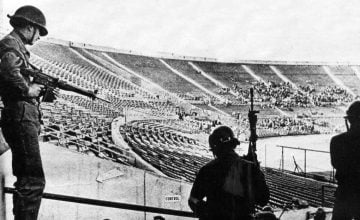
«I felt an indescribable sorrow then, because I did not know if I would see him alive again,» said the claimant. During this occasion, her father was subjected to «interrogation under torture» and sent to the Estadio Español de Osorno, where he spent two months.
The persecution continued in his absence: «Our home was continually raided by police and military, arriving at any hour, even late at night, subjecting everyone to interrogations and beatings for hours,» she reported.
The situation tore the family apart. Her brother, J.Q., was also detained and tortured in 1974, spending four years in prison before going into exile in Canada. The claimant’s mother had to make long and arduous trips to the Military Prosecutor’s Office and the Vicaría de la Solidaridad to seek news about her husband.
«This period is a sorrowful memory; given the remoteness of the area and the difficult access, we often spent days alone because my mother had to go to the military prosecutor’s office and the Vicaría de la Solidaridad, trying to secure my father’s freedom. My brother, J.Q., was also arrested and tortured, remaining in detention for four years from 1974, before heading into exile in Canada,» she explained.
The repression had economic repercussions as well. The authorities of the time, «loyal to the dictatorship, did not allow the sale of timber products» from Catrihuala, which «plunged the community and my family into deep poverty.»
Basis for the Ruling: Transgenerational Moral Damage
The court meticulously examined the evidence, including a psychological expert report, establishing that the events «have significantly impacted the relationship between the claimant and her father, especially during her childhood and adolescence, a bond and stage that could not develop under normal conditions suitable for her growth.»
The ruling notes that, according to the evidence, G.Q.Q. was deprived of liberty for a total of 1 month and 21 days, during which he was 54 years old and his daughter was just six.
«Consequently, for the reasons stated and considering especially the age of the claimant and her family context, the temporal extent of her father’s detention, and the unlawful duress and torture he suffered, as well as the sequelae resulting from them, particularly concerning the mental health of the claimant and the implications for her family life, the Court will prudently regulate the requested indemnity, in the amount of 20 million pesos (twenty million pesos),» ordered the Twenty-Fifth Civil Court of Santiago.
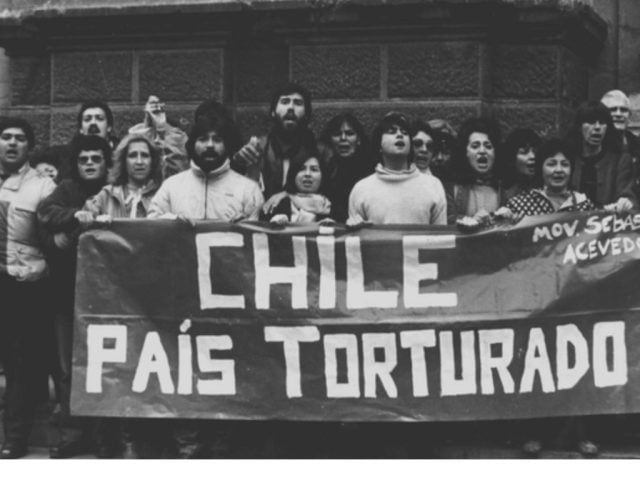
The 20 million pesos awarded as indemnification for moral damage represent, beyond the economic amount, a formal legal recognition of the transgenerational harm caused by political repression.
Relacionados
20-Year-Old Welder Tortured During Dictatorship to Receive $60 Million from Chilean State
Hace 4 semanas
Court Ruling in Santiago Orders Compensation for Torture Victim from 1983 Chilean Dictatorship
Hace 1 mes