Original article: Agrupaciones feministas de Honduras temen que Asfura elimine entidades de igualdad: «Se nos avecina un futuro muy tenebroso»
«We are entering a far-right government, with the threat of the disappearance of women’s institutions and other citizen participation and civil society entities,» declared one of the feminists participating in a massive mobilization in Honduras, just hours before the inauguration of Nasry Asfura.
On the eve of Nasry Asfura’s swearing-in, scheduled for this Tuesday, feminist organizations in Honduras expressed deep concern on Sunday regarding the possibility that the far-right government might dissolve or weaken state institutions established to protect women’s rights.
The mobilization, held in conjunction with International Women’s Day in Honduras, served as a platform to voice widespread fears perceived by activists as an imminent threat to the institutional advances in gender equality achieved during the outgoing administration of Xiomara Castro, the country’s first female president.
An Uncertain Future Under a Far-Right Government
Nubia Casco, a representative of the November 25 Platform, was firm in describing the outlook presented by the businessman’s administration, aligning with the policies of far-right former U.S. President Donald Trump.
«We are entering a far-right government, with the threat of the disappearance of women’s institutions and other citizen participation and civil society entities,» she stated during the protest.
Her voice reflected collective anxiety as she added, «For us, it is a fear (…) a very dark future is approaching us,» during her interview with TeleSUR.
This «dark future» mentioned by Casco has alarmingly statistical backgrounds. According to the latest data from the National Observatory of Violence (ONV) of the National Autonomous University of Honduras (UNAH), a total of 262 femicides were recorded in Honduras in 2024. These figures place Honduras among the countries with the highest rates of lethal violence against women in Latin America, a scourge that civil organizations fear will worsen if state mechanisms for prevention, care, and sanction are dismantled or restricted.
Skepticism and Demands Amid Fears of Mergers and Restructuring
The skepticism among rights defenders is not solely based on ideological perceptions; it is also fueled by concrete rumors about a potential state restructuring that may involve the merger or closure of key entities.
Honorina Rodríguez, one of the protest participants, provided insights on ongoing discussions: «We have spoken personally with influential individuals who have assured us that certain entities will not be eliminated, although there will be mergers and other changes. We still do not know what will happen, but we continue to demand,» she stated, as reported by EFE.
These fears are not unfounded and resonate with policies applied by other right-wing governments across Central America.
In El Salvador, for instance, President Nayib Bukele’s administration has banned the use of «inclusive language» in all public schools.
Meanwhile, in Panama, the government of José Raúl Mulino has projected the elimination of the Ministry of Women as part of a restructuring aimed at reducing public spending, a rationale that could potentially be mirrored in Honduras.
Struggle and Resistance
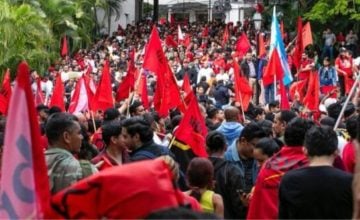
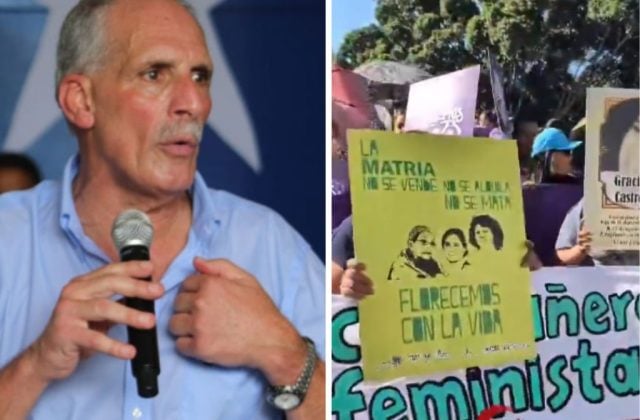
Sunday’s demonstration brought together thousands of women who marched through downtown Tegucigalpa chanting slogans such as «This day is not one of celebration but of struggle and resistance.»
Protesters carried signs bearing the faces of disappeared or murdered women, accompanied by drums and purple flares, the emblem of the global feminist movement.
With Nasry «Tito» Asfura’s inauguration scheduled for Tuesday, amidst allegations of electoral fraud and interference from Washington, uncertainty looms over the future of the National Women’s Institute (INAM) and similar agencies.
The activists’ statements on Sunday served as a public warning and a call to the international community regarding the risks they believe threaten the rights of over half of the Honduran population.
The pressing question is whether the new government will prioritize a fiscal restructuring that endangers entities dedicated to equality or, alternatively, ensure their continuity and fortification in a country where, according to UNAH figures, a woman is murdered approximately every 33 hours.
The concern expressed by activists like Nubia Casco encapsulates the sentiment of a sector that anxiously observes the closing of a political cycle that, despite its challenges, for the first time placed a woman at the forefront of the state, ushering in another cycle of uncertain predictions for the fundamental rights of Honduran women.
Relacionados
Rixi Moncada Urges Vigilance in Election Scrutiny Until All Ballots Are Counted in Honduras
Hace 3 meses
Honduran Electoral Advisor Claims 'Electoral Coup' After Presidential Announcement Without Full Vote Count
Hace 3 meses
Honduras in Crisis: New Report Documents Electoral Intervention and Warns of Democratic Erosion
Hace 3 meses