Original article: ¿Caja vacía? Cifras basadas en DIPRES muestran cerca de US$3.600 millones y entierran el discurso de Quiroz
It’s not just a figure. It primarily represents a narrative challenge.
In recent weeks, the government has consistently promoted the idea that there are no funds available, that fiscal margins are tight, and that decisions must be made under this premise. However, data derived from the latest report by the Budget Office (DIPRES) presents a different picture: the Other Assets of the Public Treasury (OATP), representing the state’s liquidity, amount to approximately $3.6 billion.
This is not merely a technical detail. It marks the point where the discussion shifts from accounting to politics.
DIPRES Fiscal Box: It Wasn’t Absence, It Was Interpretation
The concept of «box» has not been uniformly interpreted. For the government, it denotes restriction: resources that cannot be freely utilized without jeopardizing fiscal balances.
However, in strict terms, the box exists.
It’s neither symbolic nor marginal. It consists of billions of dollars in liquid or highly liquid assets that form part of the Treasury’s financial management. This is where the fundamental tension arises: it is not the same to say there are no resources as it is to say their use is limited.
The Heart of the Conflict: What Was Intended to Be Established
Finance Minister Jorge Quiroz has insisted that the current administration inherited a situation of fiscal tightness. This narrative has justified high political cost decisions, such as the fuel price hike, a 3% cut to ministries, and a series of adjustments presented as if there were no alternatives. However, with figures like these now on the table, the focus shifts. If there were resources in the box—even if temporary or subject to management—the problem changes from alleged non-existence to another: how the decision was made to use them, and to what extent fiscal tightness also served as an excuse for cuts.
DIPRES Fiscal Box: The Technical Aspect Is Also Political
From a technical standpoint, the OATP largely corresponds to seasonal cash surpluses, characteristic of the state’s income and expenditure cycle. They are not a free fund or an unconditional reserve.
Yet, they are not mere accounting fiction.
They are part of the real liquidity of the state. And on this point, language matters. Talking about «an empty box» is not the same as discussing restrictions on its use. This distinction is a simplification with concrete political effects.
What the DIPRES Data Actually Shows
The data that reignited the discussion, nearly $3.617 billion, is not presented in isolation. It falls within the category of “Other Assets of the Public Treasury”, specifically in its most recent subtotal.
The summary table of that liquidity is as follows:
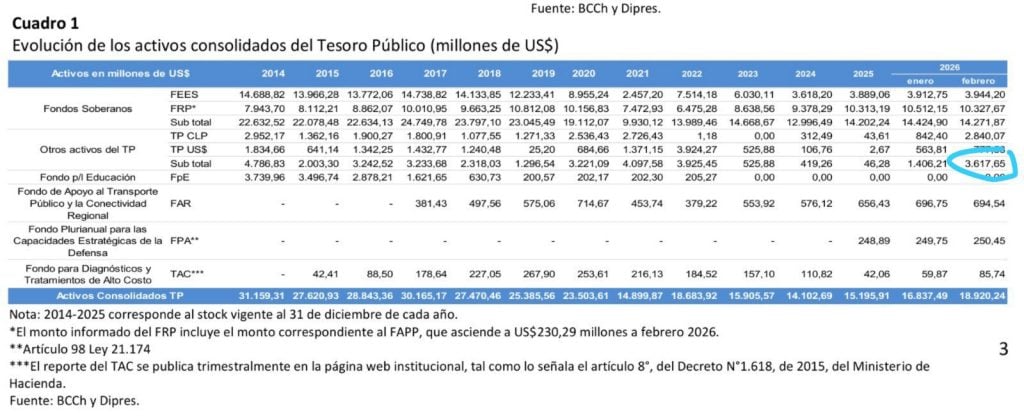
This item combines two types of resources:
–Assets in pesos (TP CLP): financial instruments in local currency, such as Central Bank securities or mutual funds.
–Assets in dollars (TP US$): resources in foreign currency that also contribute to the Treasury’s liquidity.
The sum of both constitutes what is known as OATP (Other Assets of the Public Treasury), that is, the effective box of the state.
This figure now sits at the center of the debate.
It’s Not All the State, But It’s Not Zero Either
The same table reveals that the state possesses other significantly larger assets, such as the Pension Reserve Fund (FRP) or the Economic and Social Stabilization Fund (FEES), which together exceed $14 billion.
However, those funds are not immediately available cash. They have usage rules, specific objectives, and are not accessible for immediate expenditure.
Therefore, the discussion focuses on the OATP: because they are the closest to liquidity.
The Critical Point: How the Figure Is Interpreted
The nearly $3.6 billion reflects a snapshot at a specific moment. This figure may fluctuate based on the state’s income and expenditure flow.
But its existence introduces a key nuance: an absent box is not the same as a conditioned box.
The data does not depict a state without resources. It illustrates a state with managed liquidity.
And in this difference, seemingly technical, lies a fundamental political dispute.
As a result, the impact quickly reached Congress. Lawmakers began to directly question the narrative of an «empty box,» leveraging the same data tied to DIPRES’s report.
The Kast government says the box is empty.
The official DIPRES report published TODAY states that the Boric government left a box of $3.617 billion at the end of February.
The data is public. The lie is, too. What does Minister Quiroz say now?
Source:… pic.twitter.com/6CuKSOqbvE— Daniella Cicardini (@Dani_Cicardini) March 31, 2026
Senator Daniela Cicardini pointed out the contradiction between the official narrative and the available figures, indicating that the public data shows a level of resources that does not align with the idea of total absence of funds.
In a similar vein, Congressman Daniel Manouchehri linked the discussion with recent government decisions, such as the increase in fuel prices, urging the finance minister to clarify the true state of public finances: “Minister Quiroz justified the fuel hike by saying there was no fiscal box. But the official DIPRES report today shows that the Public Treasury maintained assets of $3.6 billion. Chile deserves a serious explanation. What is the truth, Minister?”.
Minister Quiroz justified the fuel hike by saying there was no fiscal box.
But the official DIPRES report today shows that the Public Treasury maintained assets of $3.6 billion.
Chile deserves a serious explanation.What is the truth, Minister?
Source DIPRES:… pic.twitter.com/LwmfUTpY44
— Daniel Manouchehri (@danimanouchehri) March 31, 2026
More Than Just Numbers: The Cost of the Narrative
At this point, the issue is no longer just about how much money exists.
It’s about how the idea that none existed became established.
Because between a nonexistent box and a box with restrictions, there lies a key difference: the former closes the debate; the latter opens it.
Now, with the state’s own data on the table, that nuance has ceased to be purely technical.
It has become political.
Thus, the narrative of the “empty box” no longer operates as an unquestionable diagnosis but rather emerges as a way of interpreting and justifying decisions that are now viewed in a different light.
Artículos Relacionados

¿Caja vacía? Cifras basadas en DIPRES muestran cerca de US$3.600 millones y entierran el discurso de Quiroz
Hace 2 minutos
Kast Increases Salary Cap for Advisors to $9.9 Million: A Shift from Boric's $5.5 Million Limit
Hace 2 semanas