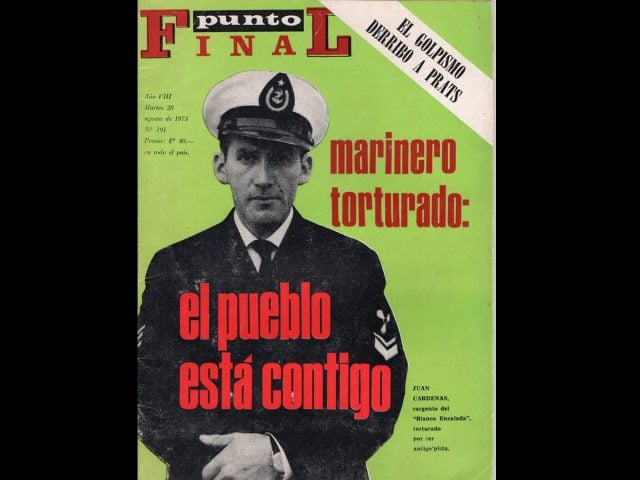
Original article: El sargento segundo Juan Cárdenas Villablanca
By Jorge Magasich, Historian
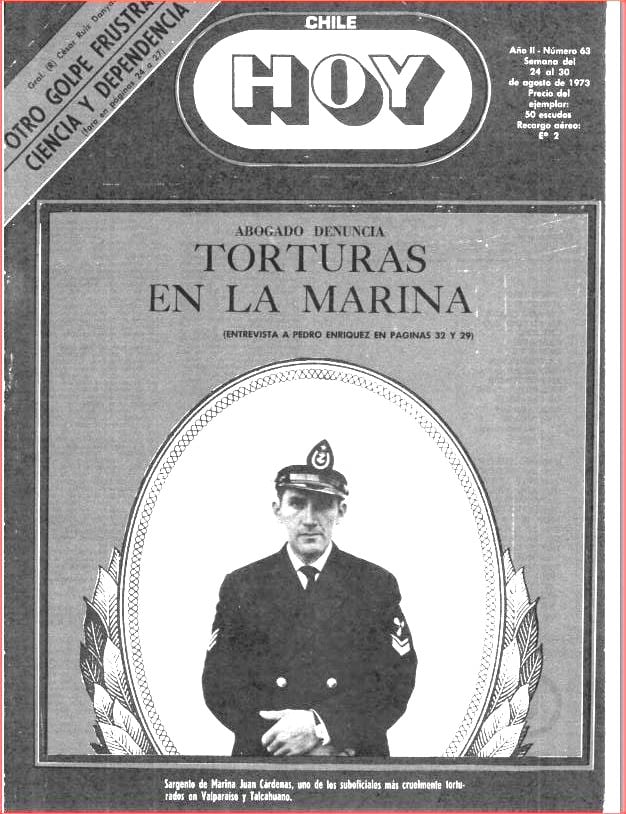
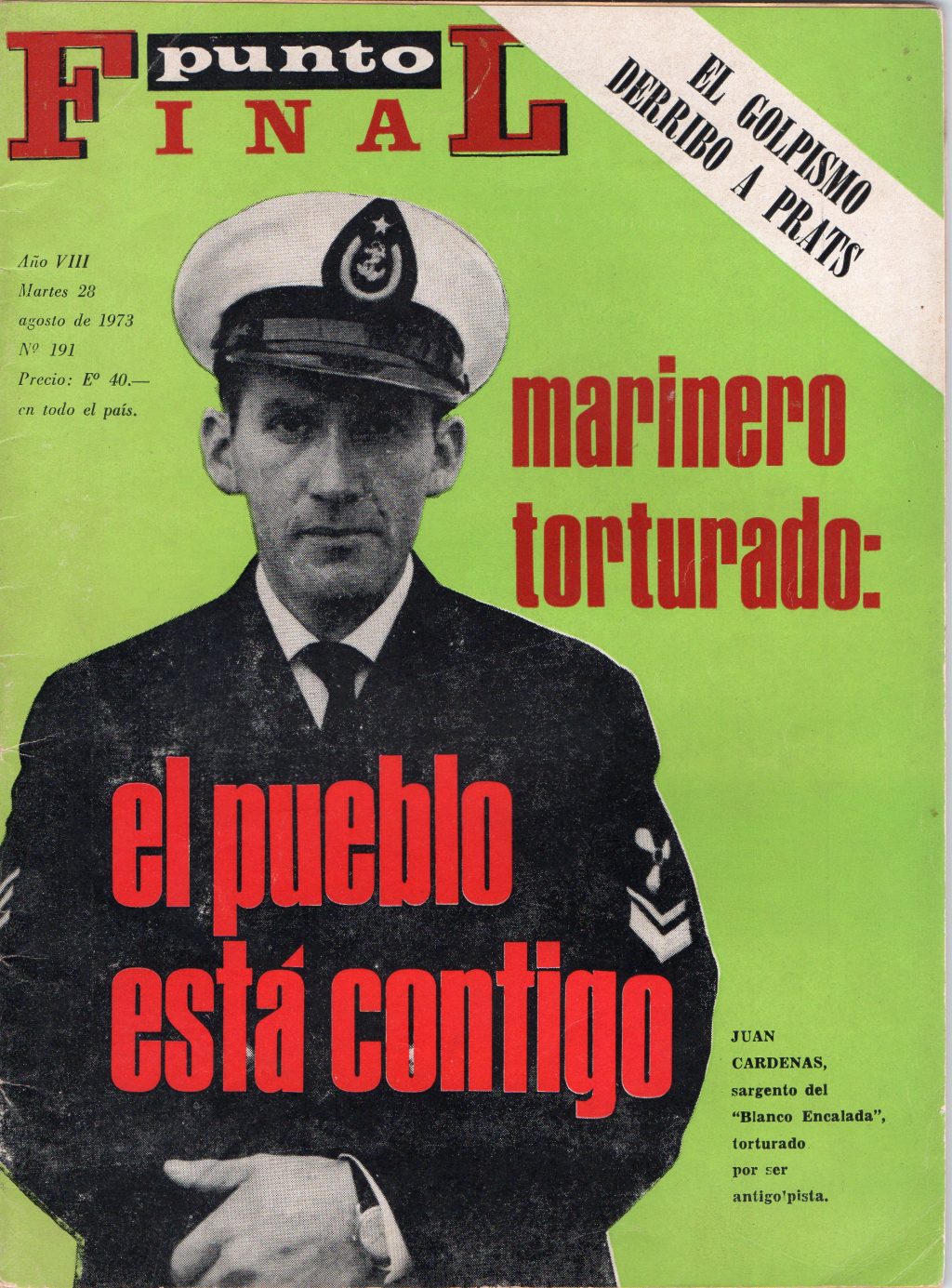
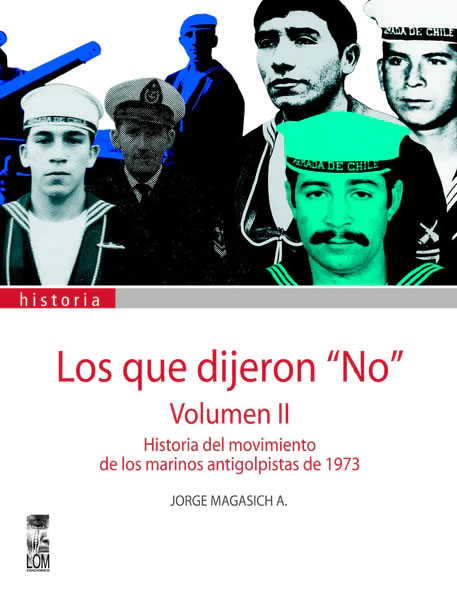
A few days ago, we bid farewell to Sergeant Juan Cárdenas Villablanca, a prominent leader of the anti-coup navy movement in 1973. In this tribute, I wish to honor his memory by recalling the significant interview he granted me in 2002, a pivotal moment for my research culminating in the book «Those Who Said ‘No’.»
At the outset of my work, it became clear that traditional sources, such as newspaper articles and memoirs, would be insufficient. I was studying a movement that primarily operated in secrecy, as organizing within the Navy to defend legal democracy is deemed a «subversive» act. Written records are scarce. I consulted legal proceedings containing the «testimonies» of interrogated individuals, but many were coerced under torture, making them unreliable.
Until 2000, the essence of this history resided in the memories of the anti-coup sailors. It was vital to obtain their testimonies to reconstruct the broader narrative of the movement.
How many interviews were necessary? In August 1973, around 250 sailors were detained, with 92 ultimately sentenced to prison. A statistics expert estimated that to achieve a credible, comprehensive perspective—mitigating the distortions inherent in human memory—it was necessary to interview one-third of the incarcerated sailors.
I began the interviews at an opportune time. The arrest of Pinochet in London (1998-2000) alleviated the fears of many anti-coup military personnel who had maintained a cautious silence. From then on, they dared to share their stories with a society eager to uncover its recent history.
It quickly became clear that the testimony of Sergeant Juan Cárdenas was more than essential. He was the highest-ranking sailor involved in the movement. At 37 years old in 1973, he was seen as «the elder» by the younger anti-coup sailors, who were in their 20s.
Would he agree to recount his story on tape? After being released from prison in 1978, Cárdenas lived in Sweden. In the early years, he participated in meetings with exiled anti-coup military personnel and granted some interviews. Later, he chose silence. Why would he give an interview to a stranger?
I managed to contact his son, also named Juan, who had recently earned a doctorate in physics and was teaching at a Swedish university. I sent an email explaining my project and seeking to connect with his father. Meanwhile, Oscar Carvajal, an exiled sailor in Sweden, sent me his address. I wrote to Juan Cárdenas, introducing myself, summarizing my research project, and emphasizing the significance of his testimony.
About a month later, my phone rang in Brussels, bringing one of the most delightful surprises I’ve had. «I am Juan Cárdenas,» he said, in a soft voice. He had received my letter detailing my project on his doctoral work. His son advised him to accept, deeming it serious. This meant that the leader of the anti-coup sailors was breaking his silence and agreeing to give me an extensive interview… We set a date.
I arrived in Stockholm on the afternoon of Friday, November 15, 2002. I was warmly welcomed by Regina, his wife, who also played a crucial role in this narrative. They lived in a two-story house that Juan Cárdenas had built himself as part of a self-construction plan with assistance from the municipality. I spent a productive weekend with them.
Returning to Brussels, I had five recorded cassettes, plus one additional surprise, which I’ll explain. The interview with Juan Cárdenas is the most extensive of the 55 published in the book «Testimonies of Anti-Coup Military Personnel.» It provides a detailed account of life in the Navy since his enlistment in 1953, sharing what he heard from his elder colleagues and recalling social conflicts often manifested as «bandejazos.»
He recounts the origins of the anti-coup navy movement, his contacts with Miguel Enríquez while studying medicine, describes meetings, debates, and initiatives, including gatherings at the Los Pingüinos bar in the port neighborhoods, the rising information about the impending coup, a detected coup plan for August 8 (which existed), meetings with Altamirano, Garretón, and Enríquez, leaders of the Socialist Party, MAPU, and MIR, his detention, torture, trial, exile, and a final assessment.
This interview, like all others, underwent historical scrutiny. I had doubts about one detail: Cárdenas claims he met with Defense Minister José Tohá in January or February 1973, relaying information about coup preparations in the Navy. However, it seemed improbable that a sergeant would have a private meeting with the minister. I opted to exclude this information until I could corroborate it with another source.
But the sergeant was indeed correct. The other source emerged when I reviewed his personal record attached to his trial:
«December 26, 1972. Demonstrated little loyalty to his commander by not informing all details regarding a request made with the Mr. DGPA» [General Director of Naval Personnel]. January 10, 1973. Due to his transfer to the CL Prat ordered by OT. DGPA. ORD N°1345/41 of November 23, he made requests to the Mr. DGPA. CTA and the Minister of Defense in order not to comply with the order. His request was denied by all authorities.»
This confirms the sergeant’s meeting with the Defense Minister. Cárdenas explains that he achieved this using his right to oppose, through proper channels, the decision to transfer him to the Prat cruiser before the stipulated time. First, he protested to the second-in-command, who responded negatively, then appealed to the commander, followed up to the personnel director, continuing up to the Commander-in-Chief (Admiral Montero) and ultimately reaching Minister of Defense José Tohá. In reality, the transfer was irrelevant to him; he wanted to report coup preparations.
The sergeant recounts his own arrest on the afternoon of Sunday, August 5, 1973, and his transfer to the Marine Infantry Regiment. I was able to compare it with the account of the commander of the destroyer Blanco, Captain Hernán Julio, one of the interviewed officers. The descriptions matched.
Now, let’s discuss the valuable «bonus.» After the interview, Sergeant Cárdenas told me, «I have something more that may interest you.» While in Valparaíso prison, he explained, Manuel Astica, the supply corporal who led the 1931 Fleet Rebellion, used to visit him, and they maintained correspondence.
In 1982, Astica sent him a cassette with the lecture he gave to commemorate the 50th anniversary of the publication of his novel Thimor, about a utopian society. He wrote it in prison after the 1931 rebellion (Astica was almost executed), and the novel was published in 1932 when the short-lived Socialist Republic granted amnesty to imprisoned sailors. In his lecture, Corporal Astica dedicates a few minutes to recalling his novel and, for over an hour, narrates the 1931 rebellion, presenting the sailors’ perspective who seized 27 ships.
I copied the cassette and transcribed it. Astica’s lecture is included as an annex in «Testimonies of Anti-Coup Military Personnel,» thanks to the «bonus» that Juan Cárdenas provided us. A true gem for history.
Today, it is evident that the feat of the sailors who risked everything to remain loyal to republican institutions in 1973 has not received the recognition it deserves. However, this is changing. French authors Désirée and Alain Frappier devoted their latest graphic novel to this heroic effort, with great historical accuracy and sublime illustrations that sometimes recreate scenes that lacked images. The album «Et que se taisent les vagues» has been available in France since late 2024 and has been well received. The title of the Chilean edition will be «The Fury of the Waves,» expected to be released in early 2026.
Sergeant Juan Cárdenas is now part of history. He will be remembered as the sailor who embodied the resolve of those who tried to prevent their homeland from being drenched in blood through a massacre and a dictatorship.
His name, along with those of his comrades, will stand beside his Russian counterpart, torpedo sailor Afanasy Matiushenko, leader of the 1905 Potemkin mutiny; the Black sailor João Cândido, who led the revolt against punishment in the Brazilian Navy in 1910, and who at 1964, while old, participated in the actions of sailors opposing the coup d’état; the German sailor Karl Arlet, who, aboard a torpedo boat, organized in 1918 the election of the first sailors’ council that initiated the German revolution; and the Portuguese sailor Joaquim Teixeira (whose interview is also featured in «Testimonies of Anti-Coup Military Personnel») who attempted to prevent Portugal from supporting Franco’s coup in 1936. In 2005, Joaquim Teixeira was awarded the highest honor conferred by the Portuguese government at the age of 89, the same age as Juan Cárdenas when he passed away. An example to be emulated…
References:
Testimonies of Anti-Coup Military Personnel. Sources for the History of the Republic. https://www.bibliotecanacional.gob.cl/publicaciones/vol-xlviii-testimonios-de-militares-antigolpistas
Those Who Said ‘No’. History of the Anti-Coup Navy Movement of 1973 https://lom.cl/products/los-que-dijeron-no-vol-1?srsltid=AfmBOoo4vUO2UkctTt3n8tNmANA2-dmGFWvOMWKdsIRLuwGPFOUUM87K
By Jorge Magasich, Historian
Column published in Le Monde Diplomatique
Continue reading:
El Ciudadano
Relacionados
Supreme Court Convicts Former Joint Command Agents for the Disappearance of Communist Leader in 1976
Hace 1 mes
Union Leader Tortured at National Stadium After Coup: Court Orders State to Pay $50 Million
Hace 2 meses
David Cid Aedo Sues El Mercurio: Claiming Editorial Practices Ruin Lives to Protect the Elite
Hace 16 horas
Historic Ruling Orders State Compensation for Torture Victim's Daughter in Pinochet's Dictatorship
Hace 2 meses