Original article: «Busca cubrir con un manto de impunidad a responsables de torturas y asesinatos»: Senador Saavedra condena proyecto que liberaría a genocidas de Pinochet
«What the right-wing parliamentarians intend to do is a project of impunity, detrimental and punishing to families who still lack truth and justice,» warned the legislator.
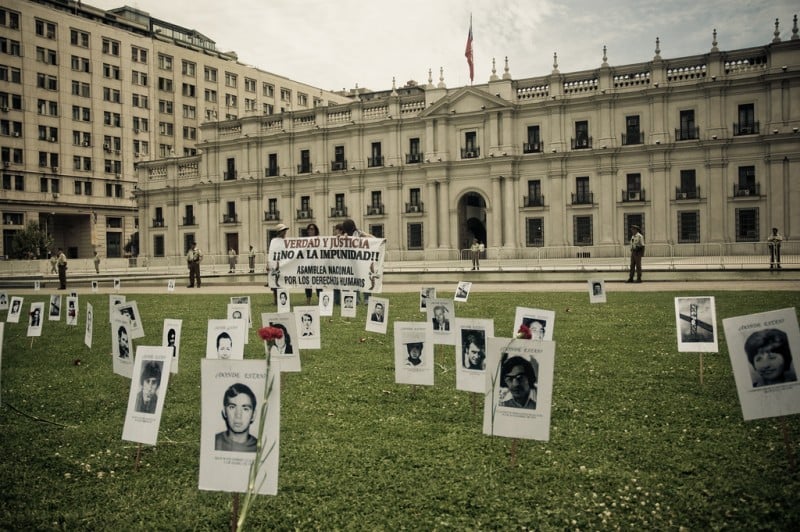
The Senate commenced discussions on Wednesday regarding a controversial bill that proposes an «alternative compliance of sentences» system for inmates with terminal illnesses or advanced age. This initiative, which would allow for house arrest for these individuals, includes potential beneficiaries who have been convicted of crimes against humanity committed during the dictatorship of Augusto Pinochet.
Although the debate was indefinitely postponed following a request from Senator Juan Ignacio Latorre (FA) for a second discussion, it highlighted the deep divide between the government and the opposition, providing a platform for Socialist Party (PS) Senator Gastón Saavedra to deliver a harsh critique, accusing the initiative’s proponents of attempting to «cloak those responsible for torture and killings in a shroud of impunity.>
The initial discussion lasted over two hours, starting with a report from the Chair of the Human Rights Commission, Senator Francisco Chahuán (RN). Chahuán, alongside Independent Senator Rojo Edwards, visited the Colina I prison to assess inmate conditions and defended the essence of the bill.
He argued that this initiative «does not seek impunity but the humanization of penal punishment,» aiming for «inmates with terminal illnesses to have a dignified death outside the penitentiary facility.»
However, Justice and Human Rights Minister Jaime Gajardo conveyed the government’s categorical rejection of President Gabriel Boric’s administration, referencing what he termed «technical flaws» in the bill and warning of its severe implications.
The minister pointed out that the initiative «presents an obvious tension and is contrary to the Rome Statute and the Inter-American Court of Human Rights.» He also cautioned that it could allow individuals guilty of crimes against humanity and serious sexual offenses to be released and complete their sentences at home.
To illustrate the magnitude of the situation, Gajardo provided statistics, indicating that among potential beneficiaries, 370 individuals are convicted of crimes against humanity, and 365 for common offenses. This latter group includes 192 for sexual abuse, 155 for rape, 27 for homicide, and 5 for parricide.
During the session, Senators Enrique Van Rysselberghe (UDI), Rojo Edwards (Ind.), and José Pilo Durana (UDI) expressed their support for the initiative. Conversely, Senators Fidel Espinoza (PS), Pedro Araya (PR), Fabiola Campillai (Ind.), Paulina Vodanovic (PS), Matías Walker (DC), Gastón Saavedra (PS), Daniel Núñez (PC), Esteban Velásquez (FRVS), Juan Ignacio Latorre (FA), Claudia Pascual (PC), Alfonso De Urresti (PS), and Yasna Provoste (DC) voiced their opposition.
Senator Saavedra Alerts to the «Project of Impunity»
In an interview with Radio and Diario Universidad de Chile, Senator Gastón Saavedra (PS) commented on the proposal pushed by Chile Vamos parliamentarians, establishing a moral and historical distance from its sponsors.
«I have a significant difference regarding the sponsors and a historical difference in the value of justice, the value of truth, and of reparation,» Saavedra asserted.
According to the senator, the project «seeks to deny all that has been done and cloak those responsible for torture and killings in a veil of impunity, while simultaneously condemning many families in the country to a relentless search for their loved ones, hiding the truth to this day.»
«What the right-wing parliamentarians intend to do is a project of impunity, detrimental and punitive to families who still lack truth and justice,» he emphasized.
Saavedra also criticized the mix of beneficiaries included in the proposal. «The project contains a ‘strange and curious’ amalgamation, as it would not only allow house arrest for those convicted of crimes against humanity but also for individuals responsible for common crimes like homicide and rape,» he argued.
«This project would facilitate a pardon for murderers and, on the other hand, for those who have committed acts of rape and harmed children and others,» he accused in statements to the cited medium.
Concern Over Future Minister Rabat and Kast’s «Denialism»
The debate could not be separated from the political context, following the recent appointment of lawyer Fernando Rabat – who defended the dictator Augusto Pinochet – as the future Minister of Justice and Human Rights under elected President José Antonio Kast.
In response to this announcement, Senator Saavedra expressed deep concern, deeming that the direction taken by the ministry “will be aligned with those who committed crimes against humanity.”
«There will not be a ministry that holds a balanced stance and allows the country to genuinely progress towards reconciliation. I believe the distances will deepen, the divide will widen with those of us who believe in justice, truth, and a path of reparation toward the reconciliation of Chileans. (Reparation) will not occur with a minister who has those credentials,» he opined.
For the senator, Rabat’s appointment reflects the essence of Kast’s denialist thinking.
«There is a coherence. Denialism is a central element of his political identity. For Kast, there was no dictatorship under Pinochet, no violation of human rights occurred, and this is reflected in the appointment,» he argued in an interview with Radio and Diario U. de Chile.
Saavedra expressed that the elected president’s decision is “clearly a political gesture,” but emphasized that it is, above all, a gesture aimed at “that group of Chileans, the military families, pinochetism, which is a faithful reflection of Kast’s political identity.”
The bill promoted by right-wing senators opens historical wounds that remain unhealed; while the authors insist on humanitarian principles, victims see an ethical contradiction in granting benefits to those who denied fundamental rights. The central question remains: Can human rights violators invoke those same rights to escape their sentences?
Relacionados
Impunity: Court Acquits Former Carabinero Claudio Crespo for Illegitimate Coercion Against Gustavo Gatica
Hace 2 meses
Families of Disappeared Prisoners Reaffirm Commitment to Human Rights Culture: "We Will Not Allow Impunity"
Hace 3 meses