Original article: Revolución Social
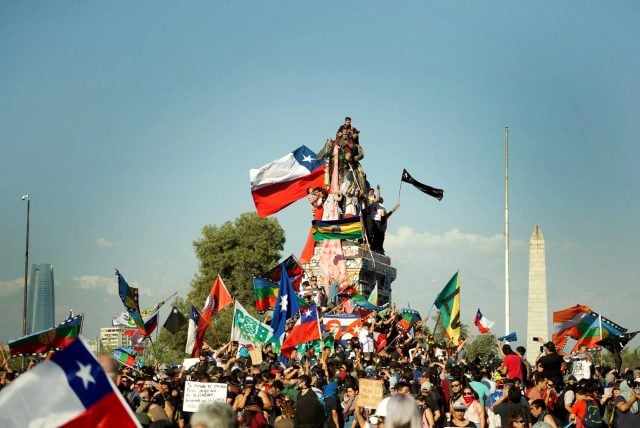
For the first time in a century, the most recent and massive emergence in the political sphere of the working people of Chile, initiated by the explosion of October 18, 2019, and still ongoing, appears to be without a revolutionary political force; that is, an organization whose essential purpose is to lead it precisely under these circumstances and that always subordinates all its actions to this goal.
By Manuel Riesco
This absence primarily stems from the participation of center-left parties in the democratic governments that followed the dictatorship, all of which postponed the necessary reforms to address its abusive legacy, generating the current national political crisis; that is, the loss of legitimacy and thus authority of the entire political system. These parties include all those who led, through various alliances and with universally recognized talent, the major popular upheavals of the 20th century, as well as the newly formed party by the brilliant generation of student leaders who spearheaded the mobilizations of 2011.
These governments undoubtedly accomplished many works for the benefit of the people and the progress of the country, but they never even attempted to end the significant abuses imposed after September 11, 1973. Instead, they all explicitly sought agreements with the major abusers. This is the main cause of the popular uprising known as 18-O, proclaimed in its brilliant slogan “It’s not 30 pesos, it’s 30 years.”
As evidenced in the historical and theoretical research published in the book Social Revolution in Chile and the Revolutionary Party of the Working People, written by Luis Corvalán Marquez and the undersigned, which summarizes the homonymous conference cycle developed by CENDA throughout 2024, it inevitably led to the delegitimization of the democratic system itself, dragging those parties with it and hindering, until now, their ability to bring a progressive solution to the current political crisis.
The path that the Chilean democratic political system —loyal to its long-standing tradition of flexibility— opened after 18-O, with the constitutional agreement of November 15, 2019, known as 15-N, also frustrated, primarily due to the parallel option of President Boric’s government to continue along the path of its predecessors and once again postpone the necessary reforms to eliminate major abuses, instead seeking agreements with the primary abusers.
This strategy, glorified as the «politics of agreements,» which may have been suitable in the initial decade of restored democracy, characterized as a phase of «calm before the storm» in the cycle of popular political activity (Harnecker 1985), ultimately became the main cause of 18-O and the failure of 15-N.
The insistence on this strategy by President Boric’s government, during a fully unleashed phase of popular political activity, intensified the delegitimization of democratic political authority. It dragged the new government and the Constitutional Convention into a situation that has spread to varying degrees to all institutions of the State. This now makes life unbearable and keeps citizens in a state of agitation across all areas of life in the country.
In the 2025 presidential primaries, the working people of Chile unexpectedly and surprisingly burst back onto the political scene, as always happens. Without asking anyone for permission, they opened a unprecedented democratic channel to address the ongoing national political crisis. By simply voting, they placed their trust in a woman they recognized as one of their own, thereby granting her the authority needed to lead all Chilean democratic and progressive forces and finally carry out the long-postponed reforms necessary to resolve the issues stemming from September 11, 1973.
But history did not unfold in that direction. The formidable coalition of democratic, progressive, and revolutionary political forces in Chile suffered one of the greatest defeats in its long and honorable history, justly recognized and admired worldwide. This defeat is all the more painful as it was inflicted by their own people.
This event brings to mind September 11, 1973, the greatest popular defeat in Chile’s history, whose experiences and ultimate, triumphant recovery in the wake of the renewed eruption of the people into politics have forever tempered its protagonists. To face this and other defeats, followed by new resistances and victories, sustained always through political activity of the people, which they will undoubtedly experience and savor in the future. To continue leading or pushing from outside the government, the ongoing progress of society and the country, as they have been doing for a century. This is inevitable, simply because that is the way of life for people and nations.
November 16, 2025, a date that will likely be dubbed 16-N, along with September 22 for the constitutional plebiscite, will be remembered as great defeats; on both occasions, the people of Chile came to the polls to express with their vote, in a massive and unquestionable way, their rejection of these political forces. It was yet another of the thirty national elections held in the past five years, pandemic notwithstanding, with the same outcome; the rejection.
All were conducted with notable collective excitement, order, calmness, and civility; the same civic qualities that enabled the people to defeat the pandemic. Both organized impeccably by the respective public services, electoral and health, managing to maintain and even enhance their remarkable legitimacy amid a national political crisis.
It is the same people who, less kindly, burst massively onto the political scene on 18-O; in the metro, on the streets, squares, and everywhere across the territory; to express their rejection to the political system for allowing the continuation of what this coalition and another right-leaning coalition with no significantly different programs had been doing for thirty years; since the people entrusted them with the administration of the State, reorganized once again as a democracy, as has traditionally been the case in Chile after independence.
Democracy was reacquired through the earlier mass political emergence of this same people, the Popular Rebellion, brilliantly led both clandestinely and openly by this same formidable political coalition, after nearly two decades of heroic resistance first, and then a massive open popular offensive, deployed on all fronts, employing all forms of struggle, well learned, practiced, and certainly not forgotten.
Like what occurred since September 11, 1973, the experience of this new collective blow suffered by this coalition must tighten the strong ties among its members even more. To thus strengthen, further still, the resilient fabric of shared experiences, both good and bad, that has made this coalition a political force that its own adversaries recognize as formidable.
Furthermore, as happened then, it is up to these political forces to deeply analyze the causes of their defeat and correct what falls under their own responsibility, but without allowing it to alter in any way, but rather, reinforcing the solidity of their structure. This is made easier by the fact that this analysis is already largely shared not only among the political forces comprising this coalition. As recently stated in an international media interview by the president of one of the parties that just won the election, «If the right cannot meet the demands of Chileans, we will enter unknown territory in terms of frustration,» he said. «What is at stake over the next four years is the people’s faith in our political system.»
These demands certainly do not boil down to a list of minor claims but require ending the major abuses that originated on September 11, 1973. The same abuses that the “30 years” governments did not even attempt to rectify, nor did the one that followed them, which is now finishing its term. Although they did undoubtedly accomplish many things for the benefit of the people and the country, none dared to confront the major abusers and put an end to the most significant injustices. On the contrary, all of these governments explicitly sought to come to terms with the major abusers, and as expected, ended up governing primarily for them.
Much less will the incoming government after this defeat. From the outset, just as was the case in the infamous second constitutional process, its leader will not recognize that the people did not vote for him but against the political system. Moreover, he will not even touch the major abusers with a rose’s petal but will openly and shamelessly govern for them, as they are the patrons who have backed him and to whom he faithfully serves for a salary.
In a cowardly and scoundrelly way, they will instead seek to divert the rightful anger of the people against the major abusers and the political system at large, towards immigrants, a very respectable and necessary minority group that for the first time in history constitutes a significant part of the working people of Chile. This new despicable abuse against a weaker, differently-nationalized brother part of the Chilean working people must be prevented at all costs.
All the above is exacerbated by the ongoing international geopolitical earthquake. The principal global power has found itself forced to retreat after recognizing the new reality in the global balance of forces, arising from the gradual yet inevitable advance of the emerging world, whose main actors have now achieved power comparable to the powers that have hegemonized the entire world for three centuries, simply because they accessed the modern mode of production earlier.
The principal power in strategic retreat aims to confront its new rivals more effectively by asserting its hegemony over the «Western Hemisphere,» which includes Latin America, for which they have resolved to implement their old doctrine of «America for the Americans,» officially renamed as «Monroe-Trump.» They have declared that they intend to secure that hegemony through direct interventions, such as the ones currently directed against Venezuela, and also through local lackeys like the newly elected president of Chile.
The recently defeated formidable democratic and progressive coalition must swiftly adopt this new strategic situation and seek to defend, above all, the national sovereignty so severely threatened, establishing strong alliances in the region and in the emerging world essential to facing the risks that this shift of the principal power represents for Chile’s national security.
To regain the people’s trust, the formidable Chilean democratic and progressive coalition must also fully assume what President Arturo Alessandri Palma eloquently demanded a century ago and to which nobody listened much at the time: “There is no exception to the law of history that leads peoples to catastrophe when they postpone necessary reforms.”
To do so, they must overcome the political cretinism that has afflicted them for decades and reclaim their revolutionary status that allowed them to lead the great mass eruptions of the working people into politics throughout the 20th century. They must never forget that the necessity for such a revolutionary workers’ party today is based on the evident fact that, periodically, social revolutions do occur.
The Social Revolution
The referenced book is an effort to assist in that political process, summarizing and reaffirming the full relevance of these core concepts of political science and illustrating them with the major eruptions of the working people of Chile in that sphere.
Social revolutions occur. They are the means by which the working people earn respect from “the great ones” (Machiavelli 1513). They constitute the culminating expression of the essential basis of political activity in human societies. They are “the directly propelling force of history” (Harnecker 1985), as they allow for resolving ongoing struggles between the factions of “the upper-class” (Harnecker 1985), in favor of those willing to undertake necessary reforms for the continuous progress of each society at the moment they occur.
Social revolutions take place. They are the culmination of cycles of political activity among the people, which periodically succeed one another in all societies and throughout all times in history. These great currents of popular political activity never follow a smooth and straight trajectory but advance through the undulations of constant flows and ebbs, progress and setbacks, victories and defeats.
The cycles that occur during the transition periods of one historical era to the next, in each specific society, form their “era of revolutions”; which not only includes glorious victories but also tragic defeats and periods of reaction and restoration, which sooner or later are swept away by new revolutions; distinguishing them from cycles and respective revolutions that take place throughout each historical epoch. Among the revolutions that culminate the cycles occurring during eras of revolutions, there is one that the peoples who conduct them and emerge transformed from them distinguish as the mother that bore them; they call it their Revolution and write it with a capital letter; although they usually take their time doing so.
Although the cycles of popular political activity are unique to each social formation, they also present some synchronicity to the extent that global phenomena affect them all. While each cycle of popular political activity may last several decades, the eras of revolutions in each specific society extend for half a century or more. These eras do not occur simultaneously in all countries and regions, but in some first and in others later, so the transition from one epoch and mode of production to the next in history always extends over several centuries.
The aforementioned text makes these and other observations regarding social revolution, after the heavy course of history imposed—at the end of the 20th century and also through mass eruptions of the working people in the political space—on the Bolshevik attempt to leap over a complete era and mode of production; thus reaffirming the classic assertion that no epoch gives way to the next in history until it has given all it can offer, to humanity as a whole across the planet.
The transition from old agrarian feudalism to urban, mercantile, and bourgeois modernity is a process that is still only halfway through, with its capricious trajectory around the planet over three centuries illuminated by the flashes of the great Modern Revolutions. When that process is complete and this epoch has given all it can, it will undoubtedly yield to a new society where antagonistic classes are abolished, along with the exploitation of man by man and the prehistory of humanity. This will undoubtedly be driven by the last of the class revolutionary eras, led by revolutionary workers’ parties.
The Revolutionary Party of the Working People of Chile
Revolutions do happen, but they are not natural or mechanical phenomena. On the contrary, they are the highest manifestation of the collective action of millions of human beings and give rise to political forces that consciously lead them.
The occurrence of revolutions, as well as their character and the course of the cycle of popular political activity, certainly encompass the collective moods, yet they are objective phenomena in the sense that they are determined by forces beyond the capacity of control by individuals or groups. Nevertheless, social revolutions also engender revolutionary political forces, whose conscious actions can slightly influence their trajectory and may eventually determine their outcome; this constitutes their subjective factor (Harnecker 1985).
Whatever its form, among the many and varied that it assumes and the ideas that inspire it, such a political force plays the role of the small rudder on a heavy transatlantic ship that, when held correctly and firmly, can slightly influence and gradually modify its trajectory. But this may be sufficient to avoid tragic collisions and safely guide it into port.
The revolutionary party of the working people of Chile, that is to say, the political force that has led its successive mass eruptions in this space, has never been a single political party, nor a guerrilla group, a religious institution or a caudillo. The revolutionary party of the working people of Chile has always been a broad coalition of progressive and revolutionary political parties, representing different social sectors and inspiring themselves with very diverse political ideologies and worldviews.
All of these parties have regularly participated in the political system at its various levels, taking advantage of the exceptionally democratic nature of the State, a long-standing feature in Chile, likely rooted in the secular absence of large feudal lords in this meager and rugged territory.
However, during the successive national political crises, meaning, in the major revolutionary situations of the 20th century, these broad coalitions of political parties have managed to be hegemonized by revolutionary leaderships of the working people, who have taken ownership of their minimal program and have pushed it forward in every situation with the heroic determination that seals the universal legacy of President Salvador Allende.
In normal times, however, spanning more than a century in some cases, all these parties have actively participated in the Chilean democratic system. The main ones were also part, at various times, of progressive governments that led the country in different periods. These governments were little or not at all revolutionary, nor should they have been, since they assumed during phases of low or non-existent massive popular presence in politics, as occurs throughout much of the cycle of popular political participation.
In other words, these are democratic progressive political parties, generally defined as social democratic, and in the case of Chile, Christian democratic. Similar to those that have led the main modern states for most of their existence in the countries that pioneered this historical epoch.
With a significant exception throughout the 20th century: the Communist Party of Chile (PC). This party, over a century old, is genuinely popular in its roots. Founded in 1912, initially as the Socialist Workers’ Party, it changed its name to Communist Party in 1920, founded by a grassroots man, Luis Emilio Recabarren (1876-1924). The PC has always assumed a maximum program that is explicitly anti-capitalist and has undoubtedly been a professional revolutionary party of the working people, in the sense defined above.
The PC has actively participated in the Chilean democratic political system since its inception in 1912. It has usually achieved respectable parliamentary representation and occasionally significant, directing many local governments and participating regularly in almost all of them. All this despite having been subject to various persecutions, including over three decades of illegality and clandestinity, one in the mid-20th century and two after the 1973 coup. This was followed by two decades of exclusion from the democratic system after the dictatorship, to which no party contributed more than the PC.
However, throughout the 20th century, it participated in government significantly only once: during the government of the Popular Unity (UP), led by President Allende, which conducted the Chilean Revolution.
As has been recalled these days, in the context of the global antifascist struggle during World War II, the PC also decisively contributed to the formation of the Popular Front in Chile. It also had a minor role in the three governments of that coalition, from the late 1930s until the end of World War II and the beginning of the Cold War. Under pressure from the United States, the PC was outlawed for more than a decade by one of the presidents it had significantly helped choose.
In contrast, in the 21st century, the PC has participated significantly in two post-dictatorship governments. Its president, Guillermo Teillier, highlighted that the first of these was the only government in which the PC participated until its legal conclusion, even though that coalition was replaced then by a center-right government. In the current government, the PC has had its most significant presence since President Allende’s government and will certainly complete the presidential term once more.
All the forces that formed the revolutionary party of the working people during the 20th century have fully participated in the “30 years” governments, including the PC, which has played a predominant role in the current governing coalition.
Undoubtedly, the two governments in which the PC has participated during this period have accomplished many positive things in the interest of the people; however, certainly, neither of these has declared or acted as a revolutionary leadership. As the government of President Salvador Allende did. Despite having been elected in both cases and functioning amid a phase of prominent popular participation in politics; both assumed amidst a national political crisis.
The new parties formed by the student mobilizations of the second decade of this century, now grouped in the Frente Amplio, which in 2021 succeeded in having one of its main leaders, the young former student leader Gabriel Boric, elected President of the Republic, committed the strategic blunder of attempting to govern like in the 1990s at a time when the country is undergoing a deep national political crisis.
President Boric is a young, educated, and reflective politician who has recently justified that decision by arguing that, in the parliamentary elections of November 2021, held simultaneously with the first presidential round in which he advanced to the second round in second place after the far-right candidate who is now the elected president, the right and far-right political forces secured half of the Chamber of Deputies and a slight majority in the Senate (Boric 2025).
That is true; however, that reasoning overlooks the most important factor, which is the phase of the cycle of popular political activity in which he is meant to take over. In fact, President Boric’s very election was possible precisely because it occurred amid the ongoing national political crisis unleashed on 18-O, and he was the central figure in the photo of the November 15 agreement aimed at opening a democratic avenue to resolve it.
In other words, Boric assumes office in an utterly different situation from that which Aylwin faced in 1990, when the cycle of popular political activity had retracted for a long time after its massive deployment during the 1980s, a heroic insurgency, mainly victorious, as it ended the dictatorship. Yet Boric convinces himself to act in the same manner as Aylwin.
The great lesson of Popular Unity and President Allende was precisely to understand that they assumed government in a revolutionary situation, what was accurately reflected in their minimum program of 40 measures. They immediately began implementing them without hesitation, exercising fully the extensive powers of the executive. Despite Salvador Allende having won the presidential election by a slim margin, with barely one-third of the national vote, and having assumed after a failed coup attempt initiated by the U.S.
The Popular Government took only 57 days to present the copper nationalization law to a parliament where it did not hold half of the seats, as Boric does, but only one-third. The outcome is well known; with the popular support it garnered, this project was unanimously approved by parliament six months later. A similar outcome occurred with all other aspects of the 40 measures program (CENDA 2023).
Since 18-O, the mass participation of the Chilean people in politics has passed through its deployed stage over the past six years. Throughout a terrifying pandemic, which they defeated with the extraordinary discipline displayed when they set their minds to it, with flexible political leadership by the democratic system as a whole, which included reforms like the Universal Guaranteed Pension (PGU) and especially the “10% withdrawals” from AFP funds that transferred from large financial groups to millions of affiliated workers, equivalent to half a year’s wages. Over these years, the people have participated massively in about thirty national elections, in all of which they have expressed their growing rejection of the current state of affairs.
The central political task today is to immediately rebuild a popular, national, anti-imperialist, democratic, and revolutionary political force that channels the immense energy of a working people that has burst into the political space, confronts the powerful, and enacts the necessary reforms. That is to say, this political force must be convinced of the minimal program of the working people and drive it with the resolve of President Salvador Allende.
In line with Chile’s political history, that political force cannot be anything other than one based on the broad coalition that was defeated voting “Approve” in the first constitutional plebiscite, was overwhelmingly victorious voting “Against” in the second held a few months later, and was defeated on 16-N — in all these cases with mandatory voting. It is the same coalition that led the Chilean Revolution through an unprecedented democratic route and then, expanded with the DC, defeated the dictatorship while leading the Popular Rebellion in the 1980s.
However, for that, it is essential that this formidable political force, as El Mercurio has termed it, be persuaded to take the reins of the current massive eruption of the people into the political space and realize the necessary reforms to put an end to the abuses that began on September 11, 1973, with the determination of President Allende.
This coalition, with its participation and leadership in almost all “30 years” governments, along with the current government, which by successively postponing necessary reforms led the democratic political system to its current catastrophe, will not be convinced to do things differently solely through good words or arguments, no matter how eloquent and accurate they may be. Only categorical political actions, like the recent defeat and the ongoing imperialist aggression, are capable of convincing them.
In times of political crisis like these, extraordinary things happen. History accelerates. As in Chile after 18-O, in thirty days, what did not happen in thirty years can unfold. Just as in Chile in 1970, when, in three years, irreversible transformations occurred that in normal times would take centuries.
Along with all the above, of course, the revolutionary workers’ parties will always join, alongside other political forces, in strong support for all noble and progressive causes of every moment, both national and global. The principal among these will be to ensure that the transition to modernity we are witnessing globally can unfold in peace, avoiding the horrors that concluded in enlightened Europe, the first continent to complete it.
The dedication to professional revolutionary activity constitutes the highest form of political activity, and this, in turn, is the most noble and essential of human activities since the result of its action can determine the course of collective action and thus the fate of millions.
Manuel Riesco
Relacionados
Reaffirming My Militant Duty to Socialism, the Cuban Revolution, and the Political Line of the Communist Party of Chile
Hace 3 semanas