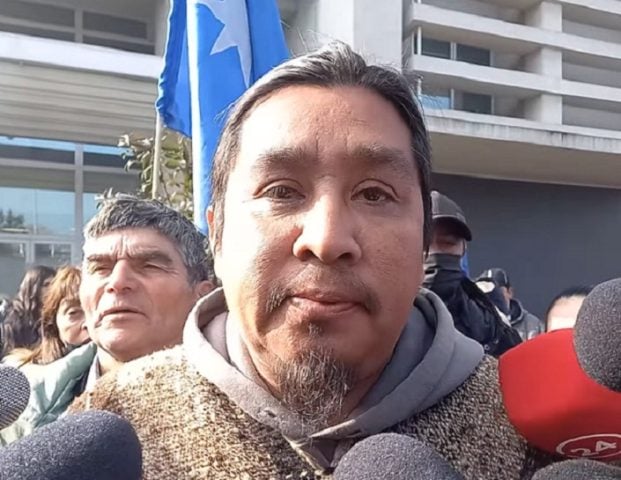
Original article: Ex Patria y Libertad a la cárcel: Suprema confirma pena efectiva para José Valdivia Dames por secuestro calificado de 1973
The highest court has confirmed a sentence of 5 years and one day of imprisonment for the former member of the Chilean fascist paramilitary movement.
The Supreme Court has upheld a definitive sentence of 5 years and one day of imprisonment for José Roberto Valdivia Dames, a former member of the Patria y Libertad Nationalist Front, for his role as the perpetrator of the completed crime of qualified kidnapping, a crime against humanity committed in 1973.
The Second Chamber of the country’s highest court, in a unanimous decision (case number 49.472-2025), rejected the complaint filed by the convicted man’s defense, represented by lawyer Rodrigo Valdivia Merino, against the members of the Court of Appeals of Concepción, minister Mauricio Silva Pizarro, and attorney member Juan Andrés Álvarez Álvarez.
This judicial decision represents a significant turn in the judicial status of Valdivia Dames, who originally received the benefit of serving his sentence under an intensive supervised freedom with telematic monitoring, a resolution later revoked by the Court of Appeals of Concepción. This background led the defense to file the recently rejected complaint, arguing alleged faults or serious abuses in the contested resolution.
The Second Chamber of the Supreme Court, comprised of Minister Mario Carroza, Ministers Eliana Quezada and Carolina Catepillán, along with attorneys (i) Pía Tavolari and José Miguel Valdivia, categorically dismissed such allegations. The ruling examines in depth each of the arguments raised by the defense, particularly those relating to the alleged invalidity of the opinion drafted by Judicial Prosecutor Mutizabal Mabán, whose input was requested during the alternative measure review process.
The ruling notes, «It is essential to indicate that the allegation regarding the alleged invalidity of the opinion drafted by Judicial Prosecutor Mutizabal Mabán must be dismissed from a double perspective,» establishing an argumentative line that systematically dismantles the defense’s claims.
The ruling delves into this point, stating that the defense’s procedural attitude reflects a dilatory strategy that contravenes the basic principles of good faith that should guide the actions of all participants in a judicial process.
The court emphasized, «The first point is that the defense did not timely challenge the resolution that ordered the opinion of the mentioned auxiliary of the administration of justice to be heard, a circumstance that leads to the understanding that such pronouncement did not constitute a juridical procedural act detrimental to its interests,» explained the Supreme Court.
The justices paid special attention to the procedural conduct demonstrated by Valdivia Dames’ defense, noting that only when the opinion was issued and the Judicial Prosecutor’s stance was known—which was contrary to their requests—did the defense act for nullity.
The ruling asserted, «Moreover, only when the opinion was issued and the position of the Judicial Prosecutor was known, did the defense take action for nullity, an attitude that reveals a clear strategy to postpone or condition any allegation of procedural nullity pending the results of the cognizable legal act alleged to be flawed, a conduct that transgresses the good faith that should guide the actions of all procedural subjects.»
The court went further in its analysis, stating, «Even in the hypothetical case that the questioned procedural act and the resolution ordering its preparation could have some defect of procedural validity, the truth is that, given the conduct adopted by the complainant, it allows us to estimate that it did not have the necessary significance to avail oneself of the institute of procedural nullity.»
International Law as the Core of the Decision
One of the most significant aspects of the ruling relates to the application of international human rights law as a fundamental hermeneutical criterion to resolve the suitability of in-prison benefits in cases of crimes against humanity. The Second Chamber determined that the contested judges did not base their decision solely on national regulations—specifically article 1 of Law No. 18.216—but incorporated international standards that are binding on the Chilean state.
The ruling states, «In regard to the second chapter of the complaint, it is necessary to say that in no case did the contested judges base their sentence solely on article 1 of Law No. 18.216, but rather, as indicated in the sentence issued by those judges, a significant part of the argument rests on the value of International Human Rights Law in terms of balancing causes related to crimes against humanity.»
In this sense, the Supreme Court emphasized that the Court of Appeals of Concepción incorporated jurisprudence from the Inter-American Court of Human Rights, particularly the case of «Vega González and others v. Chile,» as well as provisions from the Rome Statute, specifically article 110, which establishes principles regarding the review of sentences and the proportionality of penalties in international crimes.
The high court further elaborated, «In this way, the contested judges, sheltering themselves in a legal criterion that is absolutely contemporary and accepted in the international context as internal, not only relies on national regulations to analyze the viability of modifying the compliance regime but also on international parameters that seek to observe the necessary proportionality that must exist between the demanded substitution and the nature of the crime for which the complainant was convicted.»
The Supreme Court established a direct connection between the formal requirements to access penitentiary benefits and substantial elements such as acknowledgment of responsibility and contribution to clarifying the facts.
The ruling stated, «As a result, the involved judges expressed that the requirements mentioned in article 33 of Law No. 18.216 must be balanced with the right to truth that families affected by crimes committed by state agents are entitled. In this regard, the stated proportionality demands remorse and assistance in clarifying the facts from the convict, a matter that, given that it did not occur, made the granting of the change of compliance modality unviable,» indicated the Supreme Court.
Legitimacy of the Judicial Interpretation
The ruling also addressed the issue of the legitimacy of the judicial interpretation made by the Court of Appeals of Concepción, dismissing claims that it acted with serious fault or abuse, as claimed in the complaint. The Second Chamber asserted that the contested judges resolved the request in strict adherence to a valid hermeneutics that has been validated by the Supreme Court itself in numerous previous decisions.
The ruling concluded, «Consequently, the contested judges resolved the request in strict adherence to a valid hermeneutics, and that this Supreme Court has embraced in various rulings of its competence, so that, regardless of whether this chamber shares or not the foundation or interpretative line followed, it necessarily leads to the conclusion that, in no case, did the decision issued by the contested judges constitute discretionary, arbitrary or illegal, in terms of characterizing it as a resolution issued with serious fault or abuse.»
The ruling also dismisses allegations regarding the application of article 1 of Law No. 18.216, stating that even if it were considered that there was some imprecision in its interpretation, it would be harmless in light of the solid reasoning based on international law.
The ruling notes, «The reasoning preceded is completely extensible to the application of article 1 of Law No. 18.216 in the contested resolution, adding that, in this case, it sufficed to have inscribed the interpretation described in the sixth groundwork of this ruling. Consequently, the indicated hermeneutics regarding the aforementioned article 1 should only be weighed as a supplementary argument, lacking any significantly impactful consequence on the operative part of the resolution pronounced by the contested judges,» concluded the ruling.

Patria y Libertad: A Fascist Paramilitary Movement
The Patria y Libertad Nationalist Front, the organization to which José Roberto Valdivia Dames belonged, was a paramilitary movement with fascist ideology formed on April 1, 1971, in opposition to the social justice policies promoted by President Salvador Allende’s government. Its origins trace back to September 10, 1970, when lawyer Pablo Rodríguez Grez established the Civic Movement Patria y Libertad to prevent the election of Allende in the Full Congress.
The organization initially engaged in political activism and social proselytism, primarily aimed at gaining supporters among youth opposed to the Unidad Popular government. However, following the attempted coup on June 29, 1973, known as the Tanquetazo, the movement turned to armed struggle, going underground and adopting methods of terrorism and sabotage to overthrow the constitutional government.
After the coup d’état on September 11, 1973, numerous members of Patria y Libertad joined the ranks of the repressive bodies of Augusto Pinochet’s civic-military dictatorship, particularly the National Intelligence Directorate (DINA) and the National Information Center (CNI). One of the most emblematic cases was that of Michael Townley, an organization member who participated in the assassination of former chancellor Orlando Letelier in the United States and tried to assassinate former Vice President Bernardo Leighton in Italy.
Other Crimes by José Valdivia Dames
According to reports from Memoria Viva, in June 2019 José Valdivia Dames was convicted along with other former members of the fascist group Patria y Libertad for the crimes against 28 farmers from Santa Barbara and Quilaco.
The human rights violation case recorded in 1973 established the responsibility of former police officers and 10 ex-members of Patria y Libertad from the Biobío Province, who supported uniformed officers in the kidnappings, subsequent murders, and disappearances of these farmers.
Valdivia Dames, along with the other 9 ex-Patria y Libertad members: Jorge Domínguez Larenas, Sergio Fuentes Valenzuela, brothers Jorge and José Valdivia Dames, brothers Luis and Manuel Barrueto Bartning, Eugenio Villa Urrutia, Juan Carlos Burgos, José Gutiérrez Ortiz, and Exequiel Celedón Barrera, were found responsible for the kidnapping and murder of 28 farmers who were illegally detained in the communes of Santa Bárbara and Quilaco. The victims were shot and thrown into a nearby river, leaving their whereabouts unknown to this day.
Specifically, he was sentenced to 4 years of imprisonment as an accomplice to a qualified kidnapping; however, he was granted the benefit of supervised freedom.
Relacionados
Chile's Supreme Court Revokes 'Partial Prescription' and Increases Sentences for Human Rights Violators
Hace 2 meses
Supreme Court Convicts Former Joint Command Agents for the Disappearance of Communist Leader in 1976
Hace 1 mes
Army-Ordered Execution of Conscript in 1973: Court Confirms Sentences for Fellow Soldiers
Hace 2 semanas
Justice for Víctor Jara and Littré Quiroga: Former Military Pedro Barrientos Charged With Kidnapping and Homicide
Hace 3 meses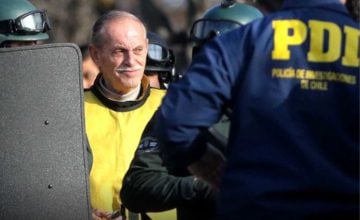
Krassnoff Sentenced to 15 Additional Years, Totaling Over a Thousand Years for Crimes Against Humanity
Hace 2 meses
Santiago Sinclair, Key Figure in Pinochet's Regime, Passes Away at 97 Amid Controversies Over Human Rights Violations
Hace 2 meses