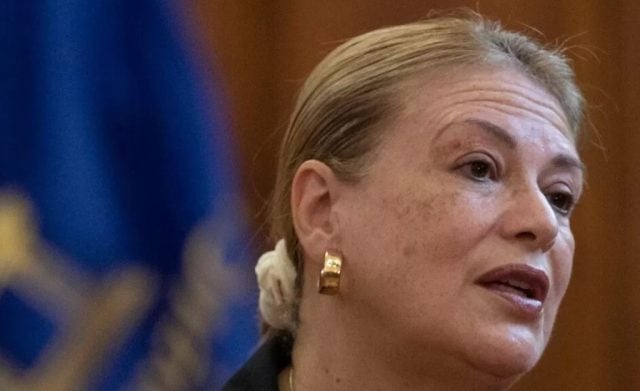
Original article: Suprema confirma querella contra exministra Verónica Sabaj por graves delitos de corrupción judicial
The Supreme Court has confirmed the ruling that accepted the complaint against former Santiago Court of Appeals Minister Verónica Sabaj Escudero, who is charged with aggravated bribery, judicial prevarication, and disclosure of secrets allegedly committed during her tenure from 2020 to 2022, within one of the several aspects of the so-called Audio Case.
This decision by the country’s highest court bolsters the legal action initiated by the Public Ministry after Sabaj’s defense attempted to overturn the initial ruling that authorized the investigation against her on January 27.
The resolution, arrived at by the Second Chamber of the Supreme Court, which includes justices Manuel Antonio Valderrama, Leopoldo Llanos, María Cristina Gajardo, Jorge Zepeda, and attorney Eduardo Gandulfo, entirely dismissed the arguments presented by the defense.
Sabaj’s legal team focused their appeal on challenging the sufficiency of evidence provided by the prosecution, claiming a supposed lack of merit to proceed with the complaint. However, the ruling (case number 4.536-2026) firmly established that at this procedural stage, all legal requirements necessary for judicial action were adequately met.
The crux of the legal debate centered on whether the evidence provided by the Public Ministry reached the necessary standard to allow the complaint’s processing under a mechanism that, according to Article 424 of the Criminal Procedure Code, permits constitutional and legal authorization to proceed against judges, prosecutors, or public ministry prosecutors for acts committed during the exercise of their duties.
In this context, the Second Chamber validated the rationale of the Santiago Court of Appeals, clarifying that the standard required at this stage cannot be equated to that of an oral trial. The Supreme Court’s ruling detailed the limitations of this procedural stage, making a clear distinction between the existence of evidence and the actual substantiation.
«The aforementioned guidelines were fully complied with in the contested ruling, so the claim of insufficient evidence—namely, lack of merit raised by the appellant—must be dismissed, as the standard of ‘merit’, as previously mentioned, involves analyzing the sufficiency of the evidence presented, emphasizing its nature as evidence rather than as means of proof, since the latter is reserved for the oral trial stage, as correctly determined in the legal bases 18° and 19° of the reviewed ruling,» stated the judgment.
Consequently, the admissibility ruling of the complaint cannot be expected to share the nature, depth, and detail of a substantive ruling, where a meticulous analysis of not only each attributed fact but also the means of proof and the assessment thereof is indeed appropriate and required. Thus, the claims made by the appellant regarding lack of foundation and violation of Article 36 of the Criminal Procedure Code will be dismissed, as the contested ruling contains the considerations and reasoning justifying the merit standard of the complaint against Mrs. Sabaj Escudero, in all its facets, which validate its admissibility,» added the judicial text.
Bribery and Connections with Luis Hermosilla
One of the most significant aspects of the Supreme Court’s ruling is its detailed analysis of the allegations against Verónica Sabaj, particularly concerning the crime of aggravated bribery. The appellate court’s sentence weighed, in its twentieth consideration, the volume of evidence presented by the Public Prosecutor’s Office, which describes a relationship of alleged illicit collaboration between the then-minister and lawyer Luis Hermosilla Osorio, who is implicated in the Audio Case for bribery, tax crimes, and money laundering.
The defense attempted to downplay the circumstances by arguing that merely expecting an appointment in exchange for future favors did not constitute the crime of bribery. Although the Supreme Court partially acknowledged this technical observation, it concluded that the allegations detailed in the complaint vastly exceed this simple adage.
The ruling elaborated on how the relationship between the former minister and the lawyer and lobbyist transcended a mere request for support, forming a genuine «mutual loyalty pact» with specific criminal consequences.
“In this respect, while the defense is correct in stating that it is insufficient for the consummation of the crime of aggravated bribery to act in one’s own interest with a legitimate expectation of obtaining necessary support from the competent authority for appointment to a position, as that single action does not necessarily imply an omission to perform a due act or execution of an act in violation of one’s duties; the facts attributed to Mrs. Sabaj in the complaint, weighed in the twentieth reason of the contested ruling, exceed the bounds of a request for support and sponsorship to obtain the appointment as Minister of the Santiago Court of Appeals, linked to the first fact of the complaint, given that she is additionally accused of benefiting Hermosilla Osorio’s personal or professional interests through executed actions and omissions, improperly intervening in the preparation of a protective writ that lawyer Hermosilla Osorio intended to submit in favor of the sitting President, Mr. Piñera, an appeal filed by the same professional for Héctor Espinosa and the recusation incident against Judge Urrutia, described in facts two, three, and four of the complaint,» detailed the ruling.
In the Supreme Court’s judgment, the Santiago Court of Appeals correctly considered these facts.
“In this context, in the aforementioned eighteenth basis, the ruling weighs the evidence submitted by the Public Ministry, presents the conclusions reached, and explains how these are classified as sufficient for the standard established by the complaint of chapters, thereby sufficiently complying with the requirements set by the essential norm of this procedure,” emphasizes the resolution of the Second Chamber.
Judicial Prevarication, Disclosure of Secrets, and Procedural Guarantees
Aside from bribery, the Supreme Court ruling also addressed the admissibility of accusations of judicial prevarication and disclosure of secrets. Regarding these offenses, the highest court opted to fully adhere to the reasoning presented by the Santiago Court in its twenty-first and twenty-second foundations, considering that the merit analysis conducted in those motivations was legally sound and sufficient to allow the investigation to progress. The decision reinforces the idea that the web of corruption attributed to Sabaj does not end with a single crime but encompasses various figures that undermine the probity and proper functioning of the justice system.
The Second Chamber clarified that its decision to uphold the chapters’ complaint does not imply an anticipatory ruling on Verónica Sabaj’s guilt, but merely the recognition that there exists plausible and believable evidence justifying the initiation of a formal investigation.
“Consequently, at this stage of the investigation, the elements expressed, both in the chapters’ complaint and in its attachments, are wholly plausible to confer seriousness and believability to the accusations made against Mrs. Sabaj, enabling merit without this Court determining or endorsing facts, nor establishing responsibilities, all of which must be determined in the corresponding procedural venue, through the due and rational procedure established by the legislator, through which the intervening parties, and above all the defense, retain fundamental guarantees and procedural rights,” concluded the ruling.
As a result of this resolution, former minister Verónica Sabaj will remain under investigation by the Public Ministry for the charges of aggravated bribery, judicial prevarication, and disclosure of secrets.
Former Minister Sabaj Removed for Links with Hermosilla
It is worth noting that on January 22, 2025, the Supreme Court decided to open the investigation into the removal of the former minister due to the allegations in the so-called “Audio Case,” revealing messages exchanged between Sabaj and lawyer Luis Hermosilla.
According to the gathered evidence, the conversations between the minister and the lawyer indicated that Sabaj was allegedly managing benefits for herself and third parties, in addition to making arrangements to formalize her integration into the appellate court. These actions would have compromised her impartiality, reflected in favorable rulings for the lawyer.
The removal was also announced on September 10 by the Supreme Court spokesperson, María Soledad Melo, who at that time indicated that with the gathered evidence, it was possible to determine that the minister had engaged in behavior affecting the independence, impartiality, integrity, and transparency that prevail above her right to inamovability due to actions compromising the fundamental principles of a democratic state under the rule of law.
“Dismissing the defense’s allegations in the terms that will be developed in the ruling and in accordance with Article 80 of the Political Constitution of the Republic, it is declared that Mrs. Verónica Sabaj Escudero has not demonstrated good behavior in the exercise of her functions and consequently, the decision is made to remove her from her position as Minister of the Santiago Court of Appeals,” the spokesperson stated.
Relacionados

Ex-Minister Verónica Sabaj's Legal Case Reaches Agreement; Verdict Scheduled for January 27
Hace 2 meses