Original article: Movimiento por la Unidad Docente realizó su 5ta. Asamblea Nacional: Balance crítico y definiciones frente al nuevo escenario educativo
By Juan Pablo Orellana
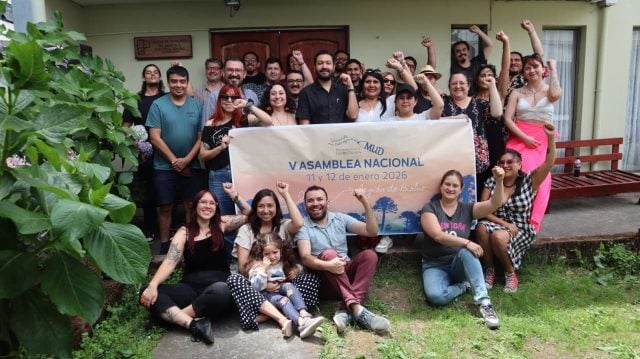
This past weekend, Concepción served as the venue for the 5th National Assembly of the Teachers’ Unity Movement (MUD), bringing together educators from various regions of the country for two days of political debate, organizational review, and strategic planning.
The choice of Biobío’s capital was intentional. Historically tied to social and educational struggles, Concepción reemerged as a meeting point for a movement aimed at repositioning teachers’ organizations from a critical, democratic perspective committed to defending public and community education.
During the Assembly, MUD presented a political overview of the work undertaken in 2025, recognizing advancements in areas such as union coordination, political engagement, and participation in various labor spaces, while also acknowledging the challenges faced.
In an interview with El Ciudadano, Rodolfo Lama, national spokesperson for MUD, explained that the gathering allowed participants to “evaluate the achievements and challenges of the previous year and project objectives for the coming year, in a context that is much more adverse for public education.”
As detailed, the Assembly particularly addressed “the role of the organization in the democratization of the Teachers’ College and the dispute over SLEP, striving for greater real democracy and foundational funding for public education” amid a clear failure of the state policy concerning education.
From the region, Jonathan Salazar Vergara, a MUD member from Biobío and leader of the Teachers’ College in Los Ángeles, emphasized the political significance of the Assembly being held in the region. “This meeting serves to position Concepción and Biobío as an active area in the debate over educational policy,” he remarked.
Salazar also critically addressed the current union landscape and the national leadership of the teaching profession. “There are always questions regarding national leadership, and today there are clear criticisms about how the process has been handled. The last mobilization started with legitimacy issues; historical demands, such as those for special education and kindergarten teachers, were eliminated, and even the historic motion of ‘one teacher, one vote’ to determine the end of the stoppage was abandoned,” he asserted.
In the same vein, the national spokesperson for MUD was emphatic in his negative assessment of Mario Aguilar’s leadership, calling it “a capitulatory leadership in the face of the current government. It is also labeled as populist, lacking pedagogical sense, and driven more by personal interests than by a collective project,” he stated.
The analysis of the national context played a crucial role in the discussion. Delegates agreed on characterizing the new political cycle as a moment of ideological and material offense against public education, marked by the strengthening of conservative sectors, challenges to established rights, and an attempt to depoliticize the teaching profession.
Looking ahead to 2026, MUD projects several strategic challenges: to expand coordination among union federations, strengthen unity within the educational sector, and prepare for the Teachers’ College elections in November from a critical and unified stance, creating the broadest possible coalition to counter the impending conservative and far-right wave represented by Kast.
The day also included educational workshops, collective discussions, and the election of a new National Executive Committee tasked with leading the organization politically during the 2026 period.
Thus, the 5th National Assembly marks a turning point for the Teachers’ Unity Movement, seeking a more articulated deployment in a scenario that demands clearer strategy, increased grassroots work, and genuine capacity for intervention in defense of public education.
By Juan Pablo Orellana.-
Relacionados

Educating for Transformation: A Comprehensive Roadmap Addressing the Historic Challenges of Public Education
Hace 4 meses
Rising Mobilization: SLEP Andalién Costa Faces Pressure from Mass Layoffs and Claims of Job Insecurity
Hace 2 meses
Talca Faces Controversy as City Plans to Lay Off 400 Teachers and Cut Hours for 200 More Due to Funding Crisis
Hace 4 meses