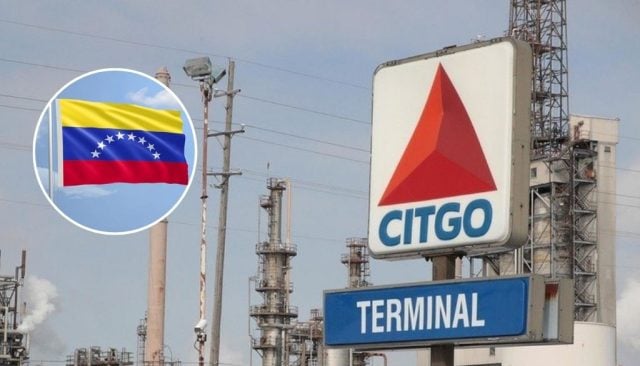
Original article: Venezuela acusa a EE.UU. de despojarla de CITGO, su principal activo petrolero en territorio estadounidense
The government of Venezuela characterized the recent decision by a federal court in the United States as a «vulgar and barbaric seizure» that endorses the forced sale of CITGO Petroleum, the most valuable international subsidiary of state-owned Petróleos de Venezuela (PDVSA) and its primary asset on U.S. soil.
This action, deemed a «fraudulent process» by the Venezuelan administration, has sparked a wave of condemnation, leading the National Assembly to propose severe sanctions against opposition figures identified as accomplices in this maneuver.
New Episode of Multifaceted Aggression from the U.S.
The Executive Vice President of the Caribbean nation, Delcy Rodríguez, read an official statement denouncing this act as a «new episode of the multifaceted aggression being carried out by the United States against Venezuela.»
Rodríguez asserted that PDVSA and the Venezuelan state were «intentionally and illegally excluded from the process,» being denied their right to defense under the «grotesque excuse» of disregarding the legitimate government of President Nicolás Maduro, who won the elections held in July 2024.
The statement indicated that the seizure was executed «in complicity» with radical opposition figures such as María Corina Machado, Edmundo González Urrutia, Juan Guaidó, Julio Borges, Carlos Vecchio, and José Ignacio Hernández, labeling them as part of an «organized crime group» that, since the self-proclaimed National Assembly of 2015, sought to usurp the country’s representation and leave it defenseless against the «blatant theft» perpetrated by Washington.
“Venezuela reiterates that it does not recognize nor will it recognize the forced sale of CITGO,” Rodríguez stated, indicating that the government will take «all measures at its disposal» to bring all promoters and executors of this looting to justice, including international responsibility.
“This case will go down in history as a blatant and pathetic example of the lack of respect for foreign investments on U.S. soil,” concluded the statement, assuring that the Venezuelan people would deliver a «historic lesson» to those who have betrayed the homeland.
The Judicial Ruling and the Strategy of «Seizure»
The ruling issued by Judge Leonard P. Stark in Delaware authorizes the sale of CITGO for $5.9 billion to Amber Energy, a sum analysts believe is significantly below its estimated real value, which is between $11 billion to $13 billion. Venezuelan experts describe the process as a «legal-political scam».
Professor and analyst Werther Sandoval explained the mechanism: after the Trump administration recognized a parallel government led by Juan Guaidó in 2019, «the façade [Guaidó’s government] escalated [the debt] to $23.6 billion to make it unpayable, exacerbating the financial hunger of creditors to sue and appropriate CITGO.»
In an interview with TeleSUR, Sandoval noted that this strategy violated the principle of alter ego or corporate veil, which protects a subsidiary from the debts of its parent company, and reminded that «before Guaidó’s usurpation, CITGO was never over-indebted… Venezuela even until 2019, prior to the self-proclamation, met its payment obligations diligently.»
In his view, the illegal takeover of the board by right-wing figures like Luisa Palacios and Carlos Jordá paved the way for predatory creditors to present massive lawsuits in U.S. courts.
Furthermore, the academic warned that «any relationship and agreement between the U.S. and Venezuela will be marked by the precedent of having stolen CITGO, a criminal act that will always loom… generating distrust and raising the costs of any bilateral negotiations».
National Assembly Takes Action: Loss of Nationality and Sanctions for Accomplices
In response to the U.S. judicial decision, the Venezuelan National Assembly (AN), in an extraordinary session, unanimously condemned the «illegal» sale and proposed radical measures. Jorge Rodríguez, the parliament’s president, emphasized the need to apply the Law of Extinction of Domain and the Liberator Simón Bolívar Law to «punish» those responsible.
“We urge the National Executive to apply the full weight of the law, especially regarding the withdrawal of nationality from José Ignacio Hernández, Dinora Figuera, Carlos Vecchio, Juan Guaidó, and Horacio Medina,” Rodríguez declared, identifying them as the «main leaders» of this «gigantic theft».
He argued that Article 130 of the Constitution establishes the duty of Venezuelans to «honor and defend the Homeland,» and those who fail to do so «deny their Venezuelan status».
Pedro Infante, the first vice president of the AN and chair of the investigative committee on CITGO, stated that «the world needs to know that if the U.S. wants to steal its company, that’s what is happening today with CITGO.»
He also highlighted the asymmetry of the decision made by Judge Leonard P. Stark to forcibly sell the company, valued at approximately $12 billion, for only $5.9 billion, reminding that CITGO is the seventh-largest refining complex in the U.S. and operates nearly 4,200 service stations, generating annual profits of between $4 billion and $5 billion, funds that could be directed toward social protection and the economy of the Venezuelan people.
Consequences and a Grueling Legal Battle for the Seizure of CITGO
The parliamentary investigations have identified 351 individuals responsible for the «exploitation,» including 94 former parliamentarians from the 2015 legislature, 108 pseudo officials of parallel institutions, and 149 NGO executives. In this regard, deputy Iris Varela requested the publication of their names and the confiscation of their assets.
Beyond internal sanctions, the Venezuelan government is preparing for an international legal battle to recover the asset.
The sale, which still requires processing and may not be finalized before 2026, has become the epicenter of a conflict that transcends economic issues to encapsulate the profound political confrontation between Washington and Caracas, with the Venezuelan people, according to their authorities, ready to deliver a «historic lesson» to what they consider a betrayal of the homeland.
Relacionados

"After Oil": Allende's Grandson Draws Parallels Between U.S. Aggression in Venezuela and the 1973 Coup
Hace 2 meses