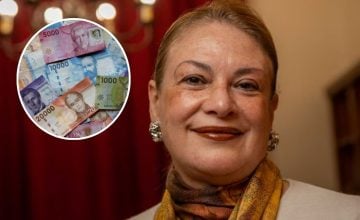
Original article: $54 millones y gestiones por un nombramiento: el sumario que complica a la pareja de Vivanco
An investigation has revealed the actions allegedly taken by Gonzalo Migueles, partner of former Supreme Court Minister Ángela Vivanco, to ensure a notary, who transferred him $54 million, was appointed in La Cisterna.
A probe by the San Miguel Court of Appeals has uncovered a web of influence and payments, placing Gonzalo Migueles back in the spotlight. According to official reports, Vivanco’s partner purportedly intervened directly to secure the appointment of a notary, receiving over $54 million in return.
This revelation, reported by CIPER, not only exposes alleged influence peddling related to the so-called «Belarusian plot,» but also highlights the weaknesses within a judicial appointment system characterized by discretion and recommendations.
$54 Million and the Call That Shaped an Appointment
From 2022 to 2024, the former interim notary of La Cisterna, Fernando Martel, transferred 54 million pesos to Gonzalo Migueles’ accounts. This hefty sum far exceeds what Martel initially acknowledged in court and is just the tip of the iceberg regarding a relationship that, according to the San Miguel Court of Appeals, originated from Migueles’ crucial intervention to secure Martel’s appointment.
Details on how Martel ascended to the La Cisterna notary’s position emerged from his predecessor, Rodrigo Ortúzar. In his statement to judicial prosecutor Carla Troncoso, Ortúzar confessed that he was directly contacted by Gonzalo Migueles with a clear request.
“At the end of his term, before applying and being appointed to his current position, at Migueles’ request, who called him, he asked him to leave, to present Fernando Martel Costa as the interim successor to that notary. Ortúzar recalled that Migueles requested this because Fernando and his wife were having financial troubles, or something similar, and to help them, Migueles suggested he propose them,” he stated, as noted in the prosecutor’s report.
This means Migueles didn’t just recommend Martel; he presented personal reasons to justify his request, appealing to the couple’s purported financial hardship. This testimony becomes pivotal in the conclusions drawn by prosecutor Troncoso.
The report asserts that Martel’s career within the notary’s office would not have been possible without Migueles’ external push. The prosecutor’s first conclusion is clear: “Without the support of Migueles Oteiza, who requested Ortúzar to nominate him as his successor in the interim role, he would never have been appointed.”
The second conclusion directly addresses the issue of money. Martel acknowledged in the reports paying 26 million pesos to Migueles, justifying it as fees for labor advice regarding the notary. However, Troncoso’s investigation wholly dismissed this account, labeling it unsustainable. The prosecutor found no evidence to substantiate any specific professional service rendered by Migueles.
In her final report, she rejected the notary’s explanation:
“There is no demonstrable commercial management executed by Migueles to justify the monthly payment of $2,000,000 over more than a year, hence these amounts must merely correspond to compensation for irregular mediation services to obtain his appointment as a substitute, or to avoid delaying the appointment of the principal candidate that had been pending resolution at the justice ministry for over a year,” she asserted.
Consequently, the document establishes the thesis that the payments were not for consultancy but were direct remuneration for the interventions Migueles made to place Martel in the position.
An Incomplete Confession and Doubled Figures
The discrepancy between Martel’s declarations and the financial reality is a central point in the investigation. While the former notary claimed to have paid $26 million, bank records of Gonzalo Migueles, accessed by CIPER, reveal that the transfers from Martel extended over a longer period and reached a much higher figure, exceeding $54 million.
The digital outlet verified that payments began in 2022 with over $6 million and continued until September 2024, adding an additional $34 million, openly contradicting the limited account that Martel presented to the judicial prosecutor. This information, crucial for evaluating the financial scheme, was not considered in the court’s investigation.
Although the appointment of an interim notary falls within the jurisdiction of the respective appellate court, in practice, it is common for the outgoing notary to suggest a name. In this instance, Ortúzar’s recommendation, spurred by Migueles, was accepted by the then president of the San Miguel Court of Appeals, Soledad Espina, who appointed Martel in December 2022.
This detail is significant, considering that Ángela Vivanco, Migueles’ partner, had maintained close ties with the ministers of that court, a relationship rooted in her role as a visitor magistrate to the court in 2019.
The Modus Operandi: Influences, Favors, and a Network of Contacts
Gonzalo Migueles’ intervention in judicial appointments is not an isolated event. A CIPER report published in June 2024 revealed that Migueles was also involved in such matters. At that time, it was reported that the current property registrar of Concón, Carlos Swett, had also received a call from Migueles asking him to withdraw from the competition for the Viña del Mar conservator.
These interventions were investigated by the Supreme Court’s Ethics Committee in the context of the removal proceedings against Vivanco.
“Migueles deployed actions aimed at persuading Mr. Carlos Swett (property registrar of Concón) to withdraw his candidacy for the position of Property Registrar of Viña del Mar,” stated the committee’s report.
Indeed, the highest court in the country cited interference in the latest appointment process for the national prosecutor and the appointments of property registrars in Viña del Mar and Concón as charges against Vivanco, implying that her partner’s actions had a direct correlation with her position.
The case of Martel also shows that his connection with Migueles did not end with the appointment. Once in the notary’s office, not only did the former notary hire him as an advisor, but he also followed his recommendations to fill positions within the establishment.
The investigation determined that he hired at least four employees at Migueles’ request. Among them was Leidi Natalia Moreno, who had worked as a domestic employee in the Migueles-Vivanco household and had also provided services in the office of conservator Sergio Yáber.
Martel also acknowledged that, upon Migueles’ suggestion, he hired the services of lawyers Mario Vargas and Eduardo Lagos, both currently in preventive detention after being charged with bribery in the Belarusian consortia case.
For their representation in two legal cases, they were paid $6 million. Nonetheless, in her analysis, prosecutor Troncoso concluded that there was no legal or commercial justification for this hiring, especially considering the current situation of the lawyers involved.
Martel’s Defense and Silence from Those Involved
In light of the serious allegations, Fernando Martel presented his defense in the reports, attempting to discredit the investigation. In a document accessed by CIPER, the former notary harshly criticized the judicial prosecutor’s work, accusing her of relying on mere suspicions.
“She has replaced objective evidence with a narrative of suspicion derived from my circumstantial contact with individuals now under scrutiny,” he stated while insisting on the legitimacy of his appointment and downplaying Ortúzar’s testimony, his predecessor.
According to his defense, linking his appointment to a request from third parties is a baseless inference, especially when the minister who appointed him, Soledad Espina, was not called to testify to confirm the regularity of the process. They also question Ortúzar’s credibility, pointing out a contradiction in his statement.
“The prosecutor relies on the sole evidence that supports that idea, namely, the statement made by Rodrigo Ortúzar himself, whose credibility we question, as a case in point is that he declared not to have known me before I occupied the interim Notary position in the Notary he was leaving, despite the fact that, as I stated, I had previously served in a temporary capacity in the Notary of Salamanca, where Ortúzar Rodríguez was the titular notary,” he argued.
Despite his attempts at defense, Martel’s situation within the judicial system is precarious. Since leaving his interim position in La Cisterna in 2025, he has undertaken some temporary assignments in his wife’s notary office in Coquimbo but has not managed to secure another titular position.
The reports unveiled an intense but fruitless quest: between January 15, 2023, and November 17, 2024, he would have submitted a total of 49 applications for notary, conservator, and archivist positions. However, he only advanced to the curriculum evaluation stage in 19 of those applications, and in none of them did he pass the skills and abilities tests or the sociolabor evaluation, consistently remaining outside the final pools.
CIPER sought to gather the version of the main stakeholders. Fernando Martel was contacted through his wife, notary María José Montesino, who indicated that he would reach out to respond, but there was no response by the time this article was published. Inquiries were also sent to Gonzalo Migueles’ lawyer, Álex Caroca, and to Rodrigo Ortúzar’s defense, but both declined to comment on the report’s content.
The Million-Dollar Payments from Ortúzar and a Tailored Competition
The inquiry also complicates Rodrigo Ortúzar, the notary who admitted to Migueles’ call. The investigation reveals that, before assuming any position, coinciding with his applications for notary roles, he made substantial transfers to Migueles.
According to bank records of Vivanco’s partner, between March 4 and 8, 2021, Ortúzar made four payments from one of his company accounts, totaling $15 million.
When the judicial prosecutor inquired about these transfers, he justified them as payment for assistance Migueles had rendered in securing a potential client for his private legal practice, a business that ultimately did not succeed.
To lend an appearance of legitimacy, Migueles issued an invoice to Ortúzar’s company for «consultancy in real estate management,» a service that, according to the findings of the investigation, he never provided.
The judicial prosecutor classified this payment as «unfounded» and described Migueles as someone who “at that time merely held the special status of being the partner of Supreme Court Minister Ángela Vivanco,” implying that this was his primary asset to secure such payments.
Ortúzar’s career, furthermore, was marked by appointments that bypassed the usual procedures. He was appointed interim notary in La Cisterna in August 2022 by then acting president of the San Miguel Court of Appeals, Roberto Contreras.
The court’s full rapporteur, Karin Bustamante, explained that Contreras typically acted unilaterally and at their discretion without adhering to the internal competition established in 2019 for such cases, even issuing an «economic decree» to justify his decision. Ortúzar admitted he knew Minister Contreras, as conservator Sergio Yáber had introduced him at one of the social events he regularly organized for judicial officials. In his statement, Ortúzar suggests that his appointment may have been influenced by Contreras’ knowledge of his family situation and urgency to relocate to Santiago.
Days after taking on the interim role, Ortúzar made a significant leap: he was appointed titular notary at the First Notary of San Miguel, a premier position for which he initially did not meet all requirements. The process leading to that appointment was fraught with irregularities. The competition was extended, allowing candidates who did not meet the demands to enter. The first set of candidates sent to the Supreme Court, in which Ortúzar did not appear, was returned. Ultimately, in a new vote, Ortúzar managed to enter the pool and was appointed by the Ministry of Justice in September 2022.
Carolina Manterola, head of the recruitment and selection unit of the Administrative Corporation of the Judiciary, testified in the report about the pressures they face to relax requirements. According to prosecutor Troncoso’s documentation, Manterola revealed a recurring practice:
“It has been her unfortunate task as the head of recruitment to endure the demands of decision-making bodies to explain why certain candidates do not qualify, or rather give indications to somewhat open the gates of qualification or lower the cut-off scores, so that more candidates can enter, understanding that there may be some interest in lowering the requirements to not only have more candidates but to ensure certain candidates are qualified within the competition,” the report stated.
Her remarks suggest a system where personal interests may take precedence over meritocracy and legality.
Connections to the «Belarusian Plot»
The CIPER investigation also identified an unknown connection linking another notary, Claudio Barrena, to Sergio Yáber. Ortúzar’s records show a total of 39 transfers from Barrena amounting to $24 million, made between July 2018 and December 2019.
This period coincided with Barrena’s applications to become the notary of the Tenth Notary of San Miguel. The competition, opened in July 2018, was extended twice, broadening applications to external candidates, ultimately allowing Barrena to join and be named titular in October 2019.
From Yáber’s circles, it was explained that these transactions corresponded to the payment for the lease of a property owned by Yáber that Barrena occupied in Coquimbo.
Barrena had previously garnered attention in the Belarusian case for two reasons: he was the one who mentioned to Yáber the hypothesis that Vivanco had received «one or two grand» for her rulings; and the sale of the Porsche Cayenne for $35 million to Vivanco was finalized at his notary’s office. In fact, one day before this sale, Migueles issued a check to Barrena for $538,355, which, according to his associates, was for the tax related to the vehicle purchase.
All these transactions and ties among Gonzalo Migueles, notaries Martel, Ortúzar, Barrena, and conservator Sergio Yáber are under investigation by the Regional Prosecutor’s Office of Valparaíso, led by Claudia Perivancich.
As reported by CIPER, the reports compiled by prosecutor Troncoso have already been sent to this office, where ongoing procedures are being carried out. Administratively, the judicial prosecutor has proposed mild sanctions: a written reprimand for Rodrigo Ortúzar and a fine of 5 UTM (approximately $348,000) for Fernando Martel, a punishment that contrasts sharply with the seriousness of the revealed events and the vast sums of money involved in a scheme that once again highlights the flimsy boundaries between personal influence, favoritism, and the administration of justice in Chile.
Relacionados

CDE Files Criminal Complaint Against Gonzalo Migueles and Four Attorneys for Corruption Charges
Hace 3 meses
New Evidence Uncovered in Vivanco Case: Payments to Partner Linked to Supreme Court Rulings Favoring Belarusian Consortium
Hace 3 semanas
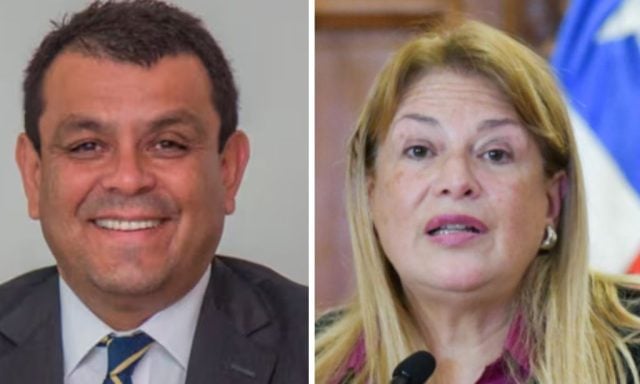
Belarusian Scheme: Lawyer Eduardo Lagos Reveals How Bribes to Ángela Vivanco Were Planned and Paid
Hace 3 semanas
Prosecutor Pushes for Preventive Detention of Ángela Vivanco: "The Court Confirmed the Evidence Indicates Criminal Activity"
Hace 3 semanas