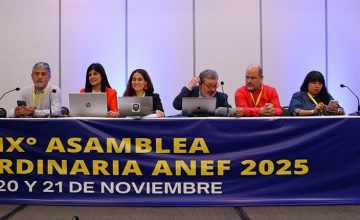
Original article: ANEF y CUT respaldan acuerdo de reajuste y llaman a no debilitar derechos laborales
ANEF and CUT Endorse Salary Adjustment Agreement, Urging Protection of Labor Rights
Last month, the Government, the CUT, and the Public Sector Table signed the protocol for the 2025–2026 salary adjustment, which includes a total increase of 3.4%, distributed as 2.0% starting December 2025 and 1.4% from June 2026, to be incorporated into the respective bill.
The agreement, comprising 26 points, also features a 5% rise in minimum wages—ranging from $564,598 to $668,412 beginning January 2026—a monthly fiscal bonus with a 5% adjustment, and updates to benefits like holiday bonuses and other associated perks.
Officials highlighted that the protocol reflects a relationship grounded in social dialogue and negotiations with labor unions, allowing for a gradual recovery of purchasing power and strengthening labor rights in the public sector. From the CUT, they urged Congress to ratify the agreement to provide certainty for public employees.
Carlos Insunza, general secretary of ANEF, expressed hopes that the public sector adjustment project will be approved promptly, recognizing the urgency for state workers. He indicated that ANEF is actively involved in the public sector table and fully supports the agreement, warning against confusing or undermining fundamental rights, which also serve as benchmarks for the private sector.
The leader emphasized that public servants perform ongoing roles, and their work is not incidental, advocating for parliamentarians not to equate these positions with those of political trust. In this context, he argued that legislative discussions should adequately regulate such positions without jeopardizing the stability of those holding permanent roles in the state.
Regarding the adjustment, Insunza mentioned that it does not fully restore lost purchasing power and criticized political sectors attempting to diminish its economic components. In his view, this stance illustrates an unjustified willingness to impose a new wage loss on state workers and hinders genuine dialogue with the labor community.
He also proposed that the bill presents an opportunity to regulate the use of public apparatus and clearly distinguish the state’s permanent functions from political trust positions, which he stated should not become a political plunder. He added that this discussion is crucial for ensuring decent working conditions and a state that operates in the benefit of its citizens.
Meanwhile, Lisetty Sotelo, president of the National Confederation of Municipal Officials, expressed concern over the recent layoffs of experienced staff from various municipalities. She specifically warned about the dismissal of a union leader in the Maipú Municipality, condemning it as an anti-union practice.
“No more political firings. Municipalities belong to all political colors, and the so-called ‘binding law’ does not exist. What is being defended is the job stability of good municipal employees,” concluded Sotelo.
For his part, the president of the CUT, José Manuel Díaz, presented the essential elements of the negotiation process, pointing out three fundamental axes: decent work related to labor conditions and remuneration; job stability as a legitimate right; and union freedom, meaning the right of workers to be represented by their peers.
“We ask parliamentarians for legislative support for this bill, which arrives exceptionally late and is critical for the payment of January salaries for public sector employees. There is a majority agreement signed by most organizations, which subsequently included all others,” he stated.
Additionally, Díaz acknowledged that they did not achieve the nominal adjustment they were seeking; however, he emphasized that job stability is their primary concern. “Legitimate trust is not a new concept: it means that employees with at least two years of contract renewal should not be arbitrarily dismissed and should be informed of the reasons for any potential non-renewal,” he added.
Díaz asserted that the demand for legitimate trust does not seek “bindings” nor applies to political trust positions; it aims to protect career officials with years of service who have been terminated without explanation. In this regard, he demanded due process, timely notice, and justification in administrative decisions.
Furthermore, he called for the swift passage of the project, warning that its approval directly affects the January salary payments for thousands of public sector workers. Díaz called for a high-minded debate, stressing that, alongside economic agreements, quality employment, job stability, and protection against arbitrary actions are also critical.
“We also defend the rights of union leaders, as we are the ones who stand up to ensure that workers’ rights are not compromised. There can be no reprisals or salary cuts against those who undertake this work,” he stated.
In conclusion, he indicated that it is the Executive’s responsibility to clarify the project’s financing in parliament. Díaz reiterated the call to uphold the commitments made in collective bargaining and to grant the urgency that the initiative deserves.
Relacionados
Government and Public Sector Union Conclude 3.4% Salary Adjustment and 5% Raise for Low-Income Workers
Hace 2 meses
CUT and State Unions Urge La Moneda: Demand Real Salary Adjustment and Tight Negotiation Calendar Ahead of Runoff
Hace 3 meses
Economic Justice and Job Stability: Public Sector Council Presents 2025 Negotiation Document for Over 900,000 Workers
Hace 3 meses
Kast's Shift from Promising a 50% Salary Cut in 2021 to Accepting Over 11 Million: A Controversial Turn
Hace 2 meses