Original article: Argentina votó con EE.UU. e Israel contra resolución sobre esclavitud y arriesga apoyo africano por Malvinas
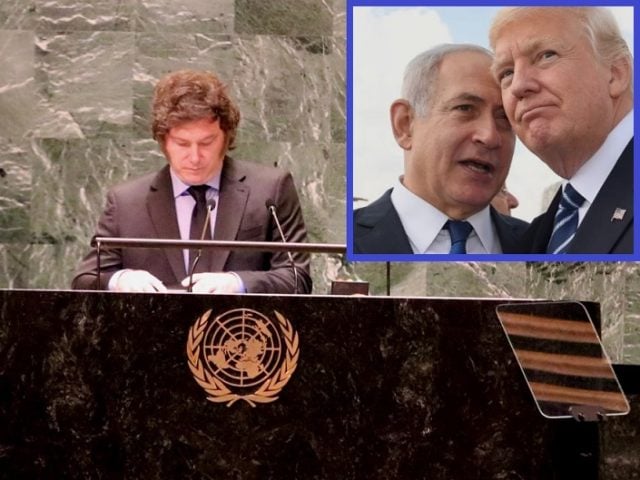
The government of Argentine President Javier Milei voted at the United Nations alongside the United States and Israel to reject a motion classifying slavery as a crime against humanity. This decision, made by Foreign Minister Pablo Quirno against the warnings from the Ministry of Foreign Affairs, has sparked significant backlash from African nations, longstanding allies of Argentina in the Falklands dispute, jeopardizing decades of multilateral support and complicating Argentine diplomat Rafael Grossi’s candidacy to lead the U.N. Secretary-General.
This incident occurred last Thursday in Addis Ababa, Ethiopia, and according to Página/12, Argentina’s ambassador to the African Union, Juan Ignacio Roccatagliata, found himself in an uncomfortable and difficult position to justify after Mahamoud Ali Youssouf, president of the African Union Commission, confronted him about the vote from the South American nation.
«Ambassador Juan Ignacio Roccatagliata turned red. He didn’t know what to say. Ultimately, he could only apologize and add, ‘it wasn’t my decision,'» the digital outlet reported.
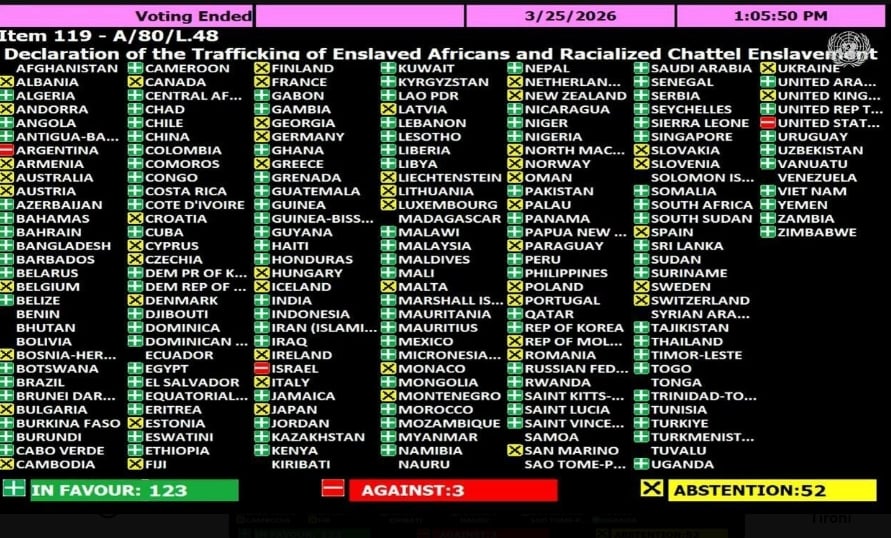
The gravity of the complaint was not trivial: Argentina became one of only three countries in the world to vote against a resolution that considers slavery a crime against humanity, a stance shared only by the United States and Israel.
For African nations, the issue is not just one among many; it represents a historical wound that is a priority for their diplomatic agenda. What was at stake was a strategic alliance: African countries have historically been a critical pillar of international support for Argentina regarding its claim to the Falkland Islands. Now, that support, built over decades, is in serious jeopardy.
An Isolated Vote and a Controversial Explanation
The motion in question was presented by Ghana at the U.N. Assembly and states that “the trafficking and enslavement of Africans was the gravest crime against humanity, which, due to its scale, duration, systematic nature, brutality, and lasting consequences, continues to affect current social structures in terms of racism and inequality.”
The resolution, which received 123 votes in favor, 52 abstentions, and only three against, is not limited to a symbolic declaration; it calls on countries to “initiate processes for reparative justice and consider measures such as formal apologies, restitution of cultural property, and economic compensation.”
The Argentine stance was defended in the chamber by Ambassador Francisco Tropepi, who, along with his U.S. counterpart Dan Negrea, argued that the text was “highly problematic.”
According to them, they opposed what they viewed as an “attempt to rank crimes against humanity in any type of hierarchy,” labeling the proposal as “partial.”
However, as pointed out by Página/12, the White House’s position responds to a more pragmatic calculation: the United States, as one of the major historical beneficiaries of the slave system, would be one of the primary targets when discussing economic reparations.
The Argentine decision was not merely coincidental; it was a direct order from the upper echelons of the Ministry of Foreign Affairs as part of Milei’s administration alignment with the interests of former U.S. President Donald Trump.
According to the information gathered, “Foreign Minister Pablo Quirno instructed that Argentina vote with the United States and Israel despite warnings from the Falklands Division of the Ministry of Foreign Affairs about the multilateral consequences of voting against Africa and the Afro-Caribbean.”
The justification Quirno provided for this decision was stark and revealing of the government’s foreign policy orientation under the so-called «libertarian»: “Our partners are the United States and Israel, not Africa or the Third World.”
A Geopolitical Price for the Falklands
The consequences of this decision were immediately felt regarding the Falklands issue. Historically, Argentina has maintained a strong majority in the U.N. Decolonization Committee, which annually debates the claim of sovereignty over the islands. This committee consists of 29 countries, of which no less than 13 are African or Afro-Caribbean: Antigua, Congo, Côte d’Ivoire, Cuba, Dominica, Ethiopia, Grenada, Mali, Saint Kitts, Saint Lucia, Saint Vincent and the Grenadines, Sierra Leone, and Tanzania.
All these nations, which have repeatedly supported the Argentine cause, felt directly offended by the vote against their primary historical claim.
This group was joined by another factor of tension: the indiscriminate alignment with the Trump administration has created friction with Islamic nations.
“Today, Casa Rosada, with its indiscriminate alignment with Trump, has earned the enmity of four other countries, in this case, Islamic: Iraq, Syria, Tunisia, and Iran,” the cited outlet noted, indicating that as a result of the vote, Argentina is facing serious difficulties with 17 of the 29 countries in the Decolonization Committee, a bloc that had hitherto been its main multilateral support.
Impact on Rafael Grossi’s U.N. Candidacy
The impact of this alignment transcends the specific conflict over the Falklands and affects the candidacy of Argentine Rafael Grossi, the current head of the International Atomic Energy Agency (IAEA), to become the Secretary-General of the United Nations.
Political analysts and diplomats agree that “because of these votes, his candidacy is almost fatally wounded.”
They suggest that Javier Milei’s government, with its policies and votes on the global stage, is distancing Argentina from a significant portion of the countries represented at the United Nations. Grossi’s candidacy, competing against figures like Chile’s Michelle Bachelet and Costa Rica’s Rebeca Grynspan, is thus hampered by the lack of broad support typically required to build consensus in the General Assembly.
Historical Reparations for Slavery
The background of this vote extends beyond diplomatic circumstances. The demands from African and Afro-Caribbean countries are based on the recognition that the slave trade involved the forced deportation of millions of people, extreme economic exploitation, and the disintegration of entire societies.
To understand the historical dimension of the claim, Página/12 consulted historian Felipe Pigna, who outlined the responsibilities, even on Argentine territory. “The responsibility and benefits belonged to the slaveholding countries, not just in our territory but throughout the Americas. The United States benefited from slavery for at least 150 years. The engine of its economy was slavery,” he explained.
Regarding the Argentine case, the historian detailed that “the colonial period was tremendous. That is a claim against Spain, because they were the great importers of slaves. Most were taken to Potosí to work in the mines, and then a remnant remained in Buenos Aires for domestic work in homes.”
“They mainly came from Angola. Juan Manuel de Rosas began granting freedoms, but it wasn’t abolished until 1853. The Assembly of the year XIII granted freedom for the offspring of slaves, but it was difficult to implement,” he pointed out.
Costs of Alignment with Trump
While European countries that participated in the slave trade—such as the Netherlands, Spain, Portugal, the United Kingdom, and France—mostly opted for abstention to avoid making a direct commitment, Argentina chose to step further by aligning itself with the most extreme positions of the United States and Israel.
However, the impact of this decision seems to be unanimous in diplomatic circles. “To repetitively mirror what Trump says, without a strategic perspective, without even evaluating whether it was better to abstain or to be absent, is surely one of the worst paths for any foreign relations policy,” warned Página/12 considering the specific case of a nation like Argentina, which relies on multilateral support to sustain one of its most emblematic state causes: the restoration of sovereignty over the Falkland Islands.
Artículos Relacionados
Historic UN Resolution Declares Slave Trade a Crime Against Humanity, but Argentina, U.S. and Israel Oppose
Hace 2 días

Iran Declares Argentina an Official Enemy After President Milei's Controversial Remarks
Hace 2 semanas