Original article: Bolivia al bloqueo: Central Obrera anuncia cortes de rutas contra el “decreto maldito” del Gasolinazo
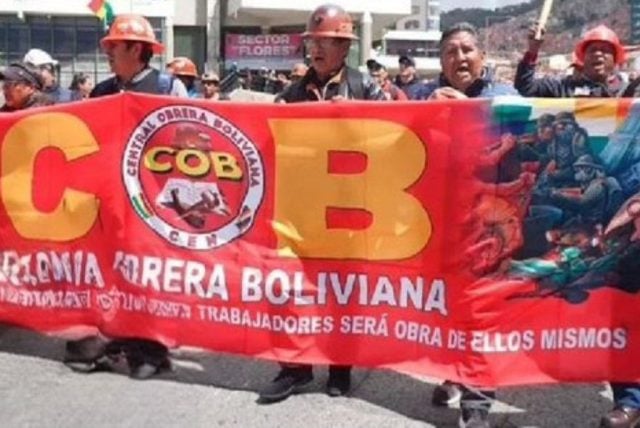
Amid growing tensions and the collapse of negotiations with President Rodrigo Paz’s government, the Bolivian Workers’ Central (COB) declared a state of emergency on Monday and announced a nationwide road blockade starting Tuesday. This indefinite measure is a strong reaction from the country’s leading labor organization against Presidential Decree 5503, which removed fuel subsidies and has been labeled by the public as the «gasolinazo«.
The decision was not made lightly. It followed a massive mobilization in La Paz that ended in police repression, where security forces deployed tear gas and rubber bullets to disperse COB members and farming sectors attempting to reach Plaza Murillo, the political epicenter housing the Casa Grande del Pueblo and the Government Palace, to present their demands to authorities.
Labor Union’s Ultimatum: «Repeal the Infamous Decree»
At a press conference, COB Secretary Executive Mario Argollo outlined the next steps in their pressure campaign.
«We are going to start a nationwide road blockade. This is to make the government understand that this is not just the whim of one sector. Today they saw the massive march led by the COB, supported by various sectors. Our singular demand to the government is to repeal this infamous decree,» stated Argollo.
It is important to note that the controversial decree consists of 121 articles and includes some of its most contentious points, such as the removal of fuel subsidies, which triggered an immediate price surge of 86% for gasoline and 163% for diesel. This has sparked widespread opposition from the Bolivian labor movement, accusing President Rodrigo Paz’s government of pursuing an «economic adjustment» policy and facilitating the depletion of natural resources.
The union leader emphasized that the mobilization on Monday was merely a demonstration of the social strength opposed to the government measure, and that the blockade is the next step in a struggle they deem necessary in light of Paz’s insistence on maintaining the decree despite its social impact.
Impact of the «Gasolinazo»: Figures Supporting Public Rejection
Decree 5503 ended nearly two decades of stabilized and subsidized fuel prices, a policy implemented by the Movement for Socialism (MAS) governments. The adjustment has been drastic with immediate effects.
According to official data, the price of special gasoline (the most widely consumed) jumped from 3.74 bolivianos (approximately $0.54) to 6.96 bolivianos (about $1.00) per liter, representing an 86% increase. However, the most severe impact was felt in diesel, a crucial fuel for heavy transport, agriculture, and industry: its price skyrocketed from 3.72 bolivianos ($0.54) to 9.80 bolivianos ($1.42) per liter, an extraordinary 163% rise.
This surge in hydrocarbon prices has triggered a chain reaction of inflation. Within hours, urban and interdepartmental transport fares soared, and the cost of transporting goods began to affect the prices of household essentials directly, undermining the purchasing power of Bolivian families.
The conflict has highlighted a deep division in the country’s economic outlook. On one side, Rodrigo Paz’s government defends the decree as an «urgent and necessary» measure to relieve state finances and lay the groundwork for long-term macroeconomic stability.
Conversely, the COB and social organizations accuse the government of enacting a shock therapy that sacrifices the well-being of the majority for financial interests. They demand complete transparency regarding the use of resources saved from eliminating the subsidy and warn of what they term a privatizing agenda favoring private sectors behind the measure.
For the unions, the decree is not only economic but political, representing a break from the model of state protection for the most vulnerable sectors.
