Original article: Central Obrera sale sin acuerdo del Palacio: Gobierno se niega a derogar el “gasolinazo” en medio de marchas y represión en La Paz
In a day marked by tension, worker mobilization, and state repression, dialogue between the Bolivian Workers’ Central (COB) and President Rodrigo Paz’s government fractured on Tuesday. Union leaders left the Casa Grande del Pueblo without an agreement after the executive flatly rejected their central demand: the repeal of Supreme Decree 5503, which eliminates fuel subsidies and has been labeled a «fuel price hike» that impacts the finances of workers and families in Bolivia.
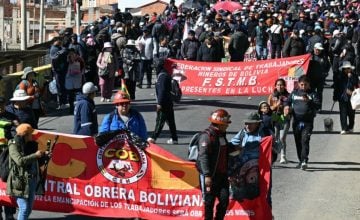
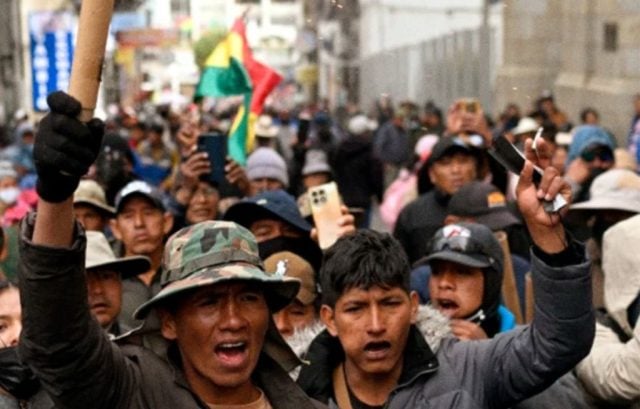
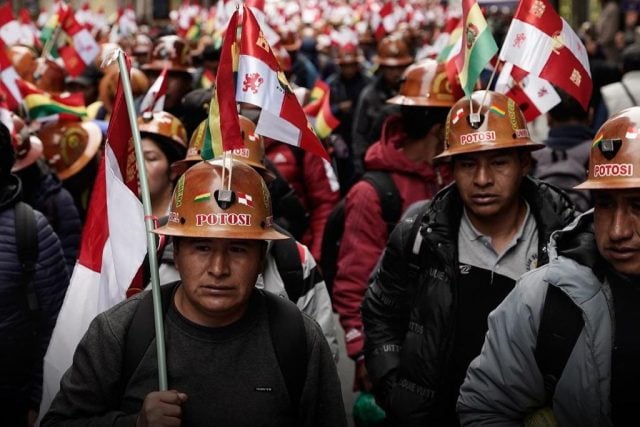
The crisis has led to confrontations, injuries, and reports of repression near Plaza Murillo, the political heart of Bolivia, where miners, factory workers, teachers, and COB-affiliated laborers protested the measure, while inside the presidential palace, the failure of negotiations was sealed.
A commission of leaders, headed by COB’s executive secretary Mario Argollo and mining leader Andrés Paye, entered the Casa Grande del Pueblo in the afternoon for an official meeting with government authorities. Upon entering, Paye expressed cautious optimism: «We are entering this meeting to listen and to be heard; there has to be equality,» he stated to the press.
However, after just over an hour of discussions, the labor delegation exited empty-handed. The government’s stance was clear and unyielding, refusing to repeal the contested supreme decree.
In a brief but emphatic communication with the press, Mario Argollo revealed the core of the disagreement: «There is a rejection from the central government; in this framework, we will responsibly inform our bases. There was a meeting, and we heard the executive’s proposal clearly: there is no intention to repeal Supreme Decree 5503, and we as COB came with that position.»
When asked about a possible definitive breakdown of the dialogue, Andrés Paye merely stated: «Due to organizational reasons, this time I will ask to allow us to meet, and the update will be provided by my executive colleague from the Bolivian Workers’ Central (COB) (Mario Argollo),» deferring the explanation to his fellow board member, who had already confirmed the deadlock with the administration of Rodrigo Paz, as reported by Visión 360.
Repression in the Streets of La Paz
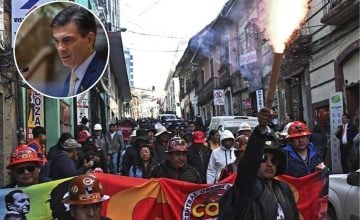
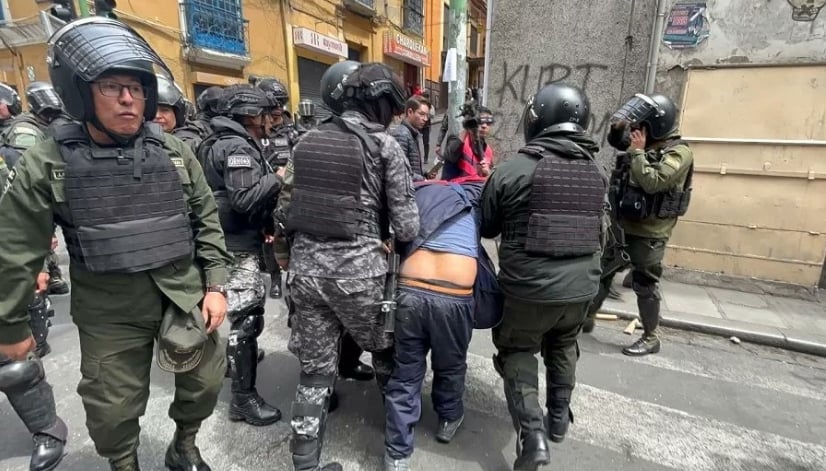
The meeting at the Government Palace took place while the surrounding streets were still smoldering from earlier confrontations. The march called by the COB, which brought together miners and urban educators, reached the vicinity of Plaza Murillo, where it was forcibly repressed by the Bolivian Police.
Police officials used tear gas to disperse the demonstrators, in an intervention that lasted approximately 25 minutes, forcing workers to retreat toward Avenida Mariscal Santa Cruz. The most intense clashes occurred around 10:45 AM local time, when the column of protesters attempted to surround the nation’s political center, reported TeleSUR.
Andrés Paye, upon leaving the meeting, strongly criticized the government for these actions: «That is the government’s instruction, to attack the people and the workers,» he denounced.
From the mining sector, reports of several injuries during the clashes emerged, and there was even mention of a possible fatality, though this information has not been officially confirmed.
Central Workers’ Union: «We Are Not Intransigent»
The failure of Tuesday’s dialogue was somewhat predictable. On Monday, COB leaders and representatives from other organizations waited over an hour for a meeting with President Rodrigo Paz and his cabinet, which never materialized. In the absence of that meeting, Argollo had already stated that mobilizations would continue until the repeal of Supreme Decree 5503, enacted by the right-wing president, which eliminates fuel subsidies and, as union members claim, facilitates the transfer of strategic resources to private entities.
«We are not intransigent,» the COB leader clarified, asserting that the labor federation would respond to any formal invitation and that their struggle was driven by labor and social demands, not political affiliations.
Meanwhile, the government claims to have reached agreements with around 20 social organizations that chose to withdraw from the protests. However, tensions in the country persist.
Currently, at least a dozen roadblocks are reported in the departments of La Paz, Cochabamba, Potosí, and Chuquisaca, highlighting that discontent has spread beyond the seat of government.
The Decree by Rodrigo Paz that Triggered the Crisis
At the center of the political and social storm lies Supreme Decree 5503, issued the week prior. The regulation, promoted under the argument of addressing the fiscal crisis, includes a series of economic adjustments, with the most sensitive being the gradual elimination of fuel subsidies.
For Paz’s government, which has been in power for just over a month, the measure aims to «rationalize public spending» and «prevent fuel smuggling.»
However, parliamentary opposition, transport workers, neighborhood associations, farmers, unions, and popular organizations decry that the measure shifts the burden of adjustment onto the working class and low-income sectors, causing a domino effect on transportation prices and the basic goods basket, leading to an immediate increase in living costs. They also warn that the decree lacks real protective mechanisms for the most vulnerable, which, in their view, will exacerbate social inequalities.
In fact, the government’s so-called «Patriotic Decree» resulted in a substantial immediate increase in fuel prices; the price of gasoline rose from 3.70 to 6.96 bolivianos, while diesel increased from 3.72 to 9.80 bolivianos.
The «fuel price hike,» according to COB, not only removes subsidies for gasoline and diesel but also «facilitates the transfer of strategic resources to national and foreign private entities.»
Obtén tu Pasaporte y apoya a El Ciudadano
Elimina la publicidad, accede a contenido exclusivo y sé parte de la comunidad.
Cancela en cualquier momento · Sin permanencia
Artículos Relacionados
Bolivia's Social Crisis Escalates: Prosecutors Target Union and Farmer Leaders Amid Protests
Hace 3 meses