Original article: “Primero a jubilados”: denuncian brutal represión policial en protesta contra la reforma laboral de Milei
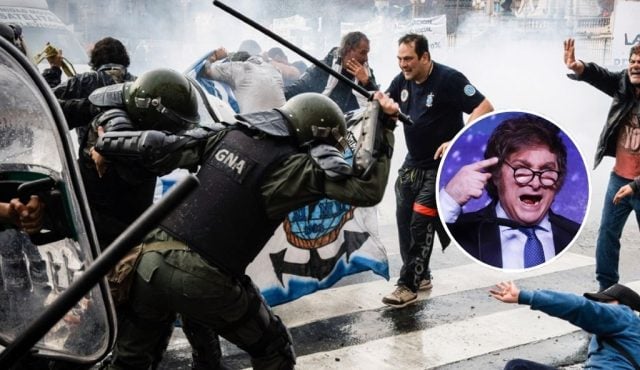
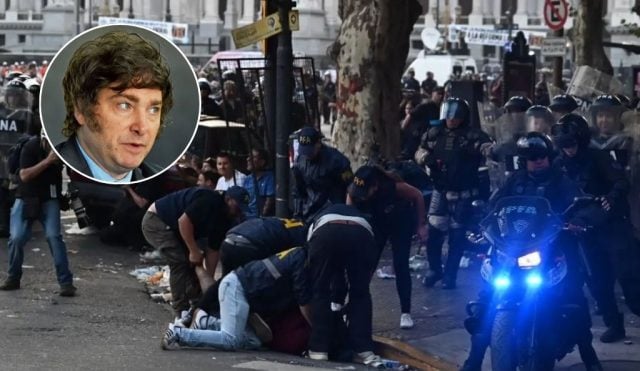
As the Argentine Senate debated the controversial labor reform championed by Javier Milei, thousands of workers gathered in front of Congress to protest. Once again, however, security forces violently dispersed the crowd using tear gas, rubber bullets, and water cannons. Social leaders and human rights organizations reported that retirees were the first to face the repression, resulting in over 30 detentions and hundreds of injuries.
Thousands of individuals convened in front of Congress in Argentina to express their opposition to the labor reform pushed by Javier Milei. What began as a peaceful and massive mobilization in defense of workers ended in brutal repression by federal forces and the Buenos Aires police. After 3 PM, as the Senate’s debate intensified, a small group of masked individuals began throwing stones and improvised projectiles over the barricades set up in front of Congress, behind which hundreds of police officers were stationed.
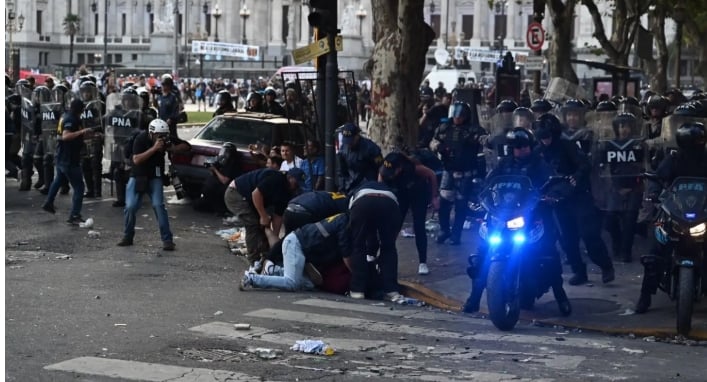
As has become customary under the so-called «libertarian» administration, security forces responded with violence. According to reports from social leaders and human rights organizations present at the scene, the repression primarily targeted retirees participating peacefully in the demonstration.
Following this initial wave of violence, tear gas and water cannons advanced on the crowd, dispersing the entire gathering with rubber bullets, pepper spray, and a large deployment that included the Federal Police, Gendarmerie, Prefectura, and the City Police of Buenos Aires.
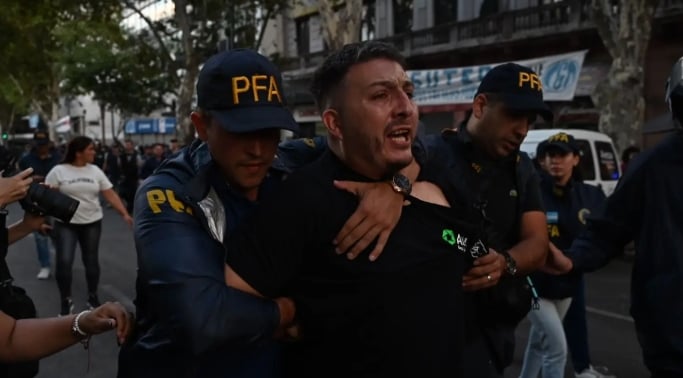
At the intersection of Sáenz Peña and Yrigoyen, at least two individuals were detained, while the City Police blocked the passage of journalists at Alsina and San José, threatening them with violence.
Radio Gráfica reporter Mario Sadras was among those affected, stating, «They pointed at my head and struck me just inches from my eye,» highlighting the level of violence exhibited by the security forces.
Government’s Justification for Repression
The operation was overseen by Security Minister Alejandra Monteoliva, who indicated in a message shared on social media that protests needed to be peaceful and any acts of violence would be met with repression.
According to the Secretary of State, there were attacks on security personnel, and some protesters were armed with mortars, Molotov cocktails, and slingshots with nuts, which she claimed had been identified.
«Dozens of individuals from leftist groups acted in an organized manner, with premeditated violence and homemade weaponry to attack our personnel and generate chaos. They will pay for it. Those who attack the forces will face the full weight of the law,» she stated in a message shared on her account on X.
Interior Minister Diego Santilli also spoke about the detentions.
«No matter how many Molotov cocktails they throw, the labor reform will happen one way or another. The party is over,» he wrote on X.
Additionally, Senator and former Security Minister Patricia Bullrich shared a message retweeted by Milei.
«The only language they understand is violence and masked faces, because they can’t get by with votes. The excuse is the protest; the goal is disorder. Debate and ‘win’ in Congress. On the streets, law and order are respected,» Bullrich wrote.
The City Police issued a statement confirming the existence of detained individuals “at the disposition of the Eastern Flagrancy Unit, where Doctor Malena Mercuriali endorsed the detentions.” Furthermore, it reported that they were charged with crimes of assault and resistance against authority, injuries, and arson, depending on the case.
Statistics of Repression: Detained, Injured, and Delayed
“The Bullrich-Monteoliva tandem deployed all their expertise inside and outside of Congress to impose libertarian labor reform,” stated human rights organizations monitoring the march, who compared the state actions to those during the processing of the Bases Law due to institutional violence exercised against the protesters.
In a conversation with Página/12, lawyer Carmen Verdú from the Coordinadora contra la Represión Policial e Institucional (CORREPI) confirmed that 20 detentions had been validated by the prosecutor’s office, and there were at least 30 individuals delayed by security forces. However, surveys conducted by social and human rights organizations reported even higher numbers.
According to records from the Provincial Commission for Memory (CPM), at least 31 individuals were arbitrarily detained, and an additional 70 were delayed on Lima Street, between Mexico and Chile, where they remained identified for hours until most were released.
Rodrigo Pomares, director of the Police Violence Program at CPM, questioned the legitimacy of the operation, indicating that it was an entirely unjustified repressive deployment because the majority of people were gathering in a completely peaceful manner. Some groups were even dispersing, as reported by Página/12.
According to the digital outlet, around 562 protesters received assistance from health teams from leftist parties, the Evacuation and First Aid Corps (CEPA), and the CPM itself.
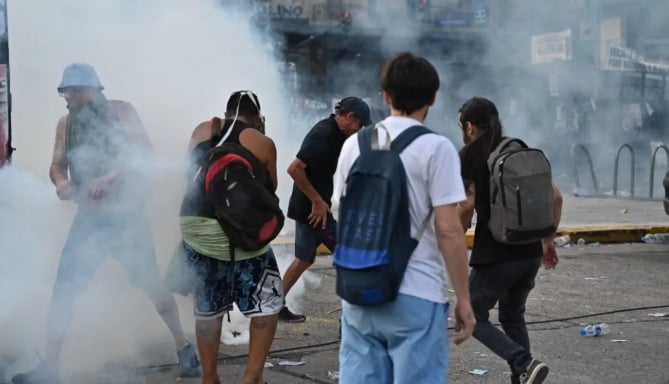
Many were affected by tear gas and pepper spray, including those from the CPM and the National Prevention of Torture Committee, like its president Juan Manuel Irrazabal, while others suffered injuries from rubber pellets.
CEPA Argentina’s emergency responder Esteban Chala described the severity of the treated injuries: “We had to stop a hemorrhage in a young man’s mouth from a rubber pellet impact to the lip. We also treated many people for gas poisoning and pepper spray,” he stated in an interview with Página/12.
Rescue workers also confirmed that several shots were fired above the waist, which is prohibited in the protocols for using so-called «less lethal» weapons, as they can cause severe injuries or death.
“They did not target only the lower body. We noticed that their attack position was at a 45-degree angle, but directed downward,” Juan Cardoso, a member of the health and care post, told this newspaper.
“We had injured from rubber bullets in the face. None with eye involvement, but close to the eye, in the cheekbone area, forehead, at the parietal region, and on the head,” he added.
Cardoso recounted how, amidst the chaos, they rescued individuals who were left wandering on the street without vision due to tear gas, while “others were severely injured or even in shock.”
Infiltrators and Provocation Allegations
According to protesters, the incidents were instigated by a small group of masked infiltrators, who aimed to cause chaos and discredit those who were peacefully demonstrating.
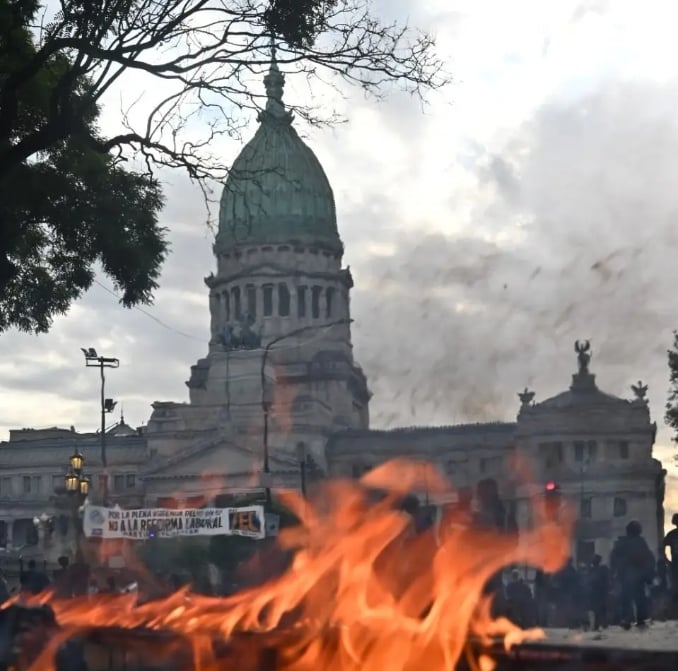
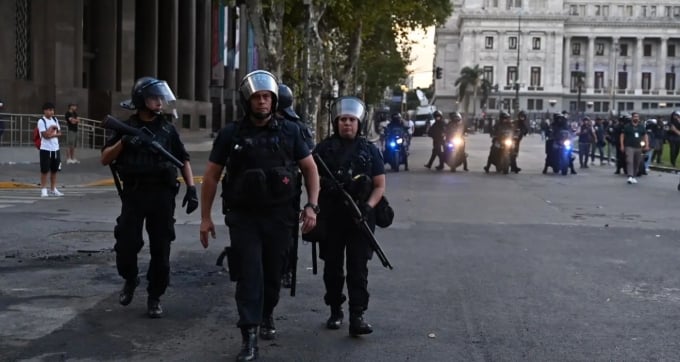
When part of the barricade was breached, the Gendarmerie’s infantry units and water cannons began spraying water and pepper gas towards everyone, most of whom were peacefully protesting.
From the Center for Legal and Social Studies (CELS), it was also reported that a particularly grave detail emerged: “They used rubber bullets, water cannons, and even the tear gas guns that Gendarme Guerrero – now under investigation – fired almost a year ago against Pablo Grillo.”
The comparison to that incident, which occurred on March 12, 2025, during a retirees’ protest in front of Congress, sparked alarms among human rights organizations, who noted the recurrence of prohibited or misused weaponry by security forces.
Tension remained throughout the day. A report from the Ombudsman’s Office of the City of Buenos Aires indicated that after much of the mobilization diminished, Jorge Macri’s police set up cordons in the surrounding streets, blocking evacuation routes to the north and south.
“In the face of the deployment of long-range pepper gas, the only way out was to leave the Congress square towards 9 de Julio,” they described.
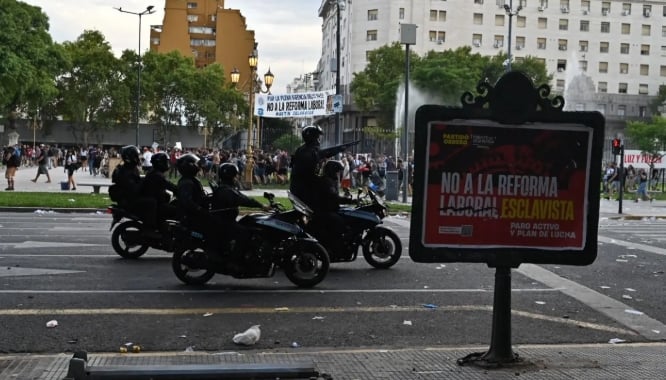
Repression continued with 15 motorcycles, followed by around 100 infantry officers firing gas cans and rubber bullets.
Police Ambush of Workers and Legislators
Hours later, the city forces repressed a group of deputies approaching Lima and Chile, where the City Police had detained 30 individuals, most of them members of the Union of Workers of the Popular Economy (UTEP). After intervention by the lawmakers, 10 people were released, but the remaining 20 were taken to Barracas Police Station, where a demonstration was called for their release.
Nicolás Caropresi, a leader of the Excluded Workers Movement, who was detained and later released, recounted how they were ambushed: «They stopped us in a completely perverse manner. We were peacefully leaving along the sidewalk, and they came from behind shooting rubber bullets at us. In front, they blocked the pass with motorcycles, cornering us from both sides. They knocked us to the ground and sprayed gas at us while we were down. These were people quietly leaving; they came seeking revenge,” he explained.
The UTEP publicly denounced that ten individuals remain imprisoned «without reason» at the Barracas neighborhood police station. Social movements and political groups demanded the immediate release of all detainees and announced they would remain vigilant and active in protest.
The Detained and the Charges Filed
According to information provided by sources from the City Police of Buenos Aires, El Destape published a list of 20 detained individuals and the charges against them:
-Julian Catalano: assault, resistance, and injuries
-Masilla Francisco: assault, resistance, and injuries
-Tripolli: arson
-Olvera Marcelo: arson
-Nicolás Viña: assault, resistance, and injuries
-Adrián Jorge Montiel: assault and resistance to authority
-Carlos Agusto Ruiz: assault, resistance to authority, and damages
-Juan Manuel Reichenbach: assault and resistance to authority
-Maximiliano Javier Melgar: assault and resistance to authority
-Gastón Ezequiel Reyes: assault and resistance to authority
-Raúl Alberto Bande: assault and resistance to authority
-Jorge Euclides Nieto: assault and resistance to authority
-Lila Amanto: arson
-Claudio Garro: arson
-Ayelén Portale: arson
-Sabina Neuman: arson
-Leonidas Orquera: arson
-Corina González: arson and other damages
-Félix Américo Maldonado: arson and other damages
-Agustín Sánchez Tomás: arrest warrant under Drug Law
Sources from the Buenos Aires police confirmed that the 20 detainees were placed at the disposal of the judiciary and that prosecutor Malena Mercuriali from the Eastern Flagrancy Unit has already “endorsed the arrests.” In contrast, human rights organizations warn that many of these apprehensions were arbitrary, and numerous individuals were arrested without having participated in any violent act.
A Consolidating Pattern of Repression
“This repression was of a magnitude more similar to the treatment during the Bases Law discussion, with a larger police presence and a clearly premeditated repressive decision,” described Rodrigo Pomares. The analysis from the director of the Police Violence Program at CPM corresponds with other organizations monitoring the operation: the national government, in conjunction with the city government, reportedly planned a high-intensity response to ensure the approval of the labor reform, regardless of the protest’s development.
Simultaneously, unions, social organizations, and political groups joined the mobilization, reaffirming their rejection of the labor reform and calling for continued protests, including a national strike. The day ended with over five hundred medical assists, dozens of detentions, complaints for violations of force protocols, and a shared understanding among mobilized sectors: the Javier Milei government is intensifying its repressive model as a central element of its political strategy.
As the Senate progressed with the contentious labor reform led by the libertarian administration, the impact of repression left its mark on those affected by tear gas, on the injuries caused by rubber bullets that disregarded protocols, and in the memory of an afternoon where once again, the first victims of state violence were the retirees.
Relacionados
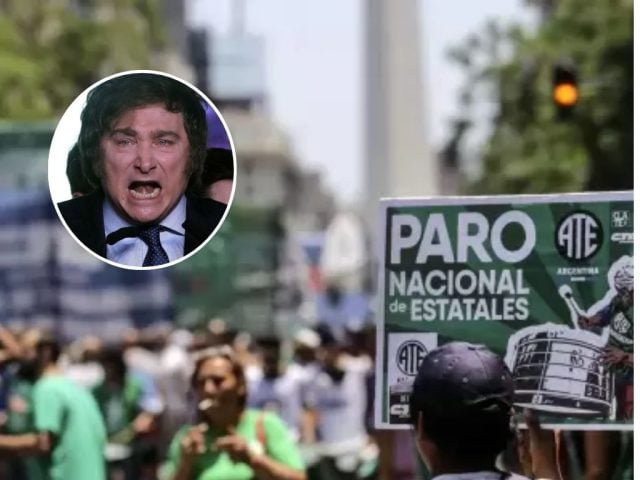
Argentine State Workers Call for National Strike Against Milei's Labor Reform: "They Want to Mess with Us"
Hace 3 meses
Will Chile Follow Suit? Milei's Labor Reform Aims to Reverse Over a Century of Progress in Argentina
Hace 2 meses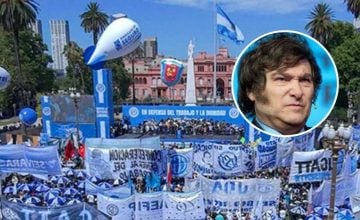
"A Sad Christmas Ahead": Retirees and Disability Groups Protest Against Milei Government at Argentina's Congress
Hace 2 meses