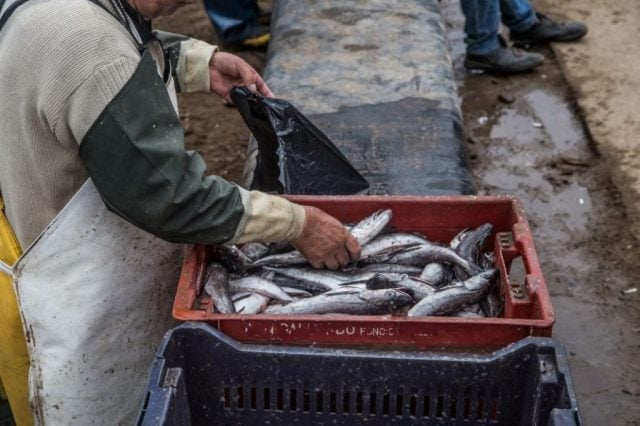
Original article: Merluza común continúa sobreexplotada en Chile: Cuota bajó 15% para el 2026
The biological status of common hake will still be classified as «overfished» in 2026, marking 13 consecutive years in this condition.
This was determined by the Technical Scientific Committee (CCT) for South Central Demersal Resources, whose minutes from the session on November 17 and 18, 2025, were recently published by the Undersecretariat of Fisheries and Aquaculture (Subpesca).
According to information provided by the Fisheries Development Institute (IFOP), the common hake continues to show negative signs, a trend observed since 2022.
The report also indicated a decline in the sizes of common hake captures, increasing the proportion of specimens below the reference length.
Consequently, the CCT recommended a 15% reduction in the 2026 common hake quota, decreasing from a total of 35,020 tons in 2025 to 29,703 for the upcoming year, which must be formalized through a ministerial decree.
«What the scientists have defined only confirms what we have warned about regarding the critical situation of common hake. We presented five measures to help it recover; however, we see no concrete actions from this government, specifically from the Undersecretariat of Fisheries, and we cannot continue to wait,» warned César Astete, director of fishing campaigns at NGO Oceana Chile.
«This situation has become unsustainable considering the impact such a decrease has on artisanal fishing in various regions of the country and on workers in the industry in Talcahuano,» Astete added.
The quota reduction is part of the CCT’s recommendation to extend the fishing ban, which currently applies throughout September.
The proposal, presented to the Management Committee in August 2025, aims to extend the ban one week earlier in August and one week later in October.
«It is proposed to adjust the extension of the ban period to the first days of October to avoid disrupting the spawning process. Furthermore, next year or the following year, we aim to begin the ban one week earlier in August,» states the technical document published by the organization.
Thus, Oceana asserts that a gradual and progressive process could be created, considering the socioeconomic effects of the measure.
From artisanal fishing, Omar Méndez, president of the Artisanal Fishers Union of Cocholgüe in the Biobío region, recalled that in previous years, «when the quota was around 42,000 tons, we warned against the impracticality of that increase, and now we see we were right as a new reduction comes to pass for 2026.»
The leader also mentioned that to recover common hake, a two-month ban is necessary along with determining a minimum size to ensure the sustainability of artisanal fishing.
Several weeks ago, Oceana along with artisanal fishing organizations presented a proposal of five measures to save common hake, which gathered insights from artisanal fishermen, the scientific community, civil society, and discussions that have taken place in Congress.
Among these measures is the proposed increase in the fishing ban to protect its reproductive peak, a measure suggested by artisanal fishing sectors in the Management Committees, who have called for a gradual extension with a regional approach.
«2026 will be the first year that the quota is distributed under the new Split Law, which allocates 45% to the artisanal sector and 55% to the industrial sector,» highlighted the NGO.
The Citizen
