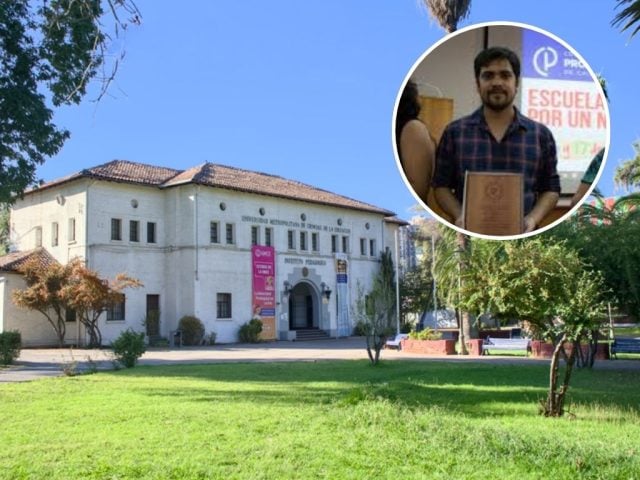
Original article: Desvinculación del docente Cristian Olivares conmueve a la comunidad del ex Pedagógico (UMCE) y genera llamado a su reintegro
The termination of Professor Cristian Olivares Gatica at the Metropolitan University of Educational Sciences (UMCE), formerly known as the Pedagogical Institute, has raised significant concern and uncertainty within the university community, particularly among students and faculty who work under similar contractual arrangements. This situation unfolds against a backdrop of scrutiny regarding labor conditions and the manner in which the decision was made. In this context, Professor Olivares has expressed a willingness to have the decision reviewed and to return to the university.
According to disseminated statements, on December 5, Olivares was notified that his fee-based contract, in place since 2015, would not be renewed, with December 12 set as the end date for his duties.
Since 2015, Olivares had served as a fee-based instructor in the Basic Education Department of UMCE, teaching courses on civic education and geography, along with subjects related to methodologies, planning, and Popular Education across various programs.
He was also the initiator and coordinator of the Diploma in Popular Education and Emancipatory Pedagogies, served as the general coordinator of GEPEM, and acted as an academic counterpart in projects linked to territorial organizations, while also fulfilling roles representing fee-based faculty as their spokesperson.
Given his track record, the educational community has called into question this decision, with some suggesting that the termination may be indicative of potential discrimination due to his union role.
Cristian Olivares has held a leadership position as the spokesperson for the Organization of Fee-Based Faculty at UMCE, where he represented workers in demands for better working conditions and delays in salary payments.
Various academic and union organizations have indicated that his dismissal occurs within a context of active union organization, raising concerns about a potentially discriminatory or anti-union character linked to the university’s decision.
More Than a Dismissal: Disassembling Academic Spaces
The Group for Studies in Popular Education and Emancipatory Pedagogies (GEPEM) stated in a release that the decision not to renew the contract for 2026 constitutes a violation of labor rights, given that Olivares’ long-term work of over ten years does not align with the nature of a fee-based agreement, noting that this precariousness also affects other faculty members at public universities.
Furthermore, they indicated that despite having explored alternatives and consulted beforehand to ensure his job continuity, the notification of non-renewal was made belatedly.
In this context, GEPEM recalled that Olivares had undertaken union leadership duties, representing fee-based faculty against various labor violations, including delays and lack of payment of salaries.
GEPEM expressed its inability to comprehend the decision made by the Basic Education Department’s administration, emphasizing the positive evaluations Olivares received from his students, his strong relationships with the academic team, and his ongoing involvement in research activities, publications, and academic events, even after his termination.
Additionally, they asserted that the termination creates profound uncertainty concerning the continuity of his academic work and denounced a critical situation: the disappearance of the office where GEPEM operated. According to the research team, the department withdrew their physical workspace, leaving the whereabouts of furniture, equipment, and valuable academic materials—such as books, journals, and collected research records accrued over a decade—unknown. This lack of information regarding the group’s assets not only hinders intellectual efforts but has been described as an act of material harassment that exacerbates the precariousness surrounding his dismissal.
«For all the above reasons, we advocate for solidarity with our colleague and request that the relevant authorities review their decision, as it severely impacts the community-building efforts that have historically characterized the Metropolitan University of Educational Sciences and the Pedagogical Institute of the University of Chile,» the statement concluded.
Warnings About Discriminatory Practices and Violation of Labor Rights
From the special education advocacy group, it was noted that Olivares’ case is not isolated but rather part of a series of dismissals justified by «trust.» This reasoning seems to have been used to terminate staff in areas such as APROTEC, despite favorable evaluations and explicit support from colleagues.
The community alleges that these criteria lack technical and objective foundations, functioning more as a tool for administrative arbitrariness.
Moreover, there are warnings about possible discriminatory practices related to gender and neurodiversity, affecting individuals within the autistic spectrum. Organizations warn that these dismissals occurred just after the university occupation, reinforcing the thesis of political and union reprisals.
Cross-Sectional Solidarity: Organizations Demand Reversal of the Termination
Additionally, the Research Group on Latin American Pedagogies at the University of Playa Ancha publicly expressed their concern regarding what they termed an unjustified dismissal, warning that this case reflects the precariousness and uncertainty faced by fee-based academics at public universities, particularly regarding long-standing employment histories.
They also highlighted a scenario of harassment and systematic persecution against workers who promote union organization, noting that anti-union practices have been a constant and have permeated the educational system.
«We hope that the UMCE authorities can carefully review this measure and reverse the decision,» concluded the public statements.
In this regard, the National Federation of Education Workers (FENATED) expressed regret over the decision, emphasizing the need to safeguard the union role of the educator and warning that his termination undermines training initiatives and critical reflection spaces linked to the organization of education workers.
Finally, the Public Community School of Barrio Franklin voiced its concern over the lack of continuity for Professor Olivares, remarking that the decision is difficult to comprehend due to its impact on educational ties with the university.
The organization noted Olivares’ role in the Diploma in Popular Education and in training students in practice, warning that the measure adversely affects the projection of these educational processes.
They ultimately called on UMCE authorities to review the decision due to its potential inconsistency with public education principles.
In a show of solidarity against what they consider an unjust termination, Basic Education students are gathering signatures in support of the professor, which can be accessed by clicking here.
Career, Publications, and Teaching: The Educator’s Arguments
In conversation with El Ciudadano, Cristian Olivares stated that the non-renewal of his contract was justified by a supposed evaluation of the «academic needs» of the Basic Education Department. However, he asserted that when seeking explanations, he was informed the reason was that he was not a basic education teacher, despite the fact that—according to him—that criterion has not historically been exclusionary and is not observed by a large portion of the academic staff.
For Olivares, the justification appears inconsistent, as he fulfills various academic needs of the Basic Education Department. He also possesses 15 years of academic experience, more than 40 publications, and nearly 60 presentations at seminars and conferences; he has participated in research projects, academic extension, and numerous outreach actions, among other achievements.
Olivares explained that for the past five years, he had been the coordinator of the Group for Studies in Popular Education and Emancipatory Pedagogy (GEPEM), despite his fee-based status. He noted that this space has received academic validation from both the departmental council and the faculty, which unanimously recognized him as its general coordinator, prompting a request from 2023 to review his contractual status to facilitate the role.
In this vein, he indicated that this group spearheaded the Diploma in Popular Education, which has become the most attended and one of the most successful at the university in recent decades.
«Between 2022 and 2023, the university’s self-evaluation report for institutional accreditation listed a total of 146 enrollments in diplomas. Of these, a hundred corresponded to new enrollments generated by our diplomas alone in those two years. We are now entering the fourth year of operation, and on track for the fifth,» the educator stated.
He also pointed out that this diploma is the only one in Chile and one of the few in Latin America linked to workers’ movements and organizations in education with the public university.
He elucidated that the diploma operates under a logic of collective management, as it was originally initiated by him and coordinated in its first year before rotating that role among different instructors. Currently, he indicated, the program is managed by faculty from other departments while maintaining the collaborative focus with which it was conceived.
In his view, these factors demonstrate that his work indeed contributes to the institutional and accreditation processes of the department. Additionally, he noted that every time these initiatives have been presented to the academic vice-rectorate, the rectorate, and other bodies, they have been highly valued for their academic projection, training, community engagement, and resource generation—a situation that, he asserted, has not been regularized due to his contractual status.
On the other hand, Olivares maintained that, in his opinion, the argument that he is not a basic education teacher is unjustified. He stated that he does indeed teach in that area, particularly in school reintegration programs, a field where—according to him—there is a lack of extensive experience and which is now part of the university’s transversal practices.
Furthermore, he added that he has promoted non-formal and popular educational experiences with national and Latin American recognition, such as the Public Community School of Barrio Franklin, which, thanks to his efforts, now serves as a practice center for the Basic Education Department to develop such work.
Olivares further noted that the department itself promotes a postgraduate program in basic education, which—he believes—would have addressed this requirement without resorting to terminations. He pointed out that, unlike other academic situations, no deadlines or institutional support were offered to regularize this requirement.
In that regard, Olivares stated that the required criterion only emerged at the end of the second semester. He indicated that even after his termination, attempts were made to find staff without stipulating being a basic education teacher as an exclusionary requirement, which—in his view—reinforces the notion that the measure is not justified by academic needs.
Popular Education, Unionization, and Tensions with the University
For Olivares, the non-renewal of his contract is interpreted as a response to events occurring in April 2024 when, after nearly ten years working fee-based at UMCE, he was involved in union organization processes and labor condition defenses both prior to and following the pandemic.
He indicated that that year saw a sharp increase in payment issues for fee-based workers, directly affecting his primary income source. In this context, he asserted he was one of the drivers of the reorganization of the fee-based workers’ group at the university, which he believes marked a turning point in his relationship with the institution.
«I was one of the spokespeople for that organization and one of those who raised significant discussions both in the academic council and in the department. This led to a class stoppage to pressure for timely payments, which was ultimately realized before the end of the month,» Olivares declared.
The educator asserted that until that incident, his relationship with the university was positive and even noted that in March, his work was highly valued by the authorities and the vice-rectorate, advancing toward his institutionalization and the formal authorization for the office he occupied to become the GEPEM headquarters.
Following the events of April, in the second semester, he was abruptly informed that he needed to vacate the office he used, despite a prior agreement with the rectorate. He noted that he was not given the opportunity to discuss or relocate the work of GEPEM, despite his repeated requests and years of service in that space.
In late December 2024, Olivares requested a meeting with the director to discuss his contractual situation. He indicated that one of the first points was the commitment made by the administration upon GEPEM’s approval to explore changing his contract modality, a matter that—according to him—never received a concrete response.
He stated that despite being in the process of obtaining his doctorate and meeting the criteria to apply for a competition, he was told that there were no possibilities of opening positions. Moreover, it was indicated that potential competitions would not consider his area of expertise, leading him to believe it would be best to seek options at another university.
Later, he learned of the opening of a competition for a mention in Social Sciences that was not communicated to coordination bodies. The competition’s bases, by decision of the director, required a doctoral degree and excluded applications from «doctoral candidates,» thus leaving out fee-based instructors in the department.
In his opinion, this measure is directly linked to the events of April 2024 and resulted in his non-renewal, despite his status as one of the longest-serving and most transversal faculty members in the field. He also noted that the withdrawal of the office impacted spaces related to union organization.
Moreover, Olivares noted that after the July meeting, he began experiencing systematic exclusions: absence of institutional responses, omissions in official communications, and obstacles in the certification of teaching assistantships. He believes that these situations create an indirect treatment that ultimately affects both students and academic processes he had developed for years.
On the other hand, Olivares stated that after a letter was sent by the Public Community School requesting explanations, the administration responded by downplaying his role in the Diploma in Popular Education and Emancipatory Pedagogy. He indicated that a narrative was constructed that deliberately omitted his status as a promoter and historical coordinator of the program, minimizing his connection to the university’s most successful diploma and the department itself.
Olivares stated that the administration also denied his association with teacher professional practice, despite having participated and received positive evaluations. He added that his role in the management that allowed the Public Community School to become a practice center for the department was overlooked, an earlier achievement that—he asserted—is now being sought to be disregarded.
Olivares maintained that there is no objective justification for the decision not to renew his contract, as—he stated—there are no academic, institutional, or economic arguments supporting it. In this sense, he dismissed the idea that the measure is related to accreditation processes or a possible lack of resources.
In his view, the non-renewal stems from other motives, possibly linked to the orientation of his work in popular education and critical emancipatory pedagogy, as well as his role in advocating for better working conditions for fee-based workers.
Various organizations, students, and academics reiterated their call for UMCE to review the decision and allow Cristian Olivares’ reinstatement, emphasizing that his departure not only affects his career but also academic projects, training spaces, and community ties developed over years within the public university.
Relacionados

End of Funding for CR2 Raises Concerns Over Chile's Ability to Combat Climate Change Challenges
Hace 2 meses
UTEM Launches Territory Observatory Aiming to Address Urban Segregation and Territorial Inequality
Hace 3 meses
Chilean Astronomer Teresa Paneque Awarded Prestigious 'Oscar' of Science Communication in Washington
Hace 3 meses
University of Chile Mourns the Loss of Esteemed Artist Gonzalo Díaz Cuevas, National Prize for Visual Arts 2003
Hace 2 meses
Chilean Claudia Fuentes Julio Appointed as New UN Deputy Secretary-General for Human Rights
Hace 4 días