Original article: Condena firme: exmarinos cumplirán 16 y 10 años por homicidio de hombre amputado que se desplazaba con muletas
The Iquique Court of Appeals upheld the 16 and 10-year sentences applied to former sailors Sergio Pérez and Christopher Garrido for the brutal beating that took the life of Milton Domínguez, a 61-year-old Colombian migrant in a vulnerable situation after losing one of his legs.
In a ruling that concludes a judicial process that captivated the Tarapacá Region and moved the entire country, the Iquique Court of Appeals rejected the nullity appeal filed by the defense of former sailors Sergio Pérez and Christopher Garrido. Thus, the sentence issued last November by the Oral Criminal Court (TOP) of Iquique was confirmed, sentencing them to 16 and 10 years of effective imprisonment, respectively, as authors of the qualified homicide of Milton Domínguez, a 61-year-old Colombian migrant who was in a vulnerable condition due to his loss of a leg and who relied on crutches for mobility.
The appellate court dismissed the defense’s arguments aimed at nullifying the oral trial. With this ruling, the former Navy officials must irrevocably serve the sentences imposed for their involvement in the brutal beating that, in the early hours of May 19, 2023, ended Domínguez’s life at the intersection of Bolívar and Ramírez streets.
The case, which caused profound social impact, highlighted the extreme vulnerability of homeless individuals, migrants, and those with disabilities, conditions tragically intertwined in the victim, who navigated life with the aid of two crutches after suffering a leg amputation in the immediate post-pandemic period.
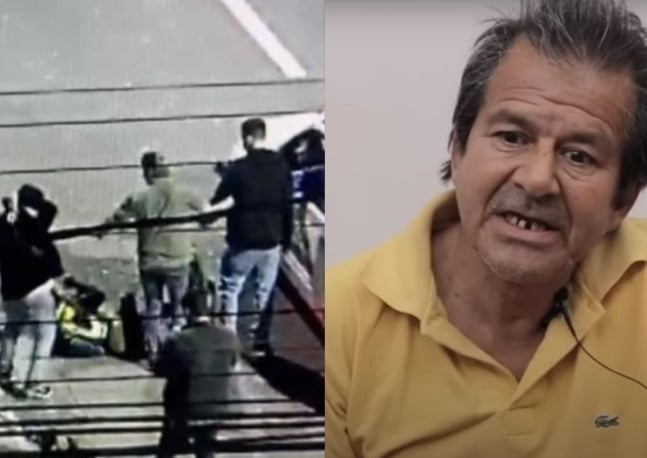
Details of the Brutal Attack
According to evidence presented during the trial, the events occurred around 5:00 AM. The convicted, along with two other Navy officials who were on duty and off-duty, engaged in a disagreement with Milton Domínguez, who was a regular user of the Men’s Shelter of the Hogar de Cristo in Iquique.
As stated by the prosecutor of violent crimes, Francisco Almazán, the situation escalated quickly. One of those present shoved the victim, leading to his fall to the ground, rendering him defenseless. It was at that moment that the attack turned into a savage beating.
The court determined that Sergio Pérez (S.P.N.) «acting with certainty»—which constitutes the treachery aspect of qualified homicide—began to strike Domínguez with his own crutches and kicked him in the head and body. While he was attacking, another individual also struck him in the head, and Christopher Garrido (C.G.S.) relentlessly beat him with a belt across the upper body.
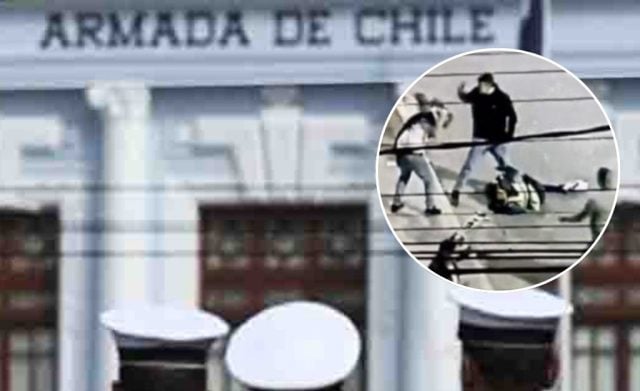
The assault, captured by security cameras in the area, showcased unprecedented violence against a man who, due to his physical condition, was unable to defend himself. Due to multiple fractures and the extreme violence, Milton Domínguez was urgently transported to the Regional Hospital Ernesto Torres Galdames, where he died hours later from a closed head trauma consistent with being struck by a blunt object.
Prosecutor Francisco Almazán expressed satisfaction with the ruling following the initial sentence, appreciating that the court took into account both the previous impeccable conduct of the accused as well as «the severity of the events and the actions taken by each one».
The investigation, which included witness testimonies, the work of the Homicide Brigade, and the Criminalistics Laboratory of the PDI, as well as the forensic report from the Medical Legal Service, was crucial in establishing the dynamics of the events and the responsibility of each former uniformed officer.
The evidence presented by the prosecution included graphic expert opinions, medical reports, eyewitness testimonies, and investigators’ statements, as well as a death certificate and clinical records.
«My Brother Knew Hell»: The Family’s Pain and the Fight for Justice
For Nancy Domínguez Moreno, Milton’s older sister, the upholding of the conviction represents a gesture of reparative justice after a long journey of pain.
«We are not seeking revenge, but justice (,,,) My brother and no one deserves such punishment. It was three minutes of beating, of hell. In those three minutes, Milton knew hell,» she stated in comments to Hogar de Cristo.
Nancy, who is an engineer and sociologist, traveled from Cali, Colombia, to confront the process and raise her voice for her brother, whom the family affectionately called «El Pajarito.» Her testimony as a witness-victim was a crucial moment.
She admitted to mentally preparing herself not to break down, caring for her own health, as she has two pacemakers and her doctor warned her of the risk of intense emotional shock. Nevertheless, the harshness of the images overwhelmed her. «What I least wanted was to elicit compassion, and I prepared myself not to cry… but I broke down and cried,» she confessed.
Despite her suffering, Nancy made the decision to confront the accused without the protection of a screen.
The judge asked me, ‘Do you want us to put up a screen so you don’t see the accused and he can’t see you?’ I replied, ‘No, Your Honor, I want to see him. Look him in the face.’ And I did. There he was, a young boy who ruined his life forever. Not only his, but I can imagine the suffering of his family and I know they are probably suffering more than we are, because our relative died brutally but rests in peace. In contrast, his will spend his youth in prison.»
The Story of «El Pajarito»: A Dream Cut Short in Chile
Behind the victim was a story of struggle and shattered dreams. Milton Domínguez, from Cali, Colombia, was a technician in the installation and maintenance of solar panels, a profession that filled him with pride and that he dreamed of using to contribute to the development of clean energy in Chile, the country he chose to start a new chapter in April 2023.
His journey, however, abruptly turned into a nightmare. After entering Chile, he contracted a fungus in his foot that led to a severe infection. He recounted his ordeal to Hogar de Cristo shortly before his death.
«I got infected with a fungus in my foot. I started with an itch, didn’t pay much attention, but after three days it had eaten my toe and turned black. I knew I was going to lose that toe (…) when I returned to the break room, and I woke up, I realized they had cut me above the knee,» he stated.
The amputation of his right leg plunged him into profound depression and led him to homelessness, distancing him from the Men’s Shelter of Hogar de Cristo in Iquique, where he had found refuge after his discharge. His sister Nancy recalls conversations from that time: «Over the phone, after he told me he’d lost his leg, he consoled me by saying, ‘I lost a little leg, but not my wings, little sister.’ That’s how he reassured me, but we’ll never know how depressed he was. I’ve tried to investigate that, but the fact is he ended up on the street.»
Despite his harsh reality, those who knew him at the shelter remember him as a calm, kind man with extraordinary inner strength. One of his phrases remains etched in the memory of those who interviewed him: «I lost a leg, not my arms.»
Artículos Relacionados

Former Carabineros Officer Sentenced for Assaulting 14-Year-Old Girl, Leaving Her Blind, Begins Prison Term at Colina 1
Hace 3 semanas
Court Upholds 77-Year Prison Sentence for Colombian Crime Leader Operating in Antofagasta
Hace 1 mes
Supreme Court Convicts Former Joint Command Agents for the Disappearance of Communist Leader in 1976
Hace 2 meses
Santiago Court Upholds Prison Sentence for Carabineros Major Over Brutal Shooting of University Student
Hace 3 semanas
Hermosilla Granted Daytime Freedom as Court Lowers House Arrest to Nighttime Only in Factop-Audio Case
Hace 2 meses