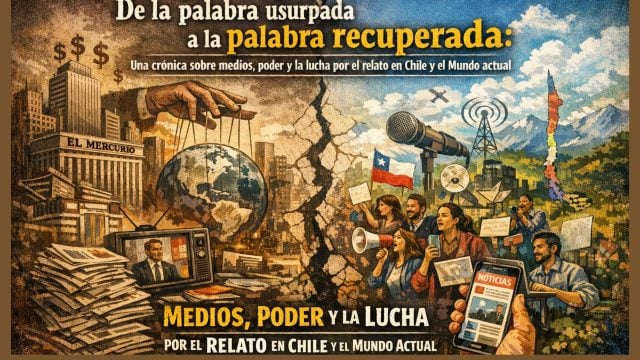
Original article: De la palabra usurpada a la palabra recuperada: Una crónica sobre medios, poder y la lucha por el relato en Chile y el Mundo actual
The history of media in Chile reflects the struggle for power and national narrative. Once dominated by a few actors who monopolized public attention and influence, «El Mercurio» epitomized the predictable flow of information through controlled channels. However, this landscape has shifted, not towards full democratization, but into a complex and unequal fragmentation that, unless addressed from communal to national levels, may allow the centralism of Santiago and its financial strongholds to overshadow the narrative emancipation of local communities.
I. The New Landscape
State advertising, while contested, has created slight fissures, yet it is the rise of new technologies that has facilitated the emergence of alternative media. Alongside traditional conglomerates, like the Edwards group and Álvaro Saieh’s media pool, new forces are now at play.
These include transnational communication companies operating under the logic of social networks or instant messaging. These private entities constantly alter their rules without any citizen consensus, with algorithms driven by interests that may not align with community needs. Sometimes, they even resort to misinformation to achieve their goals.
The right has formed a dual network in communications, with specialized media wielding significant influence as payment gateways for political and economic elites. Additionally, a constellation of digital networks disperses misinformation widely or distracting sparks that lead communities astray, consuming both resources and reach.
In response, a strong push for empowering and re-articulating citizen and communal media emerges—reflecting the ethos of Luis Emilio Recabarren, where printing serves the interests of the people and workers of Chile. It aims to capture their thoughts, aspirations, and agendas for local improvement, fostering social agreements from the grassroots perspective through a communal social lens.
This struggle is about reclaiming the narrative. It aims to prevent another digital-age usurpation of Gutenberg and foster communal solidarity, cultivating our oral traditions as united peoples, documenting them in agreements on paper and other media to reaffirm our social identity.
Not only is this fight for communication channels—be they airwaves, printed materials, or a communal digital ecosystem connected nationally—but also mirrors the territorial struggles over vital resources. This situation unfolds in a context of the historical neglect of the State, which, after selling or conceding much of the common heritage to political allies, applied similar logic to communication, favoring profitability over informed citizenship. Thus, the people’s voice has been usurped, just as river basins were privatized, robbing us of sovereignty over essential resources, including electricity generation.
Land, water, and freedom form a triad that neoliberalism has sought to erase, much like Alzheimer’s robbing memory.
A fundamental question arises: when will territories and their communities reclaim their communicative power to defend their lands, as true guardians of water, life, and an abundance-based economy rooted in common goods that grant energy and food sovereignty and add value locally to raw materials for cooperative systems—not individual gain?
The social dialogue fostered by local communication action confronts the interests of oligarchic corporations and the imperial powers of entities like the UK and Germany, alongside the United States and Meloni’s Italy, configuring a Chile and Latin America in a state of neocolonization.
We stand unequivocally on the other side—call us communists, anarchists, or socialists if you wish. However, we protect the interests of many, rather than a few. If there are individuals among us deserving recognition, it’s due to their proven commitment to service.
A culture where members mutually support one another stands in stark contrast to one seeking a superman who surpasses all, possibly resorting to violence or crime for objectives.
Time will tell which nations in Chile fulfill the promise of national industrialization and could make a difference as pressures mount for reclaiming our common resources, especially as the people begin to recognize that the communal press is a more ancient and legitimate artifact than the names of many modern states.
This Latin American and Global South consciousness represents another narrative that the hegemon has attempted to obscure or distort, yet it remains as palpable as the atrocity and injustice that underpin the genocide in occupied Palestine—an issue compounded by a peculiar lack of high-level political and diplomatic response, even from within Israel.
If anyone demands a change of regime and international trial for their dictator, it is Israel, not a Venezuela besieged by the Anglo empire throughout history, along with the United States and its thirst for oil and natural resources.
If we can reclaim our voice and historical memory from local spaces and strengthen a digital media ecosystem for our international advocacy and defense as peoples, transcending borders, we will have triumphed, heralding a profound social change at the dawn of a new millennium.
II. The Ideological Nexus: Political Zionism, War, and the International Ultra-Right
To grasp the modern war machine, it is essential to analyze the role of political Zionism as an ideology of occupation and displacement, and its symbiotic connection with the expanding international ultra-right.
This nexus provides a narrative framework and a common geopolitical project for international coordination in defense of an exclusionary nationalism, militarization of borders, and justification of state violence as a tool for dominance and even war.
A prototype far removed from social dialogue and recognition of spaces as plurinational forums for cultural respect, instead adopting anti-immigrant policies.
The examples are telling and outline a coordinated global map:
Javier Milei in Argentina, who aligns ideologically with political Zionism and shows unwavering support for Israel’s foreign agenda, all while promoting an internally violent dismantling project.
José Antonio Kast in Chile, actively supporting Israel and connected with Trump’s Republican right and European reactionary elements, positioning him as a local link in this network, promoting a political and cultural blockade against any community advance, particularly antifascist initiatives.
Donald Trump in the United States, whose recognition of Jerusalem as Israel’s capital and anti-immigration policies represent the American version of this ideological package, a Christian-Zionist nationalism allied with predatory capital, which has even labeled antifascist movements as terrorists.
Benjamin Netanyahu in Israel, as the central architect of political Zionism focused on settlement and militarized security, whose alliances with ultra-right governments in Europe and Latin America have become explicit. His administration has not only normalized occupation but also exported a model of “national security” based on surveillance, demographic control, and displacement, adopted by similar movements in the West.
Volodymir Zelensky in Ukraine, whose national defense against the Russian invasion has been instrumentalized by this ideological block to reinforce narratives of exclusionary sovereignty, ethnic nationalism, and permanent militarization. His associations with radical right governments in Poland, Hungary, and Italy, along with unconditional support from figures like Trump and Meloni, place him at a geopolitical intersection where self-defense intertwines with global rearmament agendas and the consolidation of civilizational blocs.
Viktor Orbán (Hungary): He is the theoretical and practical architect of “illiberal democracy,” promoting the conspiracy of the “great replacement” while maintaining a cynical and strategic alliance with Netanyahu that shields him from accusations of anti-Semitism, simultaneously strengthening an autocratic state based on ethnic-Christian homogeneity.
Nicolas Sarkozy in France, whose presidency foreshadowed a turn towards identity nationalism pro-Israel and anti-immigrant. An employee of Rothschild paving the way for even more radical forces like Marine Le Pen and Eric Zemmour. His rhetoric surrounding “security” and exclusionary republican assimilation fits into the model of a strong state with hard borders that this axis promotes, leading Europe and the world into an arms race for profit.
Giorgia Meloni in Italy, leader of the post-fascist ultra-right, whose government blends traditionalist Catholic nationalism with unwavering support for Netanyahu’s Israeli policies and an agenda for Europe centered on immigration restriction and defense of “Western civilization.” Meloni epitomizes the contemporary version of international right-wing movements: pro-NATO, socially anti-globalist, and aligned with political Zionism as a bulwark against Islam and the left.
Even a power like Russia is caught in this contradiction. While its foreign policy is complex, significant influence from oligarchs and Zionist lobbies exists among its elite, creating internal tension and ambiguity in its position, demonstrating how this ideology transcends traditional geopolitical blocks. This tactical alliance ultimately serves to shield criminal actions under the banners of “self-defense” or “sovereignty,” whether in Palestine, Ukraine, or through internal repression of any populace claiming dignity.
III. Dismantling the Criminal Machine: Systemic Corruption and Double Standards
This system of usurpation, abandonment, and war represents the criminal machine that humanity must dismantle collectively. A machine that has not only corrupted legislative power in Chile but has also infiltrated the judiciary and state apparatuses, which have been auctioned off to provide favors to a select few in Chile’s affluent communes like Vitacura and Las Condes, and to big capital in tax havens like Liechtenstein, leading to a highly segregated society.
Favors that newer generations can barely dream of, while some will be exempted from contributions on first home purchases as thousands remain homeless on endless waiting lists, instead of activating a communal, associative, and community-building power based on contributions from all citizens of each commune.
A housing contribution correlating to their incomes, with strict civic auditing due to the public funds involved.
Here, ethics transform into politics and direct action for social change, beginning with the recovery of the narrative for subsequent articulation.
A space where the commandment «thou shalt not kill» and the true spirit of peace, meant to be present every day rather than just at Christmas, compel the dismantling of this machinery of material and economic impunity. The war to end is the one waged daily against peoples through dispossession and structural inequality.
Structured inequality, comfortable for figures like Axel Kaiser, who opines that a separate country should be created for communists in Chile: an apartheid. Moreover, with boldness he claims that it is due to the desire to “steal everything” from him.
Yet, this fictional character does not ask who truly stole rivers or took them for themselves, who seized public enterprises, or stole the livelihoods of working people for a spade, a pickaxe. Nor does he question how many thousands of hectares were allocated to individuals by the State without merit, and in some cases, merely for being an immigrant.
IV. Towards an International Press of the Peoples: A Concrete Proposal
In response to this global dismantlement, the alternative communication model must be radical and globally oriented in solidarity. From hyperlocal to communal to glocal. Imagine a law that funds an official medium in each commune, an essential yet austere black-and-white local newspaper.
And if not funded by law, then it must be supported by the communities willing to transition from usurped words to reclaimed narratives.
The sustainability could come from contributing families in the community, from a specific tax, from a video signal online, or from an “International of the Press and the Peoples,” a global solidarity network that serves as a democratic counterweight to the ultra-right’s international ties and the media chains anchored to a decaying military oligarchy.
A network of media providing secure support and connectivity to besieged community outlets. This contrasts sharply with the abandoning state and the Zionist occupation project, constituting the construction of a new common based on true words and bottom-up cooperation to elevate citizen voices into a popular clamor—not populism for those playing with fear and social shock, recycling the international financial system with war.
V. The Global Context: War, Resources, and Capital Flight
This struggle is both local and global. Chilean lithium, sold at giveaway prices, fuels the extractivist logic that finances wars and apartheid. The capital flight from the Chilean economic right in response to the advance of collective ideas illustrates how elites drain nations while operating within this transnational network. Those complicit capital must be returned, and their perpetrators held accountable for promoting the worst aspects of humanity: war.
In conclusion, I would like to emphasize the urgency of strengthening our collective narrative against global fascism and its war nexus.
We trust that the united collective narrative from the peoples of Chile and Latin America will be wiser and more powerful.
We must confront not an isolated phenomenon but rather international fascism and its connection to the Zionist occupation project, which seeks to establish a world of visible and “invisible” walls, material and digital, permanent wars, and dispossession. This fight against their expansive policies and wars over natural resources has unleashed migratory waves worldwide that they then seek to condemn.
This will constitute the deactivation of the criminal machine, reprogramming it for peace, as humanity faces collectively, first revealing through words, and remembering that the etymology of Apocalypse means revealing the veil.
Let Peter Thiel and others not bring us the advent of something terrible. If the Antichrist—who, as they proclaim, comes before Christ—and whom they dread, is to deceive us, it will do so presenting itself as something good for the majority and resulting in justice for those who consider themselves the chosen ones.
The freedom they so staunchly defend cannot be the freedom to wage war and support the genocide of Israel. Maintaining a nuclear-capable aircraft carrier in the Middle East for decades since the end of World War II, along with another like Rammstein for launching murderous operations against the Middle East unceasingly, must end in this decade if we truly aspire to build a glocal arc of peace and global security for current and future generations.
Another world is possible, and we are here to build it, witnessing its birth from our words to materialization through communication and action for a community-driven social transformation where radio, television, print, and web—across the most diverse artistic disciplines—become manifestly creator-driven, sovereign, and empowered, celebrating our historical memory, now and into the future.
By Bruno Sommer
