Original article: Gladys Marín: La llama que no se apaga y el juicio de la memoria
By Lois Pérez Leira
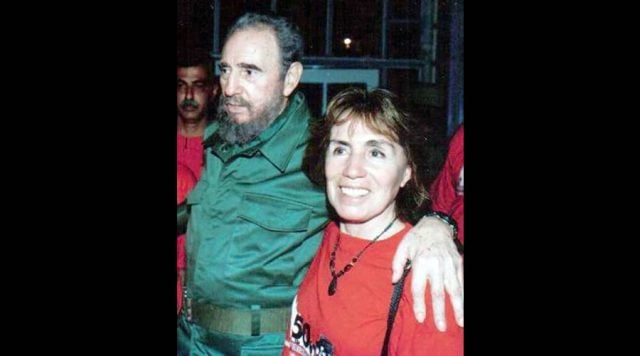
A new anniversary passes since the departure of Gladys Marín, and memory, that rebellious exercise against oblivion, immediately brings to mind an afternoon in Buenos Aires.
I don’t remember the iron leader I saw in the news from Argentina; I remember the attentive woman who sat beside me in the front row of the Central Committee, united by the pain and anger evoked by the name Inés Ollero.
That day, the air was filled with a special mystique. We shared front-row seats with Patricio Echegaray, who, with his always brilliant and passionate oratory, reminded us why we were there.
I had the difficult task of being one of the main speakers. Speaking about Inés was not just a rhetorical political exercise for me; it was talking about my youthful girlfriend, about the FJC militant who was kidnapped and murdered by the Argentine Navy. It was about a void that justice still had not filled.
At the end of the event, in the intimacy of a modest lunch, I found myself face to face with my youthful idol. In 1972, when she led the Communist Youth of Chile alongside Lucho Corvalán, Gladys embodied the hope of a continent. There, with a glass of wine in hand, I didn’t hesitate: I asked her for an interview.
The next day, in a modest hotel on Callao Street, the legendary Gladys became a curious student and a fierce ally. For two hours, our discussion centered on the legal struggle: the lawsuits for crimes of genocide and state terrorism in the Southern Cone, the role of Judge Baltasar Garzón, and the legal architecture to corner dictators.
Gladys didn’t just listen; she peppered me with questions. Her commitment wasn’t about banners; it was about strategy and conviction. She returned to her combative Chile, and I went back to my hometown of Vigo, but that thread of coordination remained intact.
Years later, we received the news of the malignant tumor that tried to extinguish her. But Gladys, true to her story, fought without ever letting go of her activist card for even a single day.
On March 6, 2005, the news of her passing shook Chile and all of Latin America. One million people took to the streets of Santiago to bid her farewell, in a funeral that was, in fact, a final demonstration of popular rebellion.
Today, as I observe the political landscape, an inevitable and bitter question arises: What remains of her thoughts? It is painful to see how some current leaders, heirs to her legacy, seem to succumb to the right’s tune, joining critiques against Cuba and Venezuela to gain a validation that the system will always deny them.
Gladys Marín was not one to seek a pat on the back from her adversaries. She understood that internationalist solidarity and resistance against imperialism were not seasonal options but rather the backbone of communist identity.
Remembering her today is not just an act of nostalgia. It is to reclaim the woman I met in that Callao hotel: a steadfast woman who understood that justice is conquered by fighting, whether in international courts or in the streets of Santiago.
Her legacy deserves to be neither diluted in the lukewarm pragmatism of current politics nor forgotten; it should be the compass that restores the dignity of our struggle.
Hasta la victoria siempre, Gladys!
Lois Pérez Leira
Relacionados

Tribute to Gladys Marín: "She Never Abandoned Mobilization, Community Engagement, and Human Connection"
Hace 3 días
Embroidered Book with Burlap Tells the Story of the Current Memory Site Estadio Víctor Jara
Hace 3 meses
"For Peace, Democracy, and the Sovereignty of the People": Traditional "Fiesta de los Abrazos" Kicks Off in Recoleta
Hace 2 meses
Senator Campillai Condemns Approval of Monument for Piñera: "We Remember Him as a Human Rights Violator"
Hace 2 meses
"Premeditated and Hate-Fueled Attack": Government and INDH Report Memorial Destruction in San Joaquín to Authorities
Hace 2 meses