Original article: Deplorable: Argentina, EE.UU. e Israel votaron en contra de reconocer la esclavitud como crimen de lesa humanidad
UN General Assembly Resolution Condemns Slavery as a Crime Against Humanity, Yet Argentina, U.S. and Israel Vote Against

In a historic move seen as a step towards restorative justice, the United Nations General Assembly approved resolution A/80/L.48 on Wednesday, designating the transatlantic slave trade and the racial slavery of Africans as «the most heinous crime against humanity» in history.
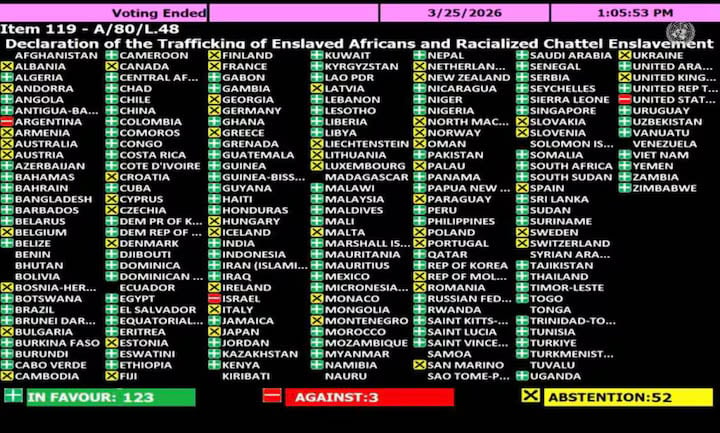
The vote, which garnered 123 votes in favor, reflects a solidified international consensus on recognizing the lasting impacts of an exploitative system that lasted for four centuries. According to the text released by the multilateral organization, this system constitutes «the most inhumane and enduring injustice against humanity» due to its magnitude, systemic nature, and brutality.
The voting results revealed a small opposition bloc. In contrast to the overwhelming majority support, only three countries voted against the initiative led by a coalition of African, Caribbean, and Latin American nations: Argentina, the United States, and Israel. This isolated position stands in stark contrast to the growing global movement advocating for reparations and institutional recognition of the crimes committed under the hereditary slavery regime, which commodified humans as perpetual property, as recognized in the resolution’s text.
In addition to the three negative votes, 52 nations chose to abstain, including almost all members of the so-called Western bloc, as well as powers like Japan. The resolution, coinciding with the 25th anniversary of the Durban Declaration and Programme of Action, emphasizes the imprescriptibility of these crimes, reminding that the legal instruments that legitimized this atrocity—from papal bulls in the 15th century to slave codes in Barbados and France—systematically violated international law.
The General Assembly not only condemned the past but also established a concrete framework for the future. The text urges member states to engage in dialogue on restorative justice that includes formal apologies, restitution of cultural properties, and guarantees of non-repetition. As a concrete gesture, the resolution calls for the immediate and cost-free return of art objects, monuments, and national archives to their countries of origin, reaffirming the obligation of states to fully repair the harm caused by internationally unlawful acts.
View UN Voting Results
https://news.un.org/es/story/2026/03/1541279
Argentina’s Vote: Denialism and Geopolitical Alignment
The decision by Javier Milei’s government to vote against the resolution sparked immediate critical reactions in the realms of human rights and Afro-descendant activism. According to analysis by political scientist Federico Pita, founder of the African Diaspora of Argentina (DIAFAR), the negative vote deepens a «denialist turn» in the country’s foreign policy. In his column published in the newspaper *Página/12* (Negrx) and replicated on Argentina Indymedia, Pita argues that the vote’s timing, occurring on the International Day of Remembrance of the Victims of Slavery, symbolizes a geopolitical subservience that aligns Argentina only with the United States and Israel.
Pita emphasizes that this stance directly conflicts with the international commitments undertaken by the Argentine state. He recalls that the National Constitution grants constitutional hierarchy to human rights treaties and that Argentina endorsed the Durban Action Plan (2001), which clearly states that slavery and the transatlantic slave trade «constitute, and should always have constituted, a crime against humanity.»
In this sense, the negative vote not only signifies diplomatic isolation—joining a minority bloc of merely three nations—but also represents a regression in the historical tradition of the country regarding human rights, consolidating a foreign policy that, according to the analyst, «humiliates itself before the world» by rejecting agendas that challenge the historical debts of racism.
Artículos Relacionados

Deplorable: Argentina, EE.UU. e Israel votaron en contra de reconocer la esclavitud como crimen de lesa humanidad
Hace 1 minuto


Activists Demand Arrest of Israeli-Ukrainian Sniper in Chile for Genocide and War Crimes in Gaza
Hace 1 mes
Netanyahu Welcomes Kast's Election in Chile, Aiming to Strengthen Cooperation on Security and Water Resources
Hace 3 meses