Original article: Hogar We Liwen tras absolución de 18 comuneros mapuche: “La lucha por el territorio no puede ser tratada como delito”
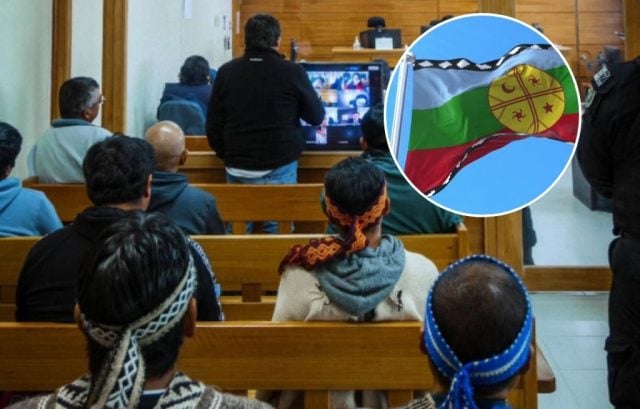
In a unanimous decision, the Oral Criminal Trial Court in Valdivia acquitted 18 Mapuche communal members facing accusations related to their alleged involvement in timber theft in the Trafún area, located in the Panguipulli commune of the Los Ríos region.
The court found that the evidence presented by the Public Prosecutor’s Office was insufficient to substantiate the alleged crimes or to demonstrate the involvement of the accused in events dating back to 2018 and 2019.
Following the verdict, the We Liwen Mapuche Student Home issued a public statement asserting that «this outcome does not rectify the years of persecution experienced, but it reaffirms that the fight for territory, the Mapuche way of life, and itrofill mogen cannot be treated as a crime.»
The oral trial, which concluded on March 13, centered on charges brought by the prosecution against 20 members of indigenous communities, accused of stealing native species from a property allegedly owned by a forestry company in the Trafún sector. Specifically, the communal members faced charges of simple theft and receiving stolen property, offenses for which they risked imprisonment of 3 to 5 years.
However, the court concluded that the case theory presented by the prosecution could not be sustained with adequate evidence, decisively stating that sufficient proof was not provided to confirm the defendants’ involvement in the timber theft, resulting in a complete acquittal of the accused.
«Clearly, they lacked the arguments to prove their claims, therefore the majority of the defendants, including us, were acquitted. From the beginning, we asserted that we were completely innocent of the allegations,» said Cristian Reinahuel, a spokesperson for the Vicente Reinahuel community and one of the acquitted members.
In statements to Radio Bío Bío, he questioned the strength of the accusations faced during the process.
«We have established how the Mapuche are criminalized simply for fighting for their land. Clearly, the evidence was insufficient because the alleged crime never existed, therefore the prosecution could not have evidence of something that did not happen,» he stated.
In a similar vein, defense attorney Orietta Llauca elaborated on the context surrounding the case, indicating these accusations are not isolated incidents, but part of a systematic persecution against Mapuche communities aiming to reclaim their ancestral lands.
«Today we have established how the Mapuche are criminalized without justification for simply defending their territory. The evidence was clearly inadequate because the crime never existed, hence the prosecution could not prove something that did not exist,» the lawyer remarked. Llauca also expressed satisfaction with the outcome: “We are pleased and relieved; it is a great relief for our lamngen who endured this uncertainty for years where their freedom was at stake, and today they have been declared innocent by this court; all were acquitted.”
This stance was supported by Mapuche public defender Sunem Cárdenas, who also participated in representing the acquitted. Cárdenas asserted that the court recognized the validity of what the defense had maintained from the outset: the absence of criminal responsibility from her clients.
“This aligns with the case theory put forth by the defense regarding the inability to prove the theft for which my clients were accused. Furthermore, their participation in the same crime could not be established. The evidence was insufficient, and the court confirmed this,” Cárdenas stated.
We Liwen: Judicial System Used as a Tool of Persecution
In light of the verdict, the We Liwen Mapuche Student Home not only celebrated the freedom of the communal members but also connected the ruling to a broader context of territorial claims and critique of the judicial system.
“As the We Liwen Mapuche Student Home, we express our profound joy and relief following the acquittal of lamngen from the Reinahuel and Painepe communities of the Lof Trafun, who have been declared not guilty and freed after enduring accusations of alleged timber theft for years,” stated the First Nations students.
The organization elaborated on its analysis, emphasizing that this case is not an isolated incident but reflects a systematic pattern of persecution. “This resolution reveals what Mapuche communities have denounced for years: the use of the judicial system as a tool of persecution and criminalization against those who defend their territory,” the statement asserts.
The organized Mapuche students stressed that the case of the lamngen from the Lof Trafun is situated in “a historical context where Mapuche communities have been constantly subjected to judicial processes due to territorial conflicts linked to the presence of forestry companies and the intensive exploitation of forests, a model that has persisted over territories ancestral without respecting the rights of indigenous peoples.”
The text highlights the human cost that these processes impose on the families of the affected communal members.
“For years, the families of the accused lamngen have faced lengthy judicial processes, public stigmatization, economic and emotional strain, all while defending their territory and way of life. Today, their acquittal confirms what their communities have always asserted: the accusations were unfounded,” they stated.
Mapuche Struggle and Defense of Territory
The organization expressed respect and pride toward the Reinahuel and Painepe communities, along with their traditional authorities and families, recognizing the collective effort that supported the accused throughout the lengthy process.
Additionally, the young Mapuche reaffirmed their “commitment to defending territories, the memory of our peoples, and supporting communities that continue to face criminalization processes.”
«As long as there is injustice in our territories, our voices will rise alongside our communities. Amulepe taiñ weychan» —meaning «may our fight continue» or «may our struggle endure,» they emphasized.
Underlying Conflict: The Reclaiming of Ancestral Lands
It is important to note that alongside the criminal process, this case is part of a complex dispute over land ownership and use in the Trafún area, pitting indigenous communities against a forestry company. It is worth recalling that the trial hearing even faced postponements, as occurred in July 2025, when the Valdivia Court of Appeals had to rule on a lawsuit related to overlapping title deeds.
According to information gathered by regional media such as the Puelche.cl portal, this disputed territory is a site of ancestral use for Mapuche communities, who have historically turned to these forests for timber for heating and providing fodder for their animals, long before the arrival of settlers and individuals in the early 20th century. The defense attorneys contextualized that the actions of the communal members cannot be divorced from the reclamation of territorial rights that have persisted across generations.
The sector where the events occurred, Trafún, located 77 kilometers from the city of Panguipulli and 200 kilometers from Valdivia, constitutes an ancestral territorial space for the Mapuche people. Currently, the old Lof Trafunko, recognized under the Merciful Titles of 1913 in the name of Vicente Reinahuel and Juan Painepe, is fragmented into five registered indigenous communities with CONADI: Juan Painepe 1, Juan Painepe 2, Vicente Reinahuel, Kollanco, and Vicente Reinahuel Autónoma.
According to information provided by the communities themselves, they began a reclamation process for their ancestral territory in February 2011. This 15-year struggle not only seeks material subsistence but also the preservation and reproduction of the culture of the original Mapuche people in that space.
Historical Context: Merciful Titles and Land Reduction
A thorough understanding of the conflict requires tracing back to the early 20th century when the Chilean State granted what are called Merciful Titles. The Vicente Reinahuel and Juan Painepe communities are part of the original Lof Trafunko, a name that was lost during the early surveys and occupation of the land in the area. The region’s name changed to “Trafún,” which has persisted to this day, following the imposition of indigenous land reductions in 1907, as noted by the aforementioned portal.
These reductions drastically cut the land of the Lof (ancestral community) into two Merciful Titles: N° 2410 for Vicente Reinahuel, granted on January 5, 1913, recognizing 1,357 hectares and 45 people; and N° 2409 for Juan Painepe, dated December 30, 1913, recognizing 286 hectares and 10 people. These titles did not acknowledge the entirety of the territory that the lof used seasonally, an area extending from what is today known as the Trafun estate (currently referred to as Las Vertientes) to the Quetro Pillan volcano within the Villarrica National Park.
Cultural Significance of the Disputed Territory
An anthropological report conducted in 2012 identified at least 52 sites of cultural significance within this territorial space. Among the most notable, and located along the path to the peweñentu (place of Araucarias) or pinaladas, are: “Cuche Pewen (Grandmother Pewen), Ruka Grürü (Lodging Area), Aliwe Mawiza (Mountain of Souls), and Kalfu Lafken (Blue Lagoon).”
The study notes that these spaces were occupied in a transhumant manner by the communities. Furthermore, the area once contained a Nguillatun meadow and a palin court, which were abandoned due to violence inflicted around 1940, when processes of land usurpation, settlement, and occupation by foreign and Chilean settlers occurred, compounded by the later annexation of much of the territory to the Villarrica National Park, as noted by El Puelche.cl.
Relacionados
18 Mapuche Communal Leaders Acquitted in Alleged Timber Theft Case as Prosecution Fails to Provide Evidence
Hace 2 días

Mapuche Political Prisoners in Purén Claim Violation of Due Process: "Basic Human Rights Are Not Respected"
Hace 2 semanas
Mapuche Prisoners Report Harassment and Excessive Force in Angol and Temuco Jails: Demand for Fair Process
Hace 3 días

Quilleco Case: Trial Postponed Again Due to Lack of Judges, Raising Concerns Over Legal Irregularities
Hace 4 meses