Original article: 1 de Enero: La memoria como trinchera para la América Latina del 2026
By Jean Flores Quintana
For market logic, January 1st is just a change in the calendar, an opportunity to sell dreams of renewal. However, in the memory of rebellious peoples, this date does not signify a fresh start, but the ongoing continuation of a historic struggle.
In Latin America, we do not welcome the new year with a blank page, but with the weight and glory of those who dared to challenge the impossible. This date reminds us that our destiny is not dictated by the powerful.
We celebrate two dawns that shattered historical fatalism: the triumph of the Cuban Revolution in 1959 and the uprising of the Zapatista Army in 1994. Despite the decades that separate them, both share a profound truth that Peruvian José Carlos Mariátegui warned us about long ago: the liberation of our peoples cannot be a «carbon copy» but rather a «heroic creation.»
And that is precisely what we did: invent our own way to be free.
On January 1, 1959, the entrance of the bearded ones into Havana was not merely a change of government; it was a redefinition of what was possible.
Cuba committed the unforgivable audacity of proving that sovereignty could be built just ninety miles from the greatest empire in history. They taught us that a people’s dignity is worth more than any market.
As Fidel Castro decreed, it was a revolution «of the humble, by the humble, and for the humble,» and that lesson crossed the ocean to help liberate Africa from colonialism and ignite hope in every corner of our continent. In this struggle, women like Haydée Santamaría reminded us that revolutionary politics is, above all, an act of radical love; that «life is not just about breathing,» but fighting for what you love to the very last consequence.
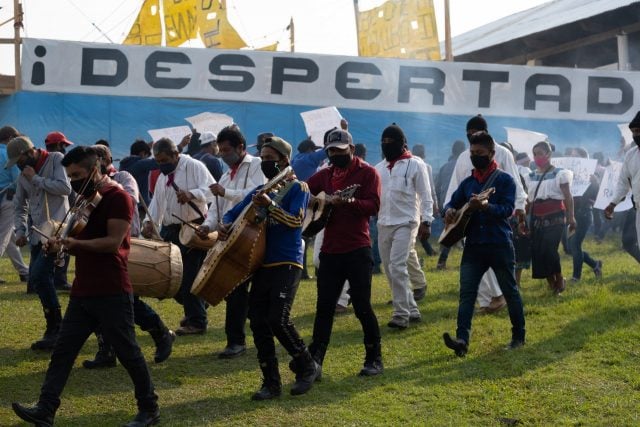
Thirty-five years later, in 1994, when neoliberalism proclaimed that history had ended and governments toasted trade agreements that sold out the homeland, the indigenous people of Chiapas emerged from the fog to declare «Enough!»
Subcomandante Marcos and the Zapatistas exposed the lie of modern progress: there can be no development if it is built on the extermination of native cultures. They gifted us a new ethical depth: «to lead by obeying.»
It was Comandanta Ramona, small in stature but immense in moral authority, who taught us that the struggle for land is inseparable from the struggle for women’s rights, demanding «never again a Mexico without us.»
However, these beacons of hope have been targets of a brutal hate campaign. The vitriol spewed by the right and their media monopolies does not stem from any democratic concern but from class terror.
They do not demonize these processes for their missteps but for their greatest virtue: having shattered the natural hierarchy between boss and worker, proving that obedience is not the only destiny.
Perhaps the most repugnant is the capitulation of a certain self-conscious left, which, in its eagerness to be accepted in the salons of liberal democracy, looks upon Cuba and Chiapas with a shameful discomfort, as if they were awkward relatives best kept hidden.
This is a form of progressivism calculated and domesticated, which has exchanged the trench for a career in bureaucracy; sectors seeking to enter Congress and institutions not out of transformative conviction but from the petty ambition of filling their own pockets.
They join the moral lynching to appear «responsible» before the oligarchy and protect their positions, but in the end, they are reduced to mere administrators of misery and whitewashers of the system.
2026 Will Not Be a Year of Peace, But a Battleground
This internal betrayal is suicidal given the looming scenario.
2026 marks the beginning of a violent global realignment where our Latin America ceases to be viewed as a continent and is again treated as a war booty. The powers no longer mask their hunger: they come for lithium, copper, water, and biodiversity, critical resources that will define the technological and military hegemony of the 21st century.
The dispute between the United States and China will strain every border, and Washington, in its imperial decline, will seek to reaffirm its «backyard» with renewed interventionism. In this chessboard, the elections of 2026 in Colombia and Brazil will serve as decisive trenches. We will not be facing democratic adversaries, but a bold and radicalized right that, under tough-talking rhetoric, seeks to hand over our sovereignty to the highest foreign bidder.
Thus, reclaiming this January 1 is an act of legitimate defense. Cuba bequeathed us the urgency to take the state to serve humanity; the Zapatistas, the power of community autonomy. Both paths converge in the certainty of Allende: «History is ours and it is made by the peoples.»
Confronted with an emboldened right and a geopolitical landscape threatening to tear us apart, looking back is not nostalgia but a war strategy.
This New Year, it is insufficient to merely wish; we must regain the ability to organize our rage and hope. Because freedom is not begged for on our knees; it is conquered on our feet.
Jean Flores Quintana.-