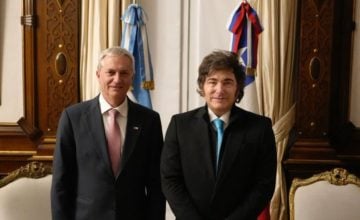
Original article: Gabinete de Kast: Una apuesta en modo Milei
By Matías Bosch Carcuro
The announcement of the cabinet that will support José Antonio Kast starting March 11 has immediately prompted scrutiny of its pedigree, track record, and, in several cases, its moral and political history. This is merely the first step in the sequence of appointments and designations that Kast will have the power to implement.
Analyzing these political decisions can provoke outrage but should not lead to scandal, as if faced with a display of mediocrity, mistakes, and immorality. These actions must be understood as an inheritance accumulated during the so-called democratic transition and then as an application of the governing manual of the new right.
The Inheritance
When we refer to inheritance, we do so in two senses. On one hand, the governments of the Concertación, Nueva Mayoría, and Gabriel Boric (a new label will soon be needed for historiography), particularly during Michelle Bachelet’s terms, entrenched the notion of a “government of experts.” This concept has been thoroughly dissected by political philosopher Wendy Brown in works like “The People Without Attributes.” In Chile, Carlos Pérez Soto has pointed out this practice as “bureaucratic and technocratic legitimization” for policies directed by governments.
Generally, this legitimization based on academic titles, especially doctorates and master’s degrees from the United States, serves merely as a point of authority to justify decisions and actions that consistently embody a mutating neoliberalism.
In peripheral and subordinated states and economies like Chile, it gives “rigor” and “reasonableness” to the neocolonial condition, under which banks, AFPs, ISAPRES, mining, forestry, fishing companies, and similar entities exploit this “long and narrow strip of land” for the accumulation of transnational capital.
The qualifications of those in charge enable them to be part of a block of power where they are all connected, and political affiliations are indifferent and negotiable. They function, and it must be said, as a pure ideological device: for the country’s owners, who essentially are the owners of the capital that appropriates the country, it guarantees that they are trained in the neoliberal dogma of the subsidiary state and neoclassical economics, with primarily reactionary and subservient convictions, ensuring “continuity of state.”
Moreover, the ideological framework helps ensure that in media outlets and thus in public opinion, discussions revolve around “technical quality” and “merit” as encapsulated in degrees rather than on politics, commitments, and whose interests are served. This results in the interests of the dominant class being treated as the general interest and welfare.
The second sense of inheritance is that this was endorsed by Boric, who prioritized Mario Marcel in economic decisions and a leadership core whose attributes, barring some honorable exceptions, were their foreign qualifications, “technical” knowledge, party standing, and concertationist expertise.
Establishing a cabinet and designating individuals with authority to determine programs, budgets, and priorities is political, and following this path could hardly lead to real changes, challenging convictions, redistributing power, or fulfilling fundamental campaign promises (such as terminating AFPs, CAE, the infamous fiscal discipline, and other neoliberal looting emblems), while avoiding acts like pardoning ISAPRES and energy companies, the “damned” Nain-Retamal law, or yielding on security and immigration policies.
The other major consequence of assuming these figures, their “merits,” and doctrines was to absorb and adopt one of the key tenets of the transition and Concertación: in the government of experts and the sacred “institutions,” the people, the citizenry, can occasionally appear but must retreat into their homes and allow “those who know” to govern. Closing the major avenues, save for campaign events.
The Novelty
In this sense, Kast fully meets the criteria, with a cabinet filled with commercial engineers and lawyers. However, we must not overlook individuals whose backgrounds, such as those who sang backup for artists or founded ice cream shops, do not reflect a working-class upbringing that uses public transport, but rather illustrate the weight of primary connections, family names, and loyalties that enable them to ascend in the realms of business, media, and high politics.
Kast stands on the foundation already prepared for him, where the first thing one must know about a minister is that they studied a recognized field in an acceptable country; in several cases, this is achieved. Consequently, political and ideological commitments become marginal matters in a society conditioned, decade after decade, for that question to hardly matter.
The novelty that scandalizes many is the doctrinal disdain for minimal agreements of the transition, the overt affiliation with pinochetism and far-right ideologies, the dirty business and corruption, as well as a strict commitment to the success of major corporate groups—this is neither an act of madness nor clumsiness.
It can be likened to Trump appointing Elon Musk as a minister of “government efficiency,” reinstating the War Department, long disbanded after World War II, or assigning Homeland Security the role of a parallel government, and the blatant manner in which they declare a government for Venezuela or Greenland.
However, it’s better and more relevant to think of Milei. Just as the current occupant of the Casa Rosada has created the “Office of the President” (for now “of the elected president”), he will appoint a government spokesperson whose role will be to fight the so-called “cultural battle,” as Manuel Adorni has vigorously done in every public appearance and post.
Lawyers and professionals dedicated to defending humanity’s worst criminals, similar to figures across the border like Villarroel, Petri, and Presti, the son of an executioner from the Argentine tyranny, are occupying the Vice Presidency and the Ministry of Defense. If there, the Minister of Economy is Luis Caputo, a financial speculator, with Minister Federico Sturzenegger tasked to “deregulate and transform the State,” here we will have Quiroz in Finance.
Just as Milei has Daniel Scioli, the former presidential candidate from Peronism in 2015, Kast will have Campos and Rincón in key positions. The ministries of Education and Social Development will serve as counterparts to the Capital Human portfolio, named so intentionally to exemplify its entrepreneurial, privatizing, and classist view of the State. And a Minister of the Interior who was a designated mayor during Pinochet’s dictatorship, ensuring that when traveling, a loyalist to the dictator leads the country.
Of course, in all this, one can see the advance taken by the major think tanks and universities of the Chilean right, including Jaime Guzmán, Libertad y Desarrollo, and the Fundación Para el Progreso, run by the Kaiser brothers, where anti-communism is professed, calls are made for bullets and a state of siege in the south, discussions about “eliminating the Central Bank” take place, and admiration for Donald Trump is evident.
They Aim for Everything
Piñera was the de-Pinochetized right-winger while the transition was peaceful and neoliberalism untouchable; when that ceased to be the case, he had no qualms about declaring war and sending out orders to fire with cruelty and arbitrariness.
From 2019 onwards, the scenario changed, and Boric’s experience not only culminated in electoral defeat but also in political and ideological failure. There is little reason to expect anything other than Kast doubling down, giving space to the hard core, and implementing the harshest policies.
It should not be assumed that his cabinet is weak, nor that general indignation will shake it. The cabinet appointment should be considered a “strategic provocation,” a key concept in radical rights to describe actions and statements that break all molds and consensus, drawing the spotlight of society upon them.
One must keep in mind that the State has the role of managing class conflict, and Kast’s job will be to radicalize neoliberalism and neocolonialism, along with aligning toward the dominance of the United States and the international right.
It is reasonable to expect them to aim to finalize undermining anti-neoliberal opposition and disassemble it as a power option. They will rally their “soldiers.” Unlike his predecessor, there will be no hesitation in pleasing, glorifying, and expanding his base, reconnecting with that 44% Pinochetism from 1988 and nearly winning in 2000 with Lavín, now emboldened and excited by his 2022 and 2025 results, alongside Trump and Claudio Crespo.
If the “macro south zone” has remained militarized, it won’t be long before an “anti-picket protocol” resembling Bullrich, a local version of the ICE, emerges. One should suspect that they understand quite well they should not place the equivalent of a Mario Marcel in Finance, wasting time “calming the markets” while the public desires to demarketize, nor pretend to be educated by meeting with Vargas Llosa, as the “cowardly right” would. They are serious and they are going for everything.
Matías Bosch Carcuro
Relacionados


"The Chainsaw Represents an Aggressive Stance": Rector Álvaro Ramis Critiques Kast's Brashness and Ties to Milei
Hace 3 meses