Original article: Gremios de la Tía Rica responden a observaciones de Contraloría y piden actualizar la ley
Labor Unions of Tía Rica Respond to Accounting Office Concerns and Call for Law Updates
This Monday, worker associations from the Directorate of Pledged Credit, popularly known as «Tía Rica«, alongside national leaders from ANEF, gathered to address the controversy sparked by a report from the General Comptroller’s Office questioning the service’s operations.
The audit revealed that 1,681 individuals with criminal records had pledged goods worth over $1.5 billion without proper verification of their provenance. In response to these concerns, the unions defended the institutional actions of «Tía Rica» and emphasized that many of the criticisms stem from gaps and limitations in the current legislation, reiterating their call to update the regulatory framework overseeing the service.
During the gathering, the president of ANECREP, Carlos González, stated that a key issue for the staff is the way information has been presented, which he claimed does not accurately reflect the legal framework under which the service operates.
González stressed that the Directorate of Pledged Credit operates under powers and procedures defined by existing law, describing it as unjust that there has been a public judgment insinuating negligence from the workers, a situation that he said has caused significant frustration within the union.
«This does not question an institution, nor a director who unfortunately had to bear the brunt of this situation. It is questioning the workers; we are not facilitators of criminals, we are not negligent, we work hard to move this forward,» he added.
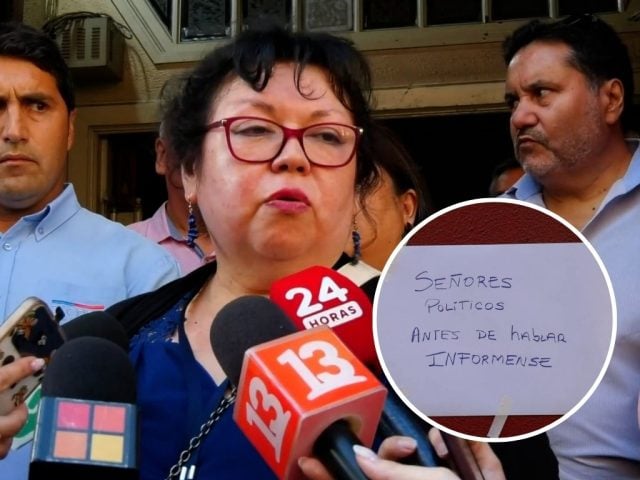
Meanwhile, the president of the Association of Pledged Credit of Chile (APRECH), Nieves Palma, voiced the union’s discontent regarding the criticisms that have emerged from various sectors following the report.
Palma pointed out that workers feel directly affected by statements coming from political actors and public representatives who, in her view, have undermined the role of the Directorate of Pledged Credit, promoting a negative image of the service and its employees.
«We are an entity that provides services to the public, assisting the most vulnerable individuals, and I find it incredibly irresponsible for some politicians to come and sweep us under the rug. We will not allow this; we demand apologies from the minister and those who have wronged us because we do not protect any criminals; we help the public, and that is what we demand today,» she declared.
In that same vein, Palma emphasized that responsibilities cannot be attributed to the current leadership of the service or recent authorities, as the issues highlighted by the Comptroller’s office stem from long-standing problems.
She reminded everyone that the operations of the Directorate of Pledged Credit are governed by DFL No. 16, a regulation that she asserted needs to be updated and modernized, a process that was already underway before the controversy.
Additionally, she stated that while it is legitimate to scrutinize and disclose the findings of the audit, it is also essential to understand the legal framework and the limitations under which the staff operates, who are, she assured, working to improve internal procedures.
Finally, she called upon various political actors to adequately inform themselves about the legislation regulating «Tía Rica» before making public judgments that, in her opinion, unjustly harm the service and its workers.
The national president of the appraisers from Dicrep, Marco Chamorro, addressed the criticisms surrounding the amounts of the loans, assuring that the current regulation prevents the granting of more than $500,000 for a pawn and sets a global cap of $3.5 million.
In this context, he stated that the accusations of alleged irregularities or collusion lack foundation, reiterating that the actions of the staff comply with DFL No. 16 and urging those who made such statements to act responsibly.
Lastly, the president of the association AINFUT, Ignacio Romero, noted that the public debate has distorted the functioning of pledged credits. He explained that the current regulation—defined in DFL No. 16 and historical decrees—clearly outlines who can pledge goods, even when they are not the legitimate owner.
He pointed out that the current situation opens a window for advancing legal updates by combining a legislative reform driven by Congress with the digital modernization processes already underway at the service, with the aim of strengthening support for the public.
From the unions, it was stated that several observations can be attributed to gaps in DFL No. 16, the regulation that governs the service. They affirmed that the debate presents an opportunity to modernize the legal framework and internal processes alongside the digitalization efforts already promoted by the institution.
Relacionados


CUT and State Unions Urge La Moneda: Demand Real Salary Adjustment and Tight Negotiation Calendar Ahead of Runoff
Hace 2 meses

University Strike in Argentina: Unions Accuse Milei of Undermining Education Financing Law with "Poverty Budget"
Hace 2 meses