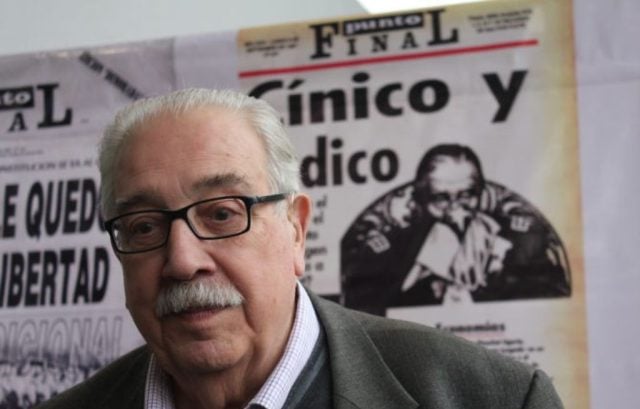
Original article: Entre la imprenta y la rebeldía: el periodismo militante de Manuel Cabieses Donoso
By Pedro Lovera Parmo.[1]
The renowned journalist and leftist activist Manuel Cabieses Donoso passed away at the age of 92. His legacy resonates not only within journalistic circles from the long 1960s and the ongoing transition to democracy but also in the political and social history of our country. As is the case with many departures, this moment serves as an opportunity to reflect on his remarkable political journey throughout the short 20th century.
In 1965, just a month before the founding of his party, the Revolutionary Left Movement (MIR), Cabieses, alongside fellow colleagues, established the legendary magazine Punto Final. What characterized this publication was its pluralistic, open, and unorthodox commitment to the left and the Chilean popular movement. This was articulated in its foundational editorial, which declared it a «democratic and progressive» medium serving the «great masses», the true protagonists of history, explicitly pledging to work for them.
This earnest declaration of principles became the guiding axis of Punto Final. Its pages were rich with reports on the campesino, student, housing, and labor movements. There were also extensive discussions on reform and revolution, guerrilla warfare in the Global South, institutional politics, imperialism, the role of the media, and women’s contributions to revolution.
Organizations such as the Manuel Rodríguez Revolutionary Movement (MR-2), the Socialist Party, the MIR itself, and various Maoist currents found a platform to express their perspectives on national, Latin American, and global realities. While the magazine had an undeniable closeness to the MIR, given Cabieses’ own militancy, it was never a sectarian outlet. This anti-sectarian stance became a personal hallmark of Cabieses, who infused it into his journalistic work.
This heterogeneous and unifying spirit—formed by a multitude of critical leftist militants—was also expressed in the intellectual openness of the magazine. Its pages featured reports and reflections on notable figures such as Antonio Gramsci, Rosa Luxemburg, Louis Althusser, Angela Davis, Fidel Castro, and Ernesto “Che” Guevara. It published works by influential writers like Roque Dalton, Fernando Martínez Heredia, Miguel Enríquez, Régis Debray, José “Pepone” Carrasco, Clotario Blest, Gladys Díaz, among many others.
The impact of Punto Final reached such magnitude across Latin America that it even contributed to the recovery of the Diario del Che en Bolivia, which was subsequently published by the magazine in its 1968 issue number 59, as announced by Fidel Castro in the closing lines of A Necessary Introduction. This presence was no accident. Throughout his life, Cabieses maintained a clear acknowledgment of the Cuban Revolution as one of the most significant political processes of 20th-century Latin America. His connection with Cuba was not merely theoretical; during his exile, he sustained political and personal ties with this movement, reaffirming his conviction that Latin America could conceive and develop its own emancipatory projects.
Historical reports and covers remain etched in memory, such as the fateful September 11, 1973, issue, which urged military forces to refrain from repression under the call: «Soldier: the homeland is the working class.»
Many of his journalists and collaborators suffered during the long night of the dictatorship. Names like Jaime Barros Meza, Augusto Carmona, and Máximo Gedda enlarged the list of political executions. Cabieses was not shielded from this reality: due to his public prominence as a journalist and revolutionary, he was arrested, transferred between different detention and torture centers, and ultimately expelled from the country.
As expected, his fervor did not cease with the international denunciation of the dictatorship’s crimes; from exile, he remained linked to the revolutionary cause while serving as a leader of the MIR. He participated in the Return Operation—a plan designed for militants’ re-entry to fight against the dictatorship—to which he volunteered to return to Chile and combat the civil and military dictatorship. As history tells us, the outcome was well-known.
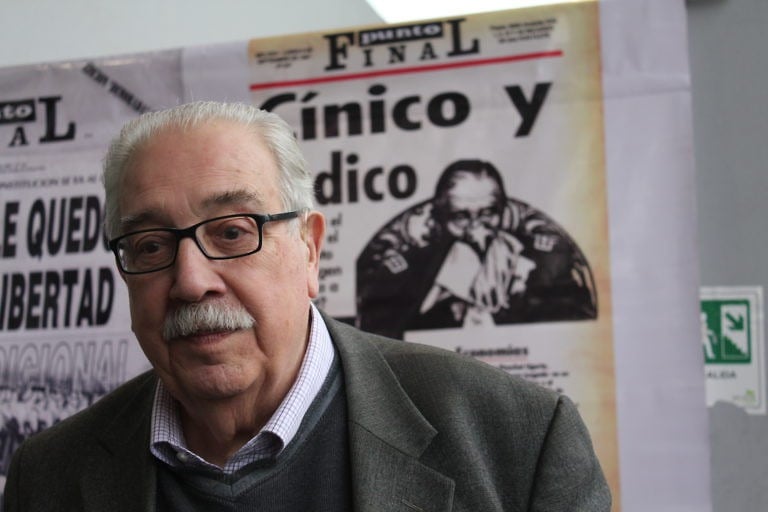
With the impending negotiated exit of dictator Augusto Pinochet, Cabieses reopened Punto Final in 1989 and became an early critic of post-dictatorship Chile, denouncing its limited and anti-democratic character, manifested in the continued prominence of the dictator. This culminated in his 1991 issue 247 cover showing Pinochet blowing his nose with the Chilean flag under the title “Cynical and Sadistic.” While the former dictator pressured Aylwin’s government to invoke the Interior State Security Law, the military prosecution opened its own case, accusing Cabieses of “inciting the troops to sedition.” The director of Punto Final was arrested for the last time in 1991, right at the return to democracy.
Cabieses’ tenacity extended beyond the purely journalistic realm. As he put it, Punto Final “has never been limited to merely a magazine’s tasks” but rather “serves as a political action instrument.” While the official narrative called for demobilization in favor of policies executed by experts without popular participation, Cabieses, along with other social and popular figures like priest Rafael Maroto and Sergio Vuskovic, focused their efforts on reuniting dispersed militancies.
In the early nineties, Cabieses took on the task of creating a new left axis, deeming “the presence of a leftist party that grouped the wide array of non-communist left trends” to be necessary. This endeavor was neither sectarian nor aimed at excluding the Communist Party; on the contrary, as Cabieses noted, “we made a significant effort to attract the PC for active support towards forming a new left axis.” Cabieses’s goal for political unity in the nineties still seems pending.
Those interested in exploring the life of Manuel Cabieses Donoso have access not only to the significant digital archive of Punto Final but also to his memoirs: Autobiography of a Rebel. There, readers will find that the story of this journalist and revolutionary is deeply intertwined with the political history of Chile and Latin America.
[1] PhD in History. Member of the Academic Committee of the Latin American Critical Thought Diploma at the University of Chile.
Relacionados
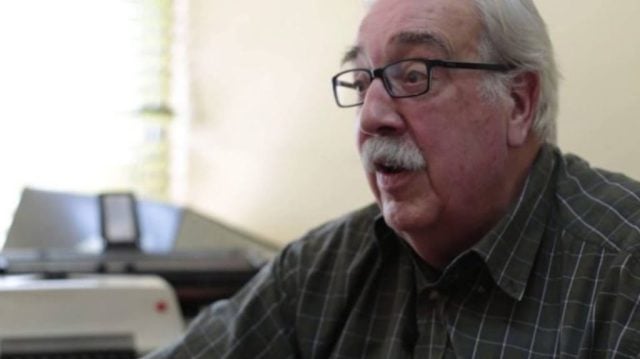
Manuel Cabieses Passes Away: The Rebel Journalist Who Defied Pinochet and Whose Voice Could Never Be Silenced
Hace 3 horas
November 19 Marks 50 Years Since the Birth of Deputy Carlos Lorca Tobar: A Reflection on His Legacy
Hace 3 meses
CUT Celebrates 73 Years: Clotario Blest's Legacy Strengthens Workers' Rights Advocacy
Hace 2 semanas
Same "Modus Operandi": Lawyers Charged in Belarus Case Were Plaintiffs Against Daniel Jadue in Achifarp Scandal
Hace 2 meses