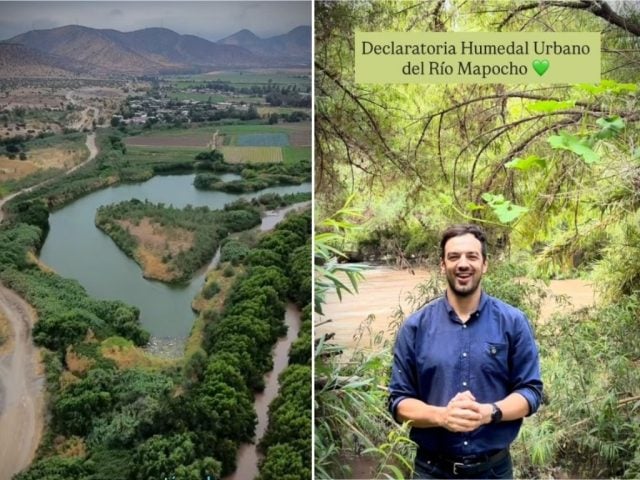
Original article: El Mapocho se protege completo: declaran humedal urbano al río en toda su extensión
Mapocho River Secures Protection as Urban Wetland: A Milestone for Biodiversity
Santiago often views the Mapocho River as a hurried postcard: we cross it, we walk alongside it, and we take it for granted. Yet beneath this daily landscape lies an ecosystem that perseveres and still supports life within the city. Hence, the recent protective measure is significant: the Ministry of the Environment has officially designated it as an urban wetland in its entirety, through Resolution Exenta N°9638/2025.
The decision was applauded by the Mayor of Maipú, Tomás Vodanovic, who described it as a «historic day» for the Metropolitan Region and for those who advocate for the river’s ecosystem. In a video shared on social media, he emphasized that this designation did not occur overnight; it has been promoted for years by municipalities and social organizations, reflecting a coordinated effort among local governments, the Santiago governor’s office, and the ministry itself.
Mapocho Urban Wetland: 13 Communes, One Ecological Corridor
The measure encompasses thirteen communes: Cerro Navia, Independencia, Las Condes, Lo Barnechea, Maipú, Padre Hurtado, Providencia, Pudahuel, Quinta Normal, Recoleta, Renca, Santiago, and Vitacura. Practically, this establishes a new environmental framework for the primary natural axis of the capital: a corridor that connects territories, fauna, flora, and communities.
Being recognized as an urban wetland means the state formally identifies the area as a wetland, either wholly or partially, within urban limits due to its essential value for city life: it serves as green space, biodiversity refuge, and also as a natural “sponge” against floods, helping reduce risks and mitigate climate change impacts. In short, it evolves from being perceived merely as «a riverbank» to an ecologically significant area that authorities must consider and protect.
The designation also opens up tangible protection mechanisms: the law allows municipalities to create ordinances to safeguard these wetlands and, when necessary, delay permits related to subdivision, lotting, urban development, or construction. It also mandates that recognized urban wetlands be included in territorial planning instruments as “areas of natural value protection”, which elevates the standards for their intervention, preventing urban development from treating them as mere available land.
A critical aspect is the preservation of over 600 hectares of riverbank, from Lo Barnechea to Padre Hurtado. «This designation enables us to protect over 600 hectares… to preserve and conserve flora and fauna,» Vodanovic stated.
Now holding the declaration, the focus shifts to the next crucial step: turning this document into real decisions. The objective is to ensure that the Mapocho River ceases to be the city’s backyard and is treated as what it truly is: a living ecosystem that requires care, planning, and oversight—from authorities, the communes, and also from the citizens.
