Original article: Milei convierte en ley una reforma laboral que arrasa con décadas de conquistas obreras
Milei Enacts Controversial Labor Reform Law Overturning Decades of Worker Protections in Argentina
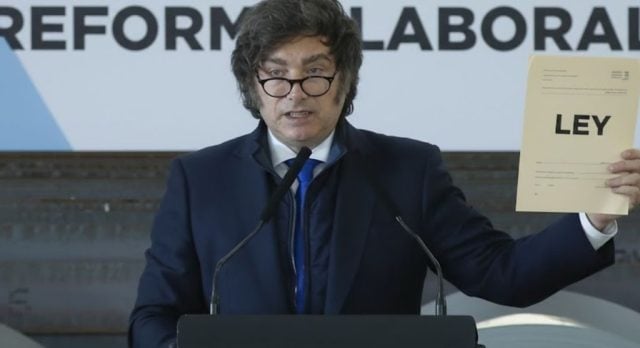
In a decisive move that significantly alters labor relations in Argentina, President Javier Milei’s administration has enacted the Labor Reform Law this week, dismantling fundamental rights of workers that have been built over decades of struggle against exploitation.
The official implementation of this legislation, which critics claim is based on a model from a century ago, was marked by the publication of decree 137/2026 in the Official Bulletin, signifying a pivotal change in Argentine labor law.
Designated as Law 27.802 and paradoxically titled «Labor Modernization,» the new law reflects no amendments from the controversial text approved by the Senate on February 27.
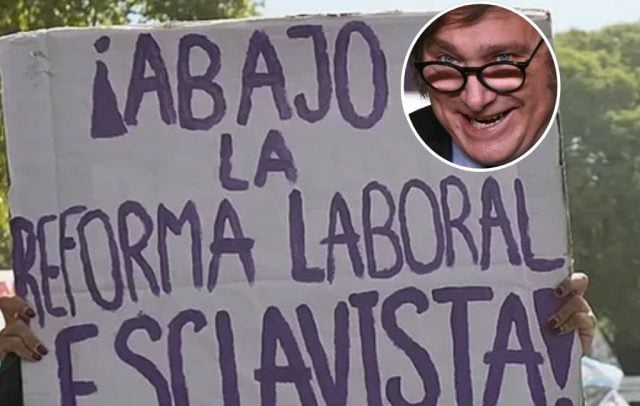
Its passage followed weeks of intense mobilizations and episodes of repression outside the National Congress, highlighting the deep social conflict generated by the proposed changes.
Far from modernization, the law substantially alters the Labor Contract Law, decisively tipping the balance in favor of employer unilateralism and detracting from workers’ rights. It not only attacks individual rights but also obliterates collective rights, eliminating collective agreements and statutes, such as the Statute for Professional Journalists.
Employer Authority to Dismiss “Without Cause” and End of Fair Severance Payments
One of the most controversial aspects of the reform is the complete flexibility of dismissal conditions. The chapter regarding the Rights and Duties of the parties places nearly all power in the employer’s hands, allowing discretionary suspensions and granting the authority to dismiss employees «without cause,» as noted by Página/12.
The essence of the new legislation is clearly stated in its text: “The employer is authorized to implement any changes related to the form and modalities of work performance.” This broadly defined clause leaves workers in a state of absolute vulnerability.
The law dictates that when an employee faces actions deemed forbidden, their options are severely limited: “When the employer enacts measures prohibited by this article, the worker, after notice, if ignored, will have the possibility to consider themselves dismissed without cause.” This effectively shifts the initiative and decision-making power regarding employment termination away from the employer, rather than safeguarding the worker from unilateral contract changes.
Regarding dismissals, the legislation promoted by the libertarian administration inflicts a heavy blow to severance payments, since calculations will no longer follow sector-specific agreements but will take into account only basic salary, seniority, and other legal sums, excluding essential elements such as overtime, bonuses, and extraordinary gratuities.
The calculation basis cannot exceed 67% of the value of the agreement. Specifically for dismissals «without cause,» indemnities will be equivalent to just one month’s salary for each year of service, calculated based on the highest salary from the most recent period, representing a significant regression from the previous system. In cases of a worker’s death, the law gives businesses the power to determine how severance is distributed among family members, often limiting the amount received by the family unit.
Flexible Installments for Settling Judgments in Favor of Workers
The reform also drastically changes the payment system for favorable judicial rulings for workers, which experts interpret as a disincentive to litigate. Moving forward, employers will enjoy unprecedented payment facilities: small and medium enterprises can pay judgments in 12 monthly installments, while large businesses can do so in six monthly installments.
The applicable interest rate will be merely 3% per annum, adjusted to the Consumer Price Index (CPI) from Indec, a figure that does not align with market financial rates and represents a significant loss of real value for the worker’s judgment.
Transferring Labor Jurisdiction to Buenos Aires
Justifying the end of the alleged «lawsuit industry» and high labor litigation, the libertarian government aims to dismantle the specialized court system. The new law transfers labor jurisdiction currently managed by the National Labor Court to the City of Buenos Aires, a court that has historically recognized workers as the weakest link in labor relations.
This measure, attempted during Mauricio Macri’s administration with strong influence in the Buenos Aires judiciary, is viewed by labor unions and labor lawyers as a maneuver to undermine judicial protection for employees.
Twelve-Hour Workdays and the End of Overtime Pay
One of the most striking changes affecting the daily lives of workers is the modification of the workday. The historical principle of eight hours of work, eight hours of rest, and eight hours of leisure in Argentina and various countries has been revoked. From now on, the daily work shift may extend up to 12 hours.
To conceal this form of exploitation, the government created the so-called Hour Bank, a mechanism intended to regulate extra hours worked with rest periods, provided the weekly total does not exceed the maximum sum. However, the critical aspect of this mechanism is that hours accumulated for extra work will no longer be paid as such, since the law eliminates overtime pay as previously structured.
The legislation states that compensation for worked hours will be agreed upon between the employer and employee, but in practice, this decision will rest with the employer due to the inherent power imbalance in labor relations.
How Salaries Will Be Paid: The Return of Payment in Kind
The reform reintroduces a century-old decline in remuneration practices: payment in kind. This method, common during the Industrial Revolution and eradicated in Argentina in the early 20th century (with a more modern precedent during the Menem administration with the «basket ticket»), is now once again legal.
The regulations promoted by Milei state that “salaries must be paid in money, whether in national or foreign currency,” but immediately opens the door to non-monetary payment methods by adding that “complementary benefits that do not constitute social benefits (…), whether in cash or in kind, are included in the worker’s remuneration,” as reported by Página/12.
Thus, employers will have the option to partially pay salaries through the exchange of food or housing, revisiting old forms of exploitation thought to be overcome.
Libertarian Assault on Collective Agreements and Statutes
Law 27.802 undermines the structure of collective bargaining by establishing that “The Collective Agreements of wider scope cannot alter or dispose of the contents of agreements of narrower scope.” This means that from now on, each company can negotiate with its employees individually, setting conditions lower than the minimum established by an entire sector’s agreement. Previously, a national union negotiated a minimum set of rights for the entire sector; with the reform, collective bargaining is decentralized, representing a substantial loss of union representation power.
This assault on worker protections led by Milei is compounded by the blow dealt to professional statutes. Within 180 days, professional statutes, including that of journalists, will be repealed, a law that protects press workers from exploitation, incorporates industry-specific exceptions, and guarantees press freedom and professional practice.
Restrictions on Union Organization and the Right to Strike
The reform imposes severe restrictions on union activities in the workplace. Worker assemblies during work hours may only occur with employer permission, with prior notice of location and time, and provided that “it does not affect the normal operations of the company or cause harm to third parties.”
Moreover, the protection for union delegates is drastically reduced, limiting their union activities to just 10 paid hours monthly during work hours.
The law categorizes as «very serious infractions» actions that affect the work freedom of those not participating in a strike, organizing blockades at workplace entrances, or causing damage to company property. Any employee who breaches these restrictions may face criminal charges.
Lastly, and equally concerning, the law curtails the right to strike in activities classified as «essential services» and «transcendent services.» In the former, a minimum coverage of 75% of the activity must be guaranteed, and in the latter, a 50% coverage, rendering nearly any strike ineffective.
Cuts to Union Contributions and Creation of the FAL
The reform advanced by the far-right also imposes limits on worker contributions to their unions, which cannot exceed 2% of their salary. However, the mandatory contribution of 6% for social security remains, ensuring funding for the health system.
In a highly controversial measure, the Labor Assistance Fund (FAL) is created, which uses money from pension funds to pay severance packages for dismissed employees. This implies that the state, through the pension contributions of all workers, will cover the costs of dismissal that previously fell directly on employers through their contributions.
The project sets a quota of 3% of the worker’s salary, through which the employee will finance their future dismissal. The amount the FAL will withdraw from the retirement fund amounts to nearly 4 trillion Argentine pesos.
Vacations: The Employer Decides When
Ultimately, even workers’ rest periods are subject to employer discretion. Although vacations remain paid, the right to choose their dates is transferred to the employer. There will no longer be the possibility, for instance, for a couple to arrange their vacations to travel as a family.
Now, the employer will decide when to grant time off between October of one year and April of the next. The law stipulates that vacation shards cannot be less than seven days, and at least once every three years, vacations can be awarded in the summer period, a minimal concession that does not mitigate the loss of workers’ autonomy over their own time.
Relacionados

New Nationwide Strike Against Milei: 36 Hours of Protests Over Controversial Labor Reform
Hace 2 semanas
Milei Threatens Wage Deductions: Unions Challenge Government and March Against Labor Reform
Hace 2 semanas
Fate Tire Factory Closes After 85 Years, Laying Off 925 Employees Amid Milei's Controversial Labor Reform
Hace 2 semanas