Original article: La motosierra de Milei llega al trabajo: Senado aprueba reforma que habilita jornadas de 12 horas, limita huelgas y restringe asambleas sindicales
Milei’s labor reform introduces flexible work frameworks using hour banks, allowing daily shifts to extend to 12 hours with compensatory breaks instead of overtime pay. The reform also prohibits the right to strike by designating essential activities that must maintain a minimum coverage of 50% to 75% during labor actions.
In a marathon session that lasted until after 4 AM on Thursday, the Argentine Senate approved the interim motion for the labor reform proposed by the ultra-right administration of Javier Milei. The vote ended with 42 in favor and 30 against.
The ruling party, La Libertad Avanza (LLA), with support from its allies in PRO, the Unión Cívica Radical (UCR), and provincial parties, managed to push through a package of changes that opposition blocs and unions have criticized as regressive, designed to undermine worker rights in alignment with their structural adjustment model and «chainsaw» policies.
The approved text will now move to the Chamber of Deputies, with treatment dates yet to be confirmed, though speculation suggests it could happen next week. Projections indicate the initiative could gather 131 affirmative votes in the lower house, surpassing the 129 quorum needed for final approval as law.
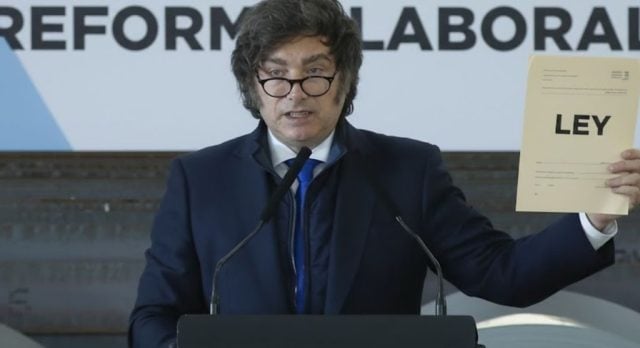
Immediately following the outcome, President Milei urged the Chamber of Deputies to expedite the legislation, which they describe as “the modernization of the Argentine labor market.”
Extension of Work Hours to 12
A central aspect of the project that generated considerable controversy is the significant modification of the workday regime. The initiative allows for an increase in daily hours from 8 to 12, provided that a minimum rest period of 12 hours between shifts is adhered to.
Another key point is the elimination of overtime pay through the creation of an «hour bank,» effectively removing the traditional «double pay» system commonly utilized by workers to boost their incomes. Instead of receiving additional remuneration for hours worked beyond the usual schedule, the hour bank stipulates that employees compensate for that extra time by working fewer hours on other days or taking a day off.
Furthermore, part-time contracts for periods shorter than the legal working hours will be introduced, which could represent a gateway to income precarization.
Restrictions on the Right to Strike
Regarding collective conflicts, the reform introduces substantial modifications. The list of activities classified as essential services is expanded, mandating a minimum coverage of 75%.
The new regulatory framework identifies telecommunications—explicitly including internet and satellite communications—as essential, along with commercial aviation, air traffic control, all port activities (such as signaling, dredging, mooring, loading and unloading, and towing), customs and immigration services, hospital and health services (including medicine transport), the production and distribution of drinking water, gas, oil, fuels, and electricity, waste collection, cash transport, private security services, and education at all levels except university.
Additionally, the project establishes a new category: “critical services” or “services of transcendental importance,” which must guarantee a minimum operational level of 50% during disputes. This category encompasses everything from the maritime, river, land, and underground transportation of persons and goods to customs and immigration services related to international trade, pharmaceutical production, radio and television, continuous process industries (such as steel, aluminum, chemical, and cement), the entire food supply chain, financial services, hospitality, gastronomy, e-commerce, construction, airports, mining, cold storage, mail, the agricultural sector, and production tied to export commitments.
Security forces are required to provide 100% coverage.
According to the reform, unions must give five days’ notice for strike actions.
Assemblies: With Permission and Without Pay
Another contentious issue during the debate was the new regulation of labor assemblies in the workplace. According to the approved text, union meetings “must not disrupt the normal activities of the business” and will require prior authorization from the employer.
Additionally, the union must prove it is up to date on wage payments to exercise this power. Time spent in assemblies will not be compensated, as reported by El Destape.
Collective Agreements: The End of Ultraactivity
The reform introduces a significant modification to the collective bargaining system by drastically limiting the principle of ultraactivity. Following the enactment of the law, only normative clauses—those that establish conditions and direct individual benefits of work—will remain in effect after a collective agreement has expired. These clauses will stay operational until a new agreement is in force.
Obligatory clauses will remain valid only by express agreement of the parties. Furthermore, agreements at the enterprise or regional level will take precedence over those at a greater scope (activity or national), reversing the traditional regulatory hierarchy.
The Ministry of Labor will also have the authority to suspend the effects of duly active agreements by ultraactivity “when their application generates severe economic distortions affecting the public interest.”
Labor Assistance Fund: An Insurance with Waiting Periods and Delays
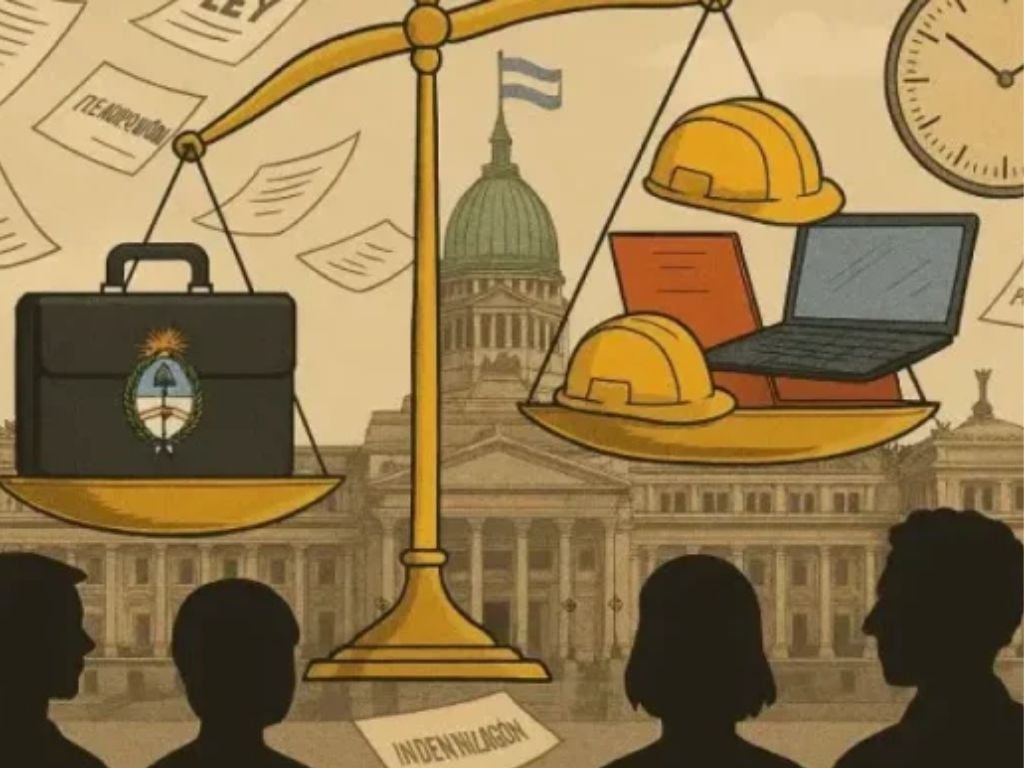
The establishment of the Labor Assistance Fund (FAL) constitutes another cornerstone of the initiative. These are individual employer-specific funds aimed at contributing to severance payments. The accounts will be formed through a mandatory monthly contribution of 1% for large companies and 2.5% for micro, small, and medium enterprises, calculated on the base remuneration for employer contributions to the Argentine Integrated Pension System (SIPA).
The fund will have a 6-month waiting period and will only cover registered workers with at least 12 months of seniority in the company. The resources will be considered separate assets, unattachable and non-embargable. The regime will come into effect on June 1, 2026, a date which the Executive Power may extend by up to 6 months via decree.
Transfer of Labor Justice and Migration of Cases
One of the last-minute changes incorporated during negotiations was the transfer of Labor Justice to the authority of the Autonomous City of Buenos Aires, which was added as an annex to the project. National Labor Justice will remain in effect until the law approving the transfer of competences between the Nation and the City is promulgated. Upon the passage of that law, necessary actions will be taken for its “gradual dissolution.”
Meanwhile, legal disputes against the National State will be excluded from the labor jurisdiction and moved to the federal administrative contentious jurisdiction, where the Labor Contract Law does not apply. Labor judges will be required to align their decisions with precedents from the Supreme Court of Justice; unjustified deviations from the jurisprudence of the highest court will constitute grounds for malperformance.
Contributions to Business Chambers
In a departure from the original text, El Destape reported that following the enactment of the law, contributions to business chambers cannot exceed 0.5% of remuneration; while contributions to trade union associations must not exceed 2% of salaries, both for members and non-members covered by the collective agreement.
Additionally, the final text states that starting January 1, 2028, contributions to business chambers will be strictly voluntary, and payment of union dues cannot be imposed on workers without their explicit, prior, individual consent, which may be revoked at any time.
Repeal of Special Statutes and Protective Laws
Starting January 1, 2027, the special regimes governing multiple activities will be repealed. The list includes Law 12,908 for Journalists, Law 14,546 for Traveling Salespeople, Law 23,947 for Hairdressers, Law 12,867 for Graphic Arts Personnel, and Decree Laws 13,839/46 and 14,954/46 for Private Drivers and others. All these groups will now be governed by the common Labor Contract Law.
Simultaneously, starting from that same date, Law 27,555 on Telework, Law 23,472 regarding Labor Credit Guarantee Fund, and home working regulations contained in the aforementioned decree laws will also be eliminated. Additionally, Chapter VIII of Title II of the LCT concerning worker inventions will be removed.
Payment of Judgments, Health Insurance, and Medical Leaves
Concerning judicial matters, judgment liabilities against large companies may be settled in up to 6 consecutive monthly installments. For micro, small, and medium enterprises, the limit is extended to 12 installments. Effective for contributions due after January 1, 2027, the employer contribution to health insurance will be set at 6% of remuneration, one percentage point higher than the original project’s 5%. The Superintendence of Health Services will be empowered to audit the use of these contributions.
Regarding non-attributable illness leaves, two remuneration levels are established: 50% if the incapacity arises from “voluntary and conscious activity posing health risks,” or 75% in other cases, for periods of 3 or 6 months depending on the presence of dependents. Medical certificates must include diagnosis, treatment, rest days, and a digital signature issued by licensed professionals nationwide. Workers will be required to undergo medical supervision by their employer. In case of irreconcilable dispute, a medical board may be consulted at official institutions or private institutes, at the employer’s expense. The employer may reassign the worker to another position after prolonged absences if there is no permanent reduction in work capacity.
Seniority, Probation Period, and Other Modifications
According to Milei’s reform, if two years elapse between the termination of the employment relationship—regardless of the cause—and the worker returns to provide services for the same employer, the previous service time will not be calculated for seniority. The probation period will also be extended from 3 to 6 months generally, allowing employers to terminate contracts without indemnification during this timeframe. For small companies, the period may extend to one year.
No Payments via Virtual Wallets
A separate chapter is devoted to the tense negotiations over salary payments via virtual wallets. Ultimately, the labor reform will not allow salaries to be paid through virtual wallets as expressly decided by Congress. This determination was a victory for traditional banks in a conflict between financial institutions and the fintech sector, representing workers’ interests and regulatory authorities. The struggle for the control and use of salary funds remained a key point of parliamentary debate, exposing tensions between business models and regulations.
In the end, the Executive Power faced a fiscal setback as the original article 190 proposing to lower the Income Tax rate for large companies from 30% to 27% was removed. Instead, the new article 190 introduces provisions on tax residency for foreigners naturalized by significant investments.
Lost Rights and Mobilizations
Beyond the amendments made concerning the end of the workday, El Destape and other Argentine media have noted that “the mileísmo maintained the core spirit of the text drafted in the Casa Rosada, despite criticisms and social presence in the streets.”
At this core, at least four key issues were identified: the attack on the preeminence of collective bargaining agreements through the prioritization of lesser agreements, the repeal of historic professional statutes, the covert prohibition of the right to strike by the mass declaration of essential services, and the employer’s power to suspend wages during assembly time.
The General Confederation of Labor (CGT) described the initiative as a “regressive and precarious” labor reform, viewing it as an attack on fundamental rights.
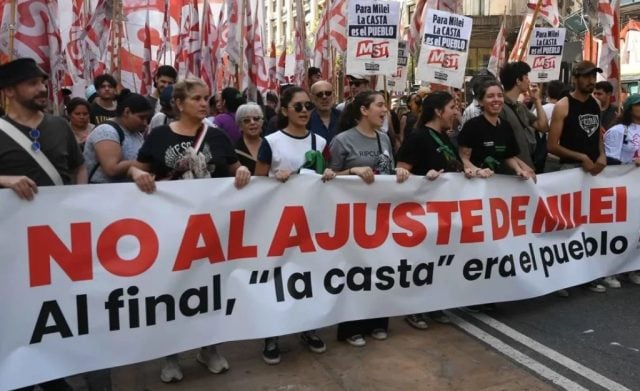
In response, both the Autonomous Workers’ Central Union and the Argentine Workers’ Central Union declared “absolute rejection” and announced they are in “permanent mobilization,” calling for protests to halt the legislative push.
Similarly, the Secretary General of the Association of State Workers (ATE), Rodolfo Aguiar, stated that the labor reform represents “the greatest offensive in democracy against workers.”
“They are spending millions to bulldoze us,” he emphasized.
The project is now awaiting treatment in the Chamber of Deputies, where the ruling party hopes to secure the 131 votes that would turn it into law. In the meantime, unions and workers are contemplating forceful measures and taking to the streets to express their opposition, as Milei’s chainsaw now sharpens its focus directly on the labor day.
Obtén tu Pasaporte y apoya a El Ciudadano
Elimina la publicidad, accede a contenido exclusivo y sé parte de la comunidad.
Cancela en cualquier momento · Sin permanencia