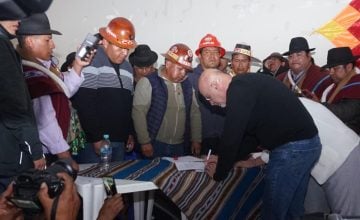
Original article: 9 días de protestas en Bolivia: Central Obrera endurece postura para anular el “Gasolinazo” y el Gobierno llama al diálogo
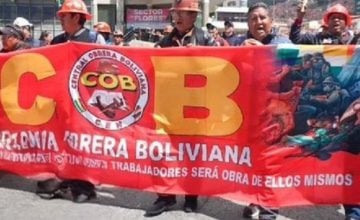
After nine days of indefinite national strikes, tensions in Bolivia remain at a critical point. The Bolivian Workers’ Central (COB) intensified its pressure tactics on Tuesday to annul Supreme Decree 5503, commonly known as the «Gasolinazo,» by initiating hunger strike pickets and new marches that have faced police repression near Plaza Murillo, the political power center.
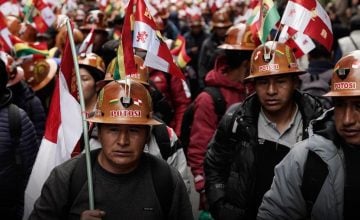
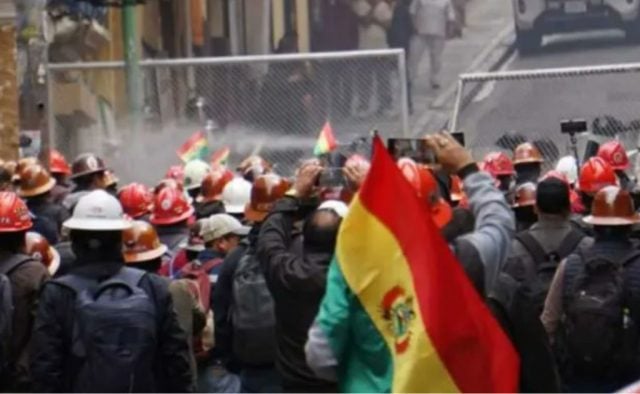
Protesters, including factory workers and teachers, marched once again through the historic center of La Paz, attempting to access the plaza through various entrances blocked by metal barriers and guarded by riot police.
The decree, which includes 121 articles, controversially eliminates fuel subsidies, leading to immediate price hikes of 86% for gasoline and 160% for diesel. This has sparked widespread rejection among Bolivia’s labor movement, accusing President Rodrigo Paz’s government of promoting an «economic adjustment» policy and facilitating the transfer of natural resources.
COB Toughens Stance: Hunger Strike and Ongoing Mobilization
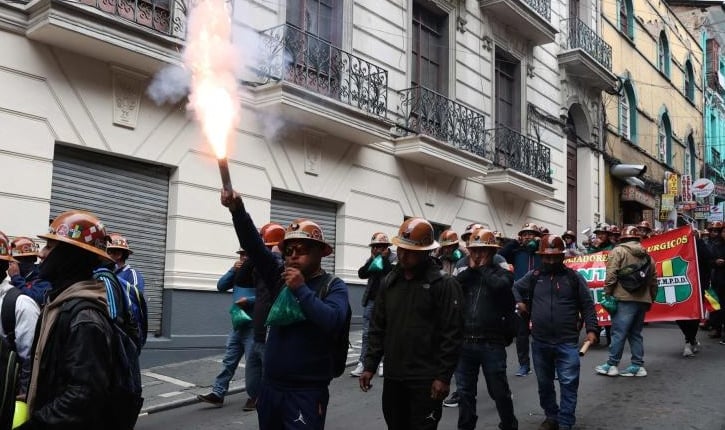
In front of the COB headquarters in downtown La Paz, there are now not only slogans and banners. On Tuesday, the first hunger strike pickets were established, symbolizing the radicalization of the conflict. Protest sites are set up at least in three strategic locations: the union headquarters, the Casa Social del Maestro—led by the Urban Teacher’s Union—and the offices of the Mining Federation.
«We are fulfilling what was agreed upon at the COB’s expanded meeting with all federations, confederations, and organizations, both affiliated and non-affiliated,» said Claudio Choque, COB’s Secretary General, to TeleSUR, confirming the continuation of protests.
Choque made it clear that the mobilization is detached from any partisan political interests, focusing solely on social and labor demands.
Beyond the increase in gasoline and diesel prices, labor dissatisfaction centers on what they deem the decree’s «hidden core.» Leaders allege that the regulation «expedited the delivery of the country’s natural and strategic resources without legislative oversight,» a mechanism that they believe primarily benefits private companies. For the COB, the decree is rife with «nullification flaws» due to inadequate social consultation before its promulgation.
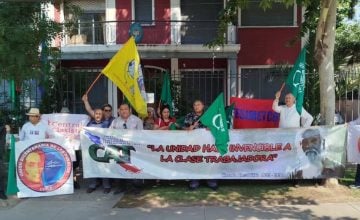
The decision to maintain pressure was reaffirmed even during Christmas. At a national expanded meeting held in the La Paz Departmental Federation of Miners, the labor union resolved to «extend pressure measures to all departments of the country» with the declared aim of consolidating a nationwide protest.
The COB announced that marches will continue in downtown La Paz and that a new expanded meeting will be held in the coming hours to evaluate the progress of the protests and define the next steps.
Government Response: Dialogue Sessions and Defense of the Decree
In the face of escalation, the government of Rodrigo Paz has opted for a strategy of calling for dialogue and defending the controversial decree, arguing that it is a measure to address Bolivia’s fiscal crisis.
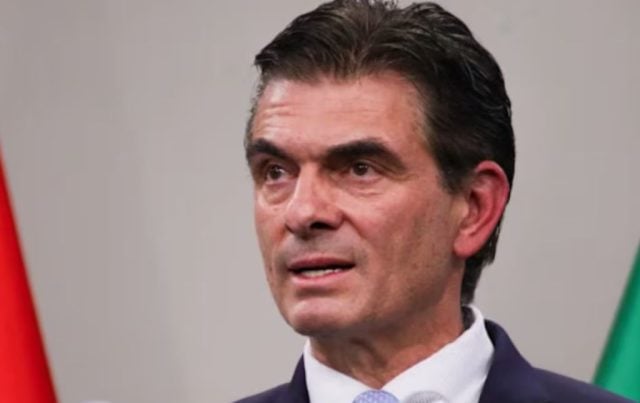
In a joint press conference, the Minister of the Presidency, José Luis Lupo, along with Minister of Government, Marco Antonio Oviedo, and Minister of Economy, Gabriel Espinoza, announced that «technical tables» will be developed starting in January with various sectors to analyze the decree.
«I would take this moment to invite the Bolivian Workers’ Central and the Federation of Miners’ Trade Unions of Bolivia to come to the dialogue,» Oviedo indicated.
Lupo detailed that the meetings will take place at the Government Palace, with media presence, and that the substantive content of the decree will be reviewed, allowing various sectors to present their observations.
He also proposed that «all instruments are perfectible,» referring to the controversial DS 5503.
Meanwhile, Minister of Economy, Gabriel Espinoza, attempted to defuse the narrative of an irreparable conflict. He recalled that in recent days, «meetings were held with various sectors such as transportation, labor groups, cooperative miners, civic committees, and the productive sector about the regulation, and points of agreement were found.»
Espinoza defended the contested elimination of fuel subsidies as a necessary step for economic stabilization, as reported by Erbol.com.
As hunger strike pickets solidify and marches threaten to return to downtown La Paz, the government remains hopeful that technical and sectoral dialogue can alleviate the situation. However, the gap between positions is vast: the COB demands the outright repeal of the decree, while the government only offers to review and «perfect» it.
Relacionados
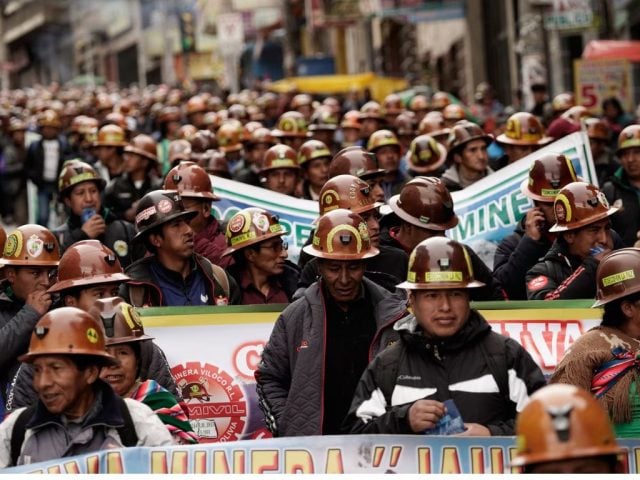
"Down with the Gasoline Price Hike": Miners Mobilize in Bolivia Against Fuel Subsidy Cuts
Hace 2 meses
Bolivia's Major Labor Union Implements Blockade at Government Headquarters in Protest Against Fuel Subsidy Cuts
Hace 2 meses
Bolivia's Miners Lead Ongoing Strike: Labor Federation Mobilizes Against Government's Fuel Price Hike
Hace 2 meses
Unrestricted Strike and Daily Protests: Labor Central Claims Paz's Fuel Price Hike Burdens Workers
Hace 2 meses